

Motmot

Philadelphia Vireo vs Yucatan Vireo

Vireo philadelphicus versus Vireo magister

Play a quiz with Philadelphia Vireo and Yucatan Vireo
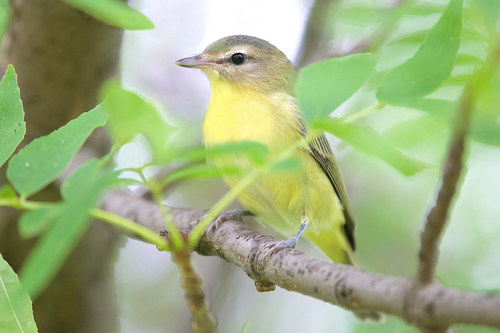
Philadelphia Vireo (Vireo philadelphicus) Philadelphia Vireo
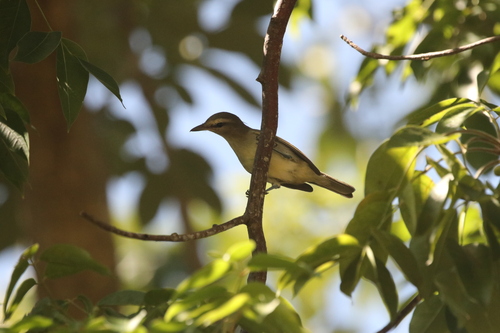
Yucatan Vireo (Vireo magister) Yucatan Vireo

Media

Loading…

In short

The most reliable field mark to separate Philadelphia Vireo from Yucatan Vireo is the color and extent of the underparts: Philadelphia Vireo shows distinctly yellow underparts, especially on the breast and belly, while Yucatan Vireo is much paler below, with buffy white to whitish underparts and only a faint olive or grayish wash on the flanks. Philadelphia Vireo also has a darker, more contrasting line through the eye (dark lores) and a brighter white supercilium, whereas Yucatan Vireo’s lores are paler brownish-gray and blend more into the face. Both species lack wing bars and eye rings, but Yucatan Vireo is generally larger and bulkier, with a heavier bill and longer tail. These differences are consistent in adults and immatures, and are visible both perched and in flight.

Identification tips

  1. Underparts color: Philadelphia Vireo always shows bright yellow underparts, especially on the breast and belly, while Yucatan Vireo is pale buffy white to white below, with only a faint olive or grayish wash on the flanks. This is the single most reliable field mark for all ages and seasons.
  2. Facial pattern: Philadelphia Vireo has a strong dark line through the eye (dark lores) and a crisp white supercilium, creating a high-contrast face. Yucatan Vireo’s lores are brownish gray and blend into the face, with a less distinct, pale brownish white supercilium. Use this mark in all plumages.
  3. Upperparts color: Philadelphia Vireo is olive-brown above with a gray crown; Yucatan Vireo is darker gray-brown with an olive tinge, sometimes with a brighter olive rump in some subspecies. If the bird appears more uniformly dark gray-brown above, suspect Yucatan Vireo.
  4. Bill structure: Yucatan Vireo has a heavier, stouter gray bill with a paler base to the mandible, while Philadelphia Vireo’s bill is stout but more delicate in proportion. Bill color is not highly contrasting in the field but can help with close views.
  5. Size and bulk: Yucatan Vireo is larger and bulkier, with a longer tail and heavier build. Philadelphia Vireo is smaller and more compact. Use this only when you have a good sense of scale or direct comparison.
  6. Leg color: Both species have blue-gray to bluish legs and feet, so this is not a useful separator.
  7. Wing bars and eye ring: Both species lack wing bars and eye rings, so do not use these features to separate them.
  8. Juvenile/immature plumage: No distinctive age-specific upperwing or flight marks are described for either species, so do not rely on wing pattern in flight or perched birds.
  9. Habitat and range: If you are in Canada or the northern US during migration, Philadelphia Vireo is expected; if in the Yucatan Peninsula or Grand Cayman, Yucatan Vireo is the default. Away from these areas, especially in Texas, Yucatan Vireo is extremely rare and should be scrutinized carefully.
  10. Voice: Philadelphia Vireo’s song is a series of clear, spaced notes; Yucatan Vireo’s voice is not described here, so do not rely on vocalizations for separation.
  11. Sex and season: Both species have similar plumage in both sexes and throughout the year, so sex and season do not affect identification.
  12. Subspecies variation: Some Yucatan Vireo subspecies (e.g., stilesi, caymanensis) may show brighter olive or paler underparts, but none match the Philadelphia Vireo’s bright yellow below.
  13. Contextual clues: Consider the surrounding bird community and habitat—Philadelphia Vireo is often found with other temperate vireos and warblers, while Yucatan Vireo is more likely with tropical species.
  14. Common pitfalls: The biggest mistake is overestimating yellow tones in poor light or on faded Yucatan Vireos—always check for the sharpness of the facial pattern and the true extent of yellow below.
  15. When in doubt: If the underparts are not distinctly yellow and the face lacks a sharp dark lore, lean toward Yucatan Vireo, especially if the bird appears large and heavy-billed.

Size

Yucatan Vireo is noticeably larger and heavier than Philadelphia Vireo. The Yucatan Vireo measures about 15 cm in length and has a body mass around 15.4 g (with a range up to 25 g), making it a bulkier bird overall. Philadelphia Vireo is smaller and more delicate, though its exact mass is not specified here. In the field, Yucatan Vireo’s larger size, longer tail, and heavier, stouter bill are evident when the two are seen side by side or with experience. If size is difficult to judge due to distance or lack of direct comparison, rely on plumage and facial pattern.

Plumage

There are no distinctive age-specific upperwing patterns or juvenile flight marks described for either species, so focus on body and facial plumage. Philadelphia Vireo of all ages shows olive-brown upperparts, a gray crown, and notably yellow underparts, with a sharp dark line through the eye (dark lores) and a crisp white supercilium. Yucatan Vireo, regardless of age or subspecies, is darker gray-brown above with an olive tinge, but its underparts are much paler—buffy white to white centrally, with only a faint olive or grayish wash on the flanks. The supercilium is pale brownish white and less sharply defined, and the lores are brownish gray, blending into the face rather than standing out as a dark line. Both species lack wing bars and eye rings. Subspecies of Yucatan Vireo may show subtle differences (e.g., brighter olive rump or paler underparts), but none approach the Philadelphia Vireo’s bright yellow below.

Behaviour

Both species forage in trees and shrubs, moving methodically through foliage in typical vireo fashion. Philadelphia Vireo sometimes hovers or sallies for insects, while Yucatan Vireo’s foraging style is less specifically described but is likely similar. Neither species has a unique behavioral trait that is diagnostic in the field when compared directly.

Habitat

Philadelphia Vireo breeds in the edges of deciduous and mixed woods across Canada, and is most likely to be encountered during migration in the eastern and central US. Yucatan Vireo is found in coastal and lowland habitats in the Yucatan Peninsula, Belize, Honduras, and Grand Cayman, and is only a rare vagrant north of its range. If seen in Texas or the US outside migration, Yucatan Vireo is extremely rare. Thus, context and location are strong clues: Philadelphia Vireo is expected in temperate North America, Yucatan Vireo in the Neotropics.

Voice

Philadelphia Vireo’s song is a series of three to five notes ("weeezh weeezh weeezh"), similar to Red-eyed Vireo but with longer pauses and slightly higher pitch. There is no vocal description for Yucatan Vireo in these notes, so voice is not a reliable separator between these two in the field.

Submit a better description

Use the same sections as the comparison. Your text is published immediately.

The most reliable field mark to separate Philadelphia Vireo from Yucatan Vireo is the color and extent of the underparts: Philadelphia Vireo shows distinctly yellow underparts, especially on the breast and belly, while Yucatan Vireo is much paler below, with buffy white to whitish underparts and only a faint olive or grayish wash on the flanks. Philadelphia Vireo also has a darker, more contrasting line through the eye (dark lores) and a brighter white supercilium, whereas Yucatan Vireo’s lores are paler brownish-gray and blend more into the face. Both species lack wing bars and eye rings, but Yucatan Vireo is generally larger and bulkier, with a heavier bill and longer tail. These differences are consistent in adults and immatures, and are visible both perched and in flight.

  1. Underparts color: Philadelphia Vireo always shows bright yellow underparts, especially on the breast and belly, while Yucatan Vireo is pale buffy white to white below, with only a faint olive or grayish wash on the flanks. This is the single most reliable field mark for all ages and seasons.
  2. Facial pattern: Philadelphia Vireo has a strong dark line through the eye (dark lores) and a crisp white supercilium, creating a high-contrast face. Yucatan Vireo’s lores are brownish gray and blend into the face, with a less distinct, pale brownish white supercilium. Use this mark in all plumages.
  3. Upperparts color: Philadelphia Vireo is olive-brown above with a gray crown; Yucatan Vireo is darker gray-brown with an olive tinge, sometimes with a brighter olive rump in some subspecies. If the bird appears more uniformly dark gray-brown above, suspect Yucatan Vireo.
  4. Bill structure: Yucatan Vireo has a heavier, stouter gray bill with a paler base to the mandible, while Philadelphia Vireo’s bill is stout but more delicate in proportion. Bill color is not highly contrasting in the field but can help with close views.
  5. Size and bulk: Yucatan Vireo is larger and bulkier, with a longer tail and heavier build. Philadelphia Vireo is smaller and more compact. Use this only when you have a good sense of scale or direct comparison.
  6. Leg color: Both species have blue-gray to bluish legs and feet, so this is not a useful separator.
  7. Wing bars and eye ring: Both species lack wing bars and eye rings, so do not use these features to separate them.
  8. Juvenile/immature plumage: No distinctive age-specific upperwing or flight marks are described for either species, so do not rely on wing pattern in flight or perched birds.
  9. Habitat and range: If you are in Canada or the northern US during migration, Philadelphia Vireo is expected; if in the Yucatan Peninsula or Grand Cayman, Yucatan Vireo is the default. Away from these areas, especially in Texas, Yucatan Vireo is extremely rare and should be scrutinized carefully.
  10. Voice: Philadelphia Vireo’s song is a series of clear, spaced notes; Yucatan Vireo’s voice is not described here, so do not rely on vocalizations for separation.
  11. Sex and season: Both species have similar plumage in both sexes and throughout the year, so sex and season do not affect identification.
  12. Subspecies variation: Some Yucatan Vireo subspecies (e.g., stilesi, caymanensis) may show brighter olive or paler underparts, but none match the Philadelphia Vireo’s bright yellow below.
  13. Contextual clues: Consider the surrounding bird community and habitat—Philadelphia Vireo is often found with other temperate vireos and warblers, while Yucatan Vireo is more likely with tropical species.
  14. Common pitfalls: The biggest mistake is overestimating yellow tones in poor light or on faded Yucatan Vireos—always check for the sharpness of the facial pattern and the true extent of yellow below.
  15. When in doubt: If the underparts are not distinctly yellow and the face lacks a sharp dark lore, lean toward Yucatan Vireo, especially if the bird appears large and heavy-billed.

Yucatan Vireo is noticeably larger and heavier than Philadelphia Vireo. The Yucatan Vireo measures about 15 cm in length and has a body mass around 15.4 g (with a range up to 25 g), making it a bulkier bird overall. Philadelphia Vireo is smaller and more delicate, though its exact mass is not specified here. In the field, Yucatan Vireo’s larger size, longer tail, and heavier, stouter bill are evident when the two are seen side by side or with experience. If size is difficult to judge due to distance or lack of direct comparison, rely on plumage and facial pattern.

There are no distinctive age-specific upperwing patterns or juvenile flight marks described for either species, so focus on body and facial plumage. Philadelphia Vireo of all ages shows olive-brown upperparts, a gray crown, and notably yellow underparts, with a sharp dark line through the eye (dark lores) and a crisp white supercilium. Yucatan Vireo, regardless of age or subspecies, is darker gray-brown above with an olive tinge, but its underparts are much paler—buffy white to white centrally, with only a faint olive or grayish wash on the flanks. The supercilium is pale brownish white and less sharply defined, and the lores are brownish gray, blending into the face rather than standing out as a dark line. Both species lack wing bars and eye rings. Subspecies of Yucatan Vireo may show subtle differences (e.g., brighter olive rump or paler underparts), but none approach the Philadelphia Vireo’s bright yellow below.

Both species forage in trees and shrubs, moving methodically through foliage in typical vireo fashion. Philadelphia Vireo sometimes hovers or sallies for insects, while Yucatan Vireo’s foraging style is less specifically described but is likely similar. Neither species has a unique behavioral trait that is diagnostic in the field when compared directly.

Philadelphia Vireo breeds in the edges of deciduous and mixed woods across Canada, and is most likely to be encountered during migration in the eastern and central US. Yucatan Vireo is found in coastal and lowland habitats in the Yucatan Peninsula, Belize, Honduras, and Grand Cayman, and is only a rare vagrant north of its range. If seen in Texas or the US outside migration, Yucatan Vireo is extremely rare. Thus, context and location are strong clues: Philadelphia Vireo is expected in temperate North America, Yucatan Vireo in the Neotropics.

Philadelphia Vireo’s song is a series of three to five notes ("weeezh weeezh weeezh"), similar to Red-eyed Vireo but with longer pauses and slightly higher pitch. There is no vocal description for Yucatan Vireo in these notes, so voice is not a reliable separator between these two in the field.

Discard your changes?

You have unsaved edits. If you leave now, those changes will be lost.

Philadelphia Vireo · Yucatan Vireo · My Tricky Birds