

Parasitic Weaver vs Parrot-billed Sparrow
Anomalospiza imberbis versus Passer gongonensis
Play a quiz with Parasitic Weaver and Parrot-billed Sparrow
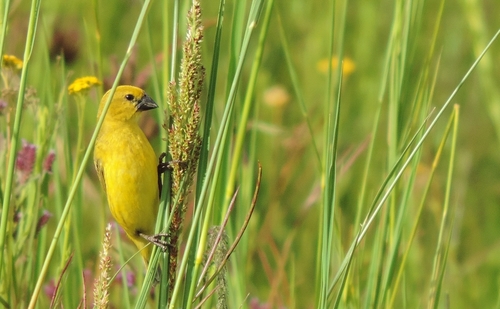 Parasitic Weaver
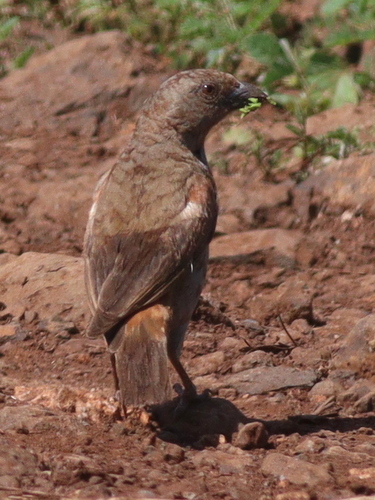 Parrot-billed Sparrow
In short
The most reliable field mark between Parasitic Weaver and Parrot-billed Sparrow is size: Parasitic Weaver is a small, finch-like bird, while Parrot-billed Sparrow is much larger and bulkier, the largest sparrow in its family. Adult male Parasitic Weavers are bright yellow and olive-green, contrasting sharply with the more subdued, greyish or brownish tones of the sparrow. Females and immatures can be trickier, but the weaver's streaked buff plumage and plain buff face differ from the sparrow's heavier build and likely greyer tones. Bill shape is also key: the weaver has a deep, conical bill, while the sparrow's bill is even more massive and parrot-like. Habitat and jizz also help—watch for the sparrow's heavy, sparrow-like movements versus the weaver's lighter, finch-like actions.
Identification tips
- Size is the quickest separator: Parasitic Weaver is small (11–13 cm), while Parrot-billed Sparrow is very large for a sparrow (18 cm, nearly 40 g). If the bird looks bulky and large, it's the sparrow.
- Bill shape and size: Both have strong bills, but Parrot-billed Sparrow's is exceptionally thick, deep, and parrot-like, even more so than the weaver's deep conical bill. On close views, the sparrow's bill is almost outsized for its head.
- Adult male plumage: Bright yellow head and underparts with olive-green streaked upperparts and a black bill are diagnostic for male Parasitic Weaver. Parrot-billed Sparrow never shows yellow.
- Female/immature plumage: Female Parasitic Weaver is buff with heavy black streaking above, lighter streaks on flanks, and a plain buff face. Parrot-billed Sparrow is more uniformly greyish or brownish, with little to no streaking and a heavier, plain look.
- Face pattern: Parasitic Weaver females have a plain buff face and buff-white throat, while Parrot-billed Sparrow's face is more uniform and lacks strong markings.
- Upperparts: Heavy black streaking on the back and upperparts is a feature of female/immature Parasitic Weaver, but not of the sparrow.
- Yellow tones: Any yellow in the plumage points to Parasitic Weaver; Parrot-billed Sparrow is never yellowish.
- General jizz: Parasitic Weaver is quick, agile, and finch-like. Parrot-billed Sparrow is heavy, deliberate, and sparrow-like in its movements.
- Habitat context: Parasitic Weaver prefers grasslands, while Parrot-billed Sparrow is found in arid lowlands. Habitat can help, but beware of overlap in transitional zones.
- Vocalizations: Chattering, nasal songs are given by Parasitic Weaver, especially displaying males. Parrot-billed Sparrow's calls are not described but are likely typical sparrow chirps.
- Tail and wing shape: No distinctive differences are noted, but the weaver's tail may appear shorter and more finch-like.
- Flock association: Parasitic Weaver may be found with other small finches, while Parrot-billed Sparrow is often with other sparrows.
- Sexual dimorphism: Only Parasitic Weaver shows strong sexual dimorphism (bright males, streaky females); Parrot-billed Sparrow sexes are similar.
- Seasonal variation: Male Parasitic Weaver's yellow becomes brighter as feathers wear before breeding; Parrot-billed Sparrow does not show such seasonal change.
- Quiz pitfalls: Immature/female Parasitic Weavers can be confused with small sparrows, but size, streaking, and bill shape should clarify. If in doubt, use a combination of size, bill, and any hint of yellow or streaking.
Size
Parasitic Weaver is a small bird, about 11–13 cm in length and much lighter than Parrot-billed Sparrow. In contrast, Parrot-billed Sparrow is very large for a sparrow, reaching 18 cm and nearly 40 grams in mass, making it over twice as heavy and substantially longer than the weaver. This size difference is usually obvious in the field, especially when seen side by side or with familiar species for scale.
Plumage
Adult male Parasitic Weaver is unmistakable: bright yellow head and underparts, olive-green streaked upperparts, and a black bill. Females are buff with heavy black streaking above and lighter streaks on the flanks, with a plain buff face and buff-white throat. Parrot-billed Sparrow, by contrast, lacks any yellow; both sexes are generally greyish or brownish, with a much more uniform and subdued coloration. The sparrow's plumage is less streaked and more solid, especially on the head, and its bill is even more massive and parrot-like than the weaver's. There are no notes on distinctive juvenile or immature wing patterns for either species, so age-specific flight marks are not a key separator here. If you see a small, yellowish, streaky bird, it's the weaver; a large, plain, heavy-billed bird is the sparrow.
Behaviour
Parasitic Weaver behaves like a small finch: quick, agile, and often seen in grassland or open areas. Parrot-billed Sparrow moves with the heavier, more deliberate actions typical of large sparrows, often feeding on the ground or in low bushes. The sparrow's bulk and size affect its jizz, making it appear more robust and less nimble than the weaver.
Habitat
Parasitic Weaver is found in grassland habitats across sub-Saharan Africa, while Parrot-billed Sparrow prefers the arid lowlands of eastern Africa. If you are in a dry, open, lowland area, especially in eastern Africa, Parrot-billed Sparrow is more likely. The weaver is more associated with grassy, possibly moister areas, and is not tied to arid zones.
Voice
Parasitic Weaver gives various chattering calls and, when displaying, a nasal song. No vocal details are provided for Parrot-billed Sparrow, but sparrow vocalizations are typically chirps or simple calls. If you hear a nasal, chattering song, it may point to the weaver, but voice is not the most reliable separator here.