

Pallid Harrier vs Pied Harrier
Circus macrourus versus Circus melanoleucos
Play a quiz with Pallid Harrier and Pied Harrier
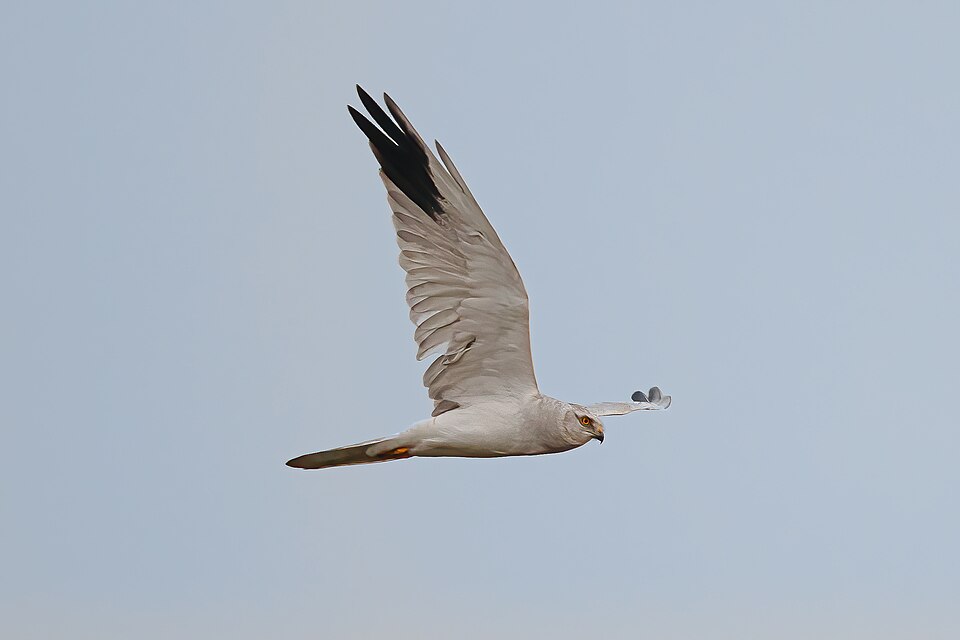 Pallid Harrier
 Pied Harrier
In short
The most reliable field mark between Pallid Harrier and Pied Harrier is the adult male's plumage: Pallid males are pale grey above and white below with only narrow black wingtips, while Pied males are strikingly black and white with a black head, back, and breast contrasting sharply with white underparts and forewing. For females and juveniles, separation is much trickier, as both are brown above and pale below with streaking, but Pallid tends to have a paler belly and a more defined facial pattern. In flight, both species show long, narrow wings held in a shallow V, but Pied Harrier's wings are slightly more rounded at the tips and the tail is more rounded. Juvenile Pied Harrier is darker above and richer cinnamon below than Pallid, which is buffier. Use a combination of underpart color, facial pattern, and wing/tail shape for the best chance at a positive ID.
Identification tips
- Adult male plumage is the best field mark: Pallid Harrier males are pale grey above and white below with only narrow black wingtips; Pied Harrier males are black and white, with a black head, neck, back, and breast, and white forewing, rump, and underparts. If you see a black-and-white harrier, it's Pied; if it's pale grey and white, it's Pallid.
- Females and juveniles are much trickier: Both are brown above and pale below with streaking. Pallid tends to have a paler, buffier belly and a more sharply defined facial pattern (pale collar and facial disk), while Pied is darker above and below, with richer cinnamon underparts in juveniles.
- Facial pattern: Look for a well-defined pale facial disk and collar in Pallid Harrier females/juvs; Pied's facial pattern is less distinct.
- Underpart color: Pallid females/juvs are buffier and paler below; Pied females/juvs are generally darker, with more contrast and richer cinnamon tones in juveniles.
- Rump patch: Both show a white rump, but Pied's is smaller and more sharply defined; Pallid's can appear larger and less sharply bordered.
- Wing shape in flight: Pied Harrier's wings are slightly more rounded at the tips and the tail more rounded; Pallid's wings are narrower and the tail more square. This is subtle and best seen in direct comparison.
- Flight style: Both species fly with long, narrow wings held in a shallow V, gliding and soaring with buoyant, leisurely wingbeats. No strong difference, but Pied may appear slightly more 'rounded' in outline.
- Eye color: Adult male Pied has yellow eyes, female has brown; not reliable at distance.
- Perching behavior: Both perch on the ground or on posts/reeds, rarely in trees. Not diagnostic.
- Geographic context: If in western Europe, Pallid is much more likely; in southeast Asia, both are possible in winter.
- Size: Both are very similar in size and structure; not a reliable field mark.
- Juvenile confusion: Both juveniles resemble juvenile Montagu's Harrier, but Pied is darker above and richer cinnamon below, while Pallid is paler and buffier.
- Sexual dimorphism: Only adult males are truly distinctive; females and juveniles are very similar between the two species and to Montagu's Harrier. Use a combination of marks.
- When in doubt: Focus on underpart color (paler in Pallid, richer/darker in Pied), facial pattern (sharper in Pallid), and overall contrast (higher in Pied).
Size
Both species are very similar in size, with Pallid Harrier averaging slightly heavier (383.5g vs 355.0g [wikidata]). Both measure about 40–49 cm in length with wingspans in the 95–120 cm range. Females are larger than males in both species, but the difference is subtle and not reliable in the field. Structural proportions are also similar, though Pied Harrier's wings are described as slightly more rounded at the tips and the tail as more rounded, while Pallid Harrier's wings are narrower overall.
Plumage
-
Juveniles and Females: Both species' females and juveniles are brown above and pale below with streaking, but Pallid Harrier females/juvs have a paler, buffier belly and a more sharply defined facial pattern (especially the pale collar and facial disk), while Pied Harrier females/juvs are generally darker above, with more contrast and a small white rump. Juvenile Pied Harrier is darker above than adult female, with rich cinnamon underparts, while Pallid juvenile is paler buff below. Both can show a 'ringtail' pattern (white upper tail coverts), but the facial contrast is stronger in Pallid.
-
Adult Males: Pallid Harrier males are pale grey above, white below, with only narrow black wingtips. Pied Harrier males are dramatically pied: black head, neck, back, and breast, with white forewing, rump, and underparts. The black-and-white contrast of Pied is unique and diagnostic.
-
Wing and Tail: In flight, both show long, narrow wings held in a shallow V. Pied Harrier's wings are slightly more rounded at the tips and the tail is more rounded, while Pallid's wings are narrower and the tail is more square. Both have a white rump, but the extent and contrast is greater in Pied.
-
Eyes: Adult male Pied has striking yellow eyes; female has brown eyes. Eye color is not a strong field mark at distance.
Behaviour
Both species hunt low over open ground with buoyant, gliding flight interspersed with leisurely wingbeats. Both perch on the ground or on posts/reeds, rarely in trees. Pied Harrier is described as primarily solitary but may form loose groups, similar to Pallid. No strong behavioral separation is available from the sources.
Habitat
Both species occur in open country, marshes, and fields. Pallid Harrier breeds from eastern Europe to central Asia and winters in India and southeast Asia, while Pied Harrier is endemic to Asia, from southern Siberia to the Philippines. Their wintering ranges overlap in India and southeast Asia. Both are rare vagrants outside their core range, but Pallid is a rare vagrant to western Europe, while Pied is not.