

Pallas's Grasshopper Warbler vs Pleske's Grasshopper Warbler
Helopsaltes certhiola versus Helopsaltes pleskei
Play a quiz with Pallas's Grasshopper Warbler and Pleske's Grasshopper Warbler
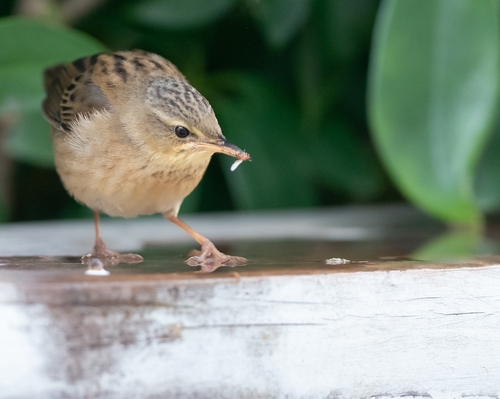 Pallas's Grasshopper Warbler
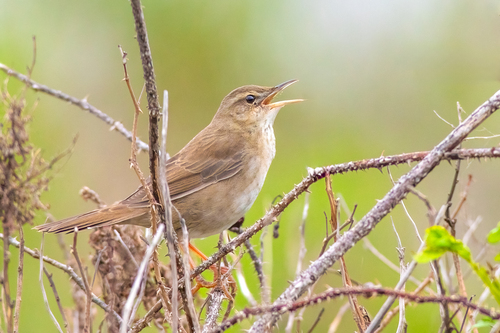 Pleske's Grasshopper Warbler
In short
The most reliable field mark for separating Pallas's Grasshopper Warbler from Pleske's Grasshopper Warbler is the presence of white tips to the tail and tertial feathers in Pallas's, which are absent in Pleske's. Pallas's also shows a warmer brown rump and is slightly larger overall. Both species are extremely skulking and difficult to see, but Pallas's is more likely to show these white feather tips when flushed or in brief flight. Voice is also helpful: Pallas's has a more melodic, Acrocephalus-like song, while Pleske's is less well described but does not match the distinctive Pallas's song. Habitat overlap can occur, but Pleske's tends to favor more shrubby and swampy areas.
Identification tips
- White tips to tail and tertials (Pallas's only): Look for crisp white tips on the tail and tertial feathers, especially in flight or when the bird flicks its tail. This is the most reliable field mark for all ages.
- Rump color: Pallas's shows a warmer, rusty-brown rump, which can be seen in good views or when the bird is flushed. Pleske's rump is less warm, appearing plainer brown.
- Juvenile underparts: Young Pallas's are yellower below, while Pleske's juveniles are not described as such. This may help in late summer or autumn.
- Overall size: Pallas's is slightly larger and bulkier, but this is subtle and should not be used in isolation.
- Back streaking: Both species have streaked brown backs, so this is not helpful for separation.
- Underparts: Both have pale, unstreaked underparts except for some streaking on the undertail of Pallas's. Use with caution.
- Song: Pallas's has a melodic, Acrocephalus-like song, unlike the less distinctive song of Pleske's. If you hear a tuneful warbler, lean toward Pallas's.
- Habitat: If found in dense shrub or swamp, consider Pleske's; in grassland or drier low foliage, Pallas's is more likely, but overlap is significant.
- Behavior: Both are extremely skulking, but Pallas's may show itself more when singing. Watch for brief flight views to catch the white tail tips.
- Sex: Sexes are alike in both species; do not use for ID.
- Bill and structure: No reliable differences are described between these two species in bill shape or wing formula.
- Flight views: Prioritize the white tail and tertial tips in Pallas's during brief flushes or when the bird is active.
- Season: Both species can occur in the same region during migration; use plumage and song rather than date for separation.
- Pitfalls: Do not confuse the white tail tips of Pallas's with wear or lighting effects; they are usually quite distinct when seen well.
- Context: If you are in South China in winter, Pleske's is more likely; further south or east, consider Pallas's, but always confirm with plumage.
Size
Pallas's Grasshopper Warbler is slightly larger than Pleske's Grasshopper Warbler, though the difference is subtle and not always apparent in the field. Both are medium-sized Locustellidae, but Pallas's is noted as being a bit bulkier and longer, which may be noticeable if seen side by side or with experience. However, size alone is not a reliable field mark due to overlap and the difficulty of direct comparison in the field. [wikipedia]
Plumage
The white tips to the tail and tertial feathers are a key feature of Pallas's Grasshopper Warbler of all ages, including juveniles and adults, and are especially visible when the bird is in flight or flicking its tail. This feature is lacking in Pleske's. Pallas's also has a warmer brown rump, which can be a useful mark if the bird is seen well as it creeps through grass or when flushed. Both species have streaked brown backs and unstreaked underparts, but Pallas's young birds are yellower below. Pleske's lacks the white feather tips and has a less warm-toned rump, making it appear plainer overall. The underparts of both species are generally pale and unstreaked except for some streaking on the undertail of Pallas's. Sexes are alike in both species, so sex does not help with identification.
Behaviour
Both species are extremely skulking and secretive, typically creeping through dense grass and low foliage, and are rarely seen except when singing or occasionally when flushed. Pallas's may be slightly more likely to show itself when singing, but both are challenging to observe well. Flight views are often brief, but Pallas's is more likely to reveal its white tail and tertial tips in these moments. Foraging behavior is similar, with both species feeding on insects low in vegetation.
Habitat
Both species breed in overlapping regions of eastern Siberia, Korea, and parts of northeastern China, but Pleske's Grasshopper Warbler is more closely associated with temperate shrubland, subtropical or tropical dry shrubland, and swamps. Pallas's Grasshopper Warbler is found in a broader range of grassland and low shrub habitats, including drier areas. In winter, Pallas's ranges further south and east (India to Indonesia), while Pleske's winters in South China. Habitat alone is not diagnostic due to overlap, but Pleske's is more likely in shrubby or swampy patches.
Voice
Pallas's Grasshopper Warbler has a distinctive, inventive, Acrocephalus-like melodic song, which is quite different from the mechanical, insect-like reeling of some other grasshopper warblers. Pleske's song is less well described but does not match the melodic quality of Pallas's. If you hear a Locustella warbler with a more complex, tuneful song, Pallas's is more likely; a less distinctive or unknown song may indicate Pleske's, but caution is needed.
Pallas's Grasshopper Warbler · Pleske's Grasshopper Warbler · My Tricky Birds