

Painted Bunting vs Blue Dacnis
Passerina ciris versus Dacnis cayana
Play a quiz with Painted Bunting and Blue Dacnis
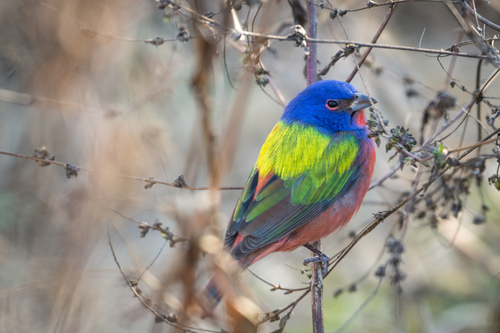 Painted Bunting
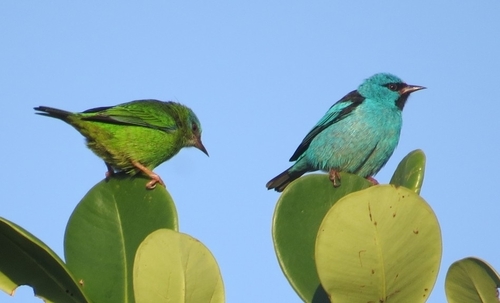 Blue Dacnis
In short
The most reliable field mark between Painted Bunting and Blue Dacnis is the male's plumage: Painted Bunting males show a vivid mix of blue, green, and red, while Blue Dacnis males are turquoise to blue with a black mask and back. Females and immatures of both species are greenish, but Painted Bunting females are a brighter, truer green, whereas Blue Dacnis females are green with a bluish head and grayish throat. Bill shape also helps: Painted Bunting has a thicker, conical bill, while Blue Dacnis has a thinner, pointed bill. Size is similar, but Painted Bunting is slightly larger and stockier. In flight or perched, look for the Painted Bunting's overall brighter green in females and juveniles, and the Blue Dacnis's blue-edged black wings in males.
Identification tips
- Adult Male Plumage: Painted Bunting males are unmistakable with a blue head, green back, and red underparts/rump. Blue Dacnis males are blue/turquoise with a black mask and back—never red or green.
- Female and Juvenile Plumage: Female and immature Painted Buntings are a bright, true green overall, lacking blue or gray on the head or throat. Blue Dacnis females are green but have a bluish head and gray throat—look for this subtle contrast.
- Wing Pattern in Males: Blue Dacnis males have black wings with broad blue edges, visible in flight or at rest. Painted Bunting wings are plain and match the body color, never showing this contrast.
- Bill Shape: Painted Bunting has a thick, conical seed-eater's bill, typical of cardinalids. Blue Dacnis has a thinner, pointed bill, more suited to gleaning insects and nectar.
- Size and Structure: Painted Bunting is slightly larger and bulkier, with a rounder body and thicker neck. Blue Dacnis is more slender and delicate, with a finer bill and more agile appearance.
- Head Pattern: Blue Dacnis males have a black mask from the lores past the eye, contrasting with the blue head. Painted Bunting males have a solid blue head with no mask.
- Back Color: Painted Bunting males have a green back; Blue Dacnis males have a black back. This is visible even when perched.
- Underparts: Painted Bunting males have red underparts; Blue Dacnis males have turquoise underparts with a black throat center.
- Tail Pattern: Blue Dacnis has a black tail with thin blue edges on the outer feathers; Painted Bunting's tail is not distinctly patterned.
- Female Head and Throat: Blue Dacnis females show a bluish tinge to the head and a gray throat, while Painted Bunting females are green throughout.
- Behavior: Painted Bunting is more likely to be seen skulking in dense foliage or low brush; Blue Dacnis is more active, foraging in the outer canopy.
- Habitat and Range: Painted Bunting is expected in North America, especially the southeast; Blue Dacnis is a tropical species and would be extremely rare north of Central America.
- Voice: Blue Dacnis gives thin, high-pitched, weak calls and a wheezy song. Painted Bunting's song is richer and more musical.
- Season and Age: In late summer and fall, Painted Bunting juveniles and females are green; Blue Dacnis females and immatures are green with bluish/gray head and throat. Always check for subtle head/throat color.
- Pitfalls: Immature Painted Buntings can only be separated from females by close inspection, but both are brighter green than any Blue Dacnis. Blue Dacnis females never show the pure, bright green of Painted Bunting.
Size
Painted Bunting is slightly larger, measuring 12–14 cm in length and weighing 13–19 g. Blue Dacnis is a bit smaller at 11–12 cm and 10–15.5 g. Both are small songbirds, but Painted Bunting is bulkier and has a more robust build, while Blue Dacnis is slimmer and more delicate. The difference is subtle in the field, but Painted Bunting may appear stockier, especially when perched.
Plumage
- Juvenile and Female Painted Bunting: Both sexes in their first year, as well as adult females, are a bright, true green above and yellow-green below. This green is unusually vivid for a North American songbird and lacks the blue or gray tones seen in Blue Dacnis. Juveniles molt twice in their first autumn, but both molts yield a plumage like the adult female—bright green overall.
- Juvenile and Female Blue Dacnis: Adult females are green above with paler greenish underparts, but their head is tinged bluish and the throat is gray, not green. Juveniles are not described in detail, but likely resemble adult females. The green is duller and less pure than Painted Bunting, and the bluish head and gray throat are key.
- Adult Male Painted Bunting: Strikingly multicolored—dark blue head, green back, red underparts and rump. No blue mask or black back. No other North American bird matches this combination.
- Adult Male Blue Dacnis: Turquoise to blue overall, with a black mask (lores to behind the eye) and black back. The wings and tail are black with blue edges. Underparts are turquoise except for a black throat center. No red or green on the body. Subspecies vary in blue shade, but always have a black mask and back.
- Wings in Flight: Painted Bunting (all ages) shows plain wings matching the body color, lacking strong contrast. Blue Dacnis males have black wings with broad blue edges, creating a contrasting look in flight or when perched with wings closed.
Behaviour
Painted Bunting is often secretive, skulking in dense foliage even when singing, and may be hard to spot despite its bright colors. Blue Dacnis is more active and can be seen foraging in the outer parts of trees, sometimes in pairs or small groups. Painted Bunting tends to perch lower in brush or low trees, while Blue Dacnis is more likely to be seen higher up, moving quickly through the canopy.
Habitat
Painted Bunting is native to North America, breeding in brushy areas, woodland edges, and low trees, often in the southeastern United States. Blue Dacnis is found in Central and South America (excluding Chile and Uruguay), inhabiting a wide range of forested and semi-open habitats, including the outer parts of trees and forest edges. If seen in North America, Blue Dacnis would be extremely rare and out of range, while Painted Bunting is expected in its breeding range.
Voice
Painted Bunting's song is not described here, but it is generally a sweet, musical warble. Blue Dacnis has a weak, wheezy song of thin, high notes (e.g., "wee-tee tsee-tew"), and its calls are high, thin "tsit" or "chit-it" notes. If you hear a thin, weak, high-pitched song, Blue Dacnis is more likely; Painted Bunting's song is richer and more complex.