

Oriental Reed Warbler vs Sakhalin Grasshopper Warbler
Acrocephalus orientalis versus Helopsaltes amnicola
Play a quiz with Oriental Reed Warbler and Sakhalin Grasshopper Warbler
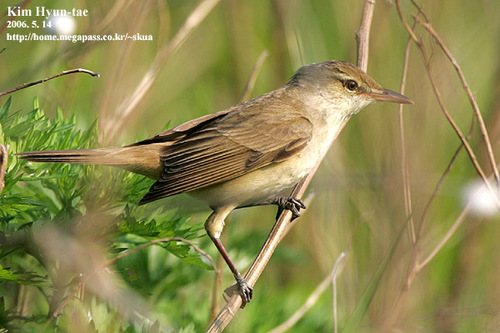 Oriental Reed Warbler
 Sakhalin Grasshopper Warbler
In short
The most reliable field mark to separate Oriental Reed Warbler from Sakhalin Grasshopper Warbler is the Oriental's pale-tipped tail, which is visible both perched and in flight and is absent in Sakhalin. Oriental Reed Warbler also shows a distinct dark eyestripe with a pale supercilium, while Sakhalin Grasshopper Warbler has a plainer face and more uniform plumage. Structurally, Oriental Reed Warbler is larger, with a heavier, longer bill and squarer tail, whereas Sakhalin appears more compact and has a shorter, finer bill. Underparts and undertail coloration also differ: Oriental is whitish below with brown flanks, while Sakhalin is buffy with dull orange undertail coverts. Vocalizations are very different if heard.
Identification tips
- Pale tail tip (all ages): Oriental Reed Warbler shows a pale tip to the tail, visible both perched and in flight. Sakhalin Grasshopper Warbler lacks this feature; its tail is uniformly colored.
- Face pattern: Oriental Reed Warbler has a strong dark eyestripe and a distinct pale supercilium (eyebrow), giving a striking facial contrast. Sakhalin Grasshopper Warbler has a plain face with no strong eyestripe or supercilium.
- Bill structure: Oriental Reed Warbler has a long, heavy bill (brown above, pink below, orange gape), while Sakhalin's bill is shorter and finer. This is best judged when both species are seen well side by side.
- Tail shape: Oriental's tail is shorter and more square-ended; Sakhalin's tail shape is not specifically described, but the lack of a pale tip is key.
- Upperparts: Oriental is brown above with a paler rump; Sakhalin is unstreaked olive-brown above, appearing more uniform and less contrasting.
- Underparts: Oriental is whitish below, with brownish flanks and undertail coverts. Sakhalin is buff below, with a uniformly grey breast and dull orange undertail coverts.
- Undertail coverts: The dull orange undertail coverts of Sakhalin are distinctive and contrast with the browner undertail of Oriental.
- Size and structure: Oriental is noticeably larger and more robust, with a longer body and bill, while Sakhalin is smaller and more compact. This is most useful with experience or direct comparison.
- Perched posture: Oriental often perches upright and prominently; Sakhalin is likely to be more skulking, though this is not always reliable.
- Song: Oriental's song is a mix of warbling and harsh, croaking notes; Sakhalin's is a short, loud, musical phrase. If heard, this is diagnostic.
- Call: Oriental gives a loud, harsh 'chack'; Sakhalin's call is not described, so this may help if the call is heard.
- Habitat: Oriental prefers reedbeds and wetland edges; Sakhalin may be in dense grass or shrubs, but habitat overlap is possible.
- No streaking below: Both species lack strong streaking on the underparts, so this is not a separator.
- No distinctive juvenile wing pattern: Neither species shows a unique juvenile upperwing pattern, so focus on tail and face for immature birds.
- Season and sex: No strong seasonal or sex-based plumage differences are described for either species; all marks above apply year-round and to both sexes.
Size
Oriental Reed Warbler is a large Acrocephalus, measuring 18–20 cm in length with a wingspan of 23–26 cm [wikipedia]. Sakhalin Grasshopper Warbler is smaller and more compact, though exact measurements are not provided in the notes. In the field, Oriental will usually appear longer-bodied and heavier-billed, while Sakhalin is shorter and more delicate overall.
Plumage
- Juvenile and non-breeding birds: The Oriental Reed Warbler of all ages shows a pale tip to the tail, which is a key separator from Sakhalin Grasshopper Warbler, which lacks this feature. Oriental also has brown upperparts with a paler rump and a contrasting dark eyestripe with a pale supercilium; underparts are whitish with brownish flanks and undertail coverts. Sakhalin Grasshopper Warbler has an unstreaked olive-brown back, a uniformly grey breast, buff underparts, and unmottled dull orange undertail coverts. Its face is plain, lacking the strong eyestripe and supercilium of Oriental. No distinctive juvenile wing or flight marks are described for either species, so the tail tip and face pattern are the most reliable plumage clues.
Behaviour
Oriental Reed Warbler often sings from a prominent perch, such as the top of a reed or bush, and may appear more upright and conspicuous. Sakhalin Grasshopper Warbler's behavior is less described, but as a Locustellid, it may be more skulking and less likely to perch prominently in the open, though this is not diagnostic from the notes provided.
Habitat
Both species are associated with dense vegetation, but Oriental Reed Warbler is typically found in reedbeds and similar wetland habitats. Sakhalin Grasshopper Warbler's habitat is not detailed in the notes, but as a grasshopper warbler, it may prefer dense, grassy or shrubby areas, sometimes away from water. In overlapping areas, habitat alone is not a reliable separator.
Voice
Oriental Reed Warbler gives a song of warbling phrases mixed with guttural, croaking notes, and a loud, harsh 'chack' call. Sakhalin Grasshopper Warbler has a short, loud, musical song, described as more musical than Pallas's Grasshopper Warbler and not at all like the insect-like reeling of European Locustella. If the song is heard, the difference is obvious: Oriental is harsh and varied, Sakhalin is short and musical.
Oriental Reed Warbler · Sakhalin Grasshopper Warbler · My Tricky Birds