

Oriental Reed Warbler vs Clamorous Reed Warbler
Acrocephalus orientalis versus Acrocephalus stentoreus
Play a quiz with Oriental Reed Warbler and Clamorous Reed Warbler
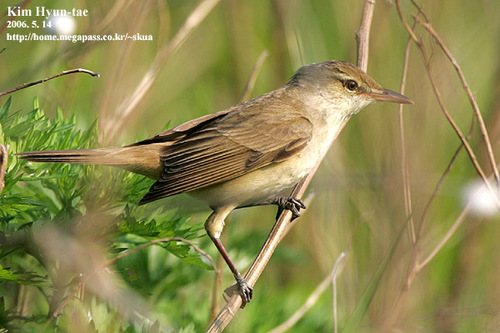 Oriental Reed Warbler
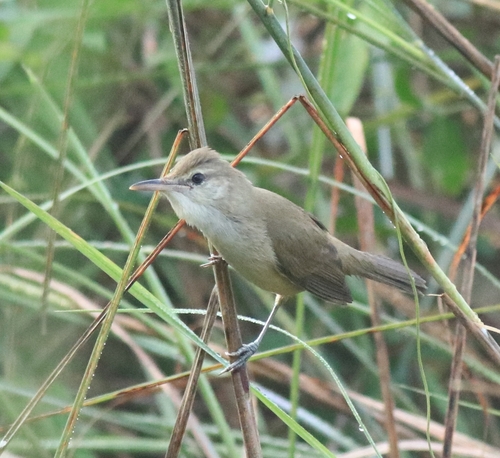 Clamorous Reed Warbler
In short
The most reliable field mark to separate Oriental Reed Warbler from Clamorous Reed Warbler is the pale whitish tip to the tail feathers, which Oriental shows and Clamorous lacks. Both are large, brown reed warblers with similar structure and size, but Oriental is slightly more slender, with a shorter, more square-ended tail and a slightly longer primary projection. Subtle plumage differences—like the narrow greyish streaks on the throat and breast of Oriental—can help, but are often hard to see in the field. Bill color and shape, as well as the presence of a pale supercilium and a dark eyestripe, are useful supporting marks. Voice and behavior are similar, so visual clues are most helpful for separation.
Identification tips
- Tail tip: Look for a pale whitish tip to the tail feathers on Oriental Reed Warbler; this is the single most useful field mark and is absent in Clamorous Reed Warbler. Check both perched and flying birds.
- Tail shape: Oriental has a shorter, more square-ended tail; Clamorous's tail is longer and less squared. This is subtle but can help in direct comparison.
- Primary projection: Oriental shows a slightly longer primary projection beyond the tertials, giving a more pointed-winged look in the hand or at rest. Clamorous's wings look a bit shorter relative to the body.
- Bill shape and color: Oriental's bill is fairly long and heavy, brown above and pink below with a bright orange gape (especially obvious in juveniles and singing adults). Clamorous's bill is strong and pointed but less distinctly colored.
- Supercilium and eyestripe: Both have a pale supercilium and dark eyestripe, but Oriental's supercilium may be more contrasting, especially in fresh plumage.
- Throat and breast streaking: Oriental shows narrow greyish streaks on the throat and breast, best seen in good light or close views. Clamorous lacks these streaks and is plainer below.
- Upperparts color: Oriental is brown above with a paler rump; Clamorous (especially northern races) can be richer brown, but this is variable and overlaps.
- Underparts: Oriental is whitish below, browner on the flanks and undertail-coverts; Clamorous is whitish below but more uniform, lacking the brown flanks and undertail contrast.
- Feet color: Oriental has grey feet, but this is rarely visible in the field and not a strong separator.
- Song: Both have loud, complex songs; Oriental's includes guttural, croaking notes and a harsh 'chack' call, while Clamorous's is a slow, chattering 'kereet-kereet-kereet' with mimicry. In practice, song is not a reliable separator unless you know both well.
- Perch choice: Both sing from prominent reed-tops or bushes, so behavior is not a separator.
- Habitat: Both are reedbed specialists; habitat does not help unless you are outside the normal range of one species.
- Size and jizz: Both are large for warblers, but Oriental is slightly more slender and less bulky than Clamorous. This is subtle and best used with experience or in direct comparison.
- Age/sex: No significant differences between sexes; age-related marks are not described except for the tail tip in Oriental, which is present in all ages.
- Pitfalls: Beware of variable plumage shades and overlapping structure; always prioritize the tail tip and throat streaking when visible.
Size
Both species are large for Acrocephalus warblers, with a length of 18–20 cm. Oriental Reed Warbler is slightly more slender and shorter-winged than Clamorous, but this is subtle and not always apparent in the field. Their wingspans overlap (Oriental: 23–26 cm), and both have a strong, pointed bill. Size alone is rarely diagnostic, but Oriental may look a touch more streamlined and less bulky than Clamorous.
Plumage
- Juvenile/immature birds: No distinctive age-specific upperwing or flight marks are described for either species, so separation relies on tail and body plumage in all ages.
- Tail: Oriental Reed Warbler shows a pale whitish tip to the tail feathers, visible when perched or in flight; Clamorous Reed Warbler lacks this feature and has a plain tail.
- Upperparts: Both are brown above, but Oriental tends to have a paler rump, while Clamorous (especially northern races) can be richer brown overall. These differences are subtle and variable.
- Underparts: Oriental is whitish below with brownish flanks and undertail-coverts, and shows narrow greyish streaks on the throat and breast (look for these in good light). Clamorous is whitish below but lacks the streaking and is more uniformly colored.
- Head: Both have a pale supercilium and a dark eyestripe, but Oriental's supercilium may be more contrasting. The bill of Oriental is brown above, pink below with a bright orange gape; Clamorous has a strong, pointed bill but bill color is less emphasized in descriptions.
- Feet: Oriental has grey feet; Clamorous, not specifically described, but not a key separator.
Behaviour
Both species behave similarly, often singing from prominent perches at the tops of reeds or bushes. They are active, moving through dense vegetation and occasionally showing themselves well when singing. No major behavioral differences are noted that would reliably separate the two in the field.
Habitat
Both species are reedbed specialists, found in tall, dense reeds near water. Oriental Reed Warbler is typical of eastern Asia, while Clamorous Reed Warbler is found from Egypt through South and Southeast Asia. In areas of overlap (e.g., southeast Asia), habitat preferences are nearly identical, so habitat is not a reliable separator.
Voice
Both species have loud, complex songs delivered from exposed perches. Oriental Reed Warbler's song is a mix of warbling phrases and guttural, croaking notes, with a loud, harsh 'chack' call. Clamorous Reed Warbler's song is loud and far-carrying but less raucous than Great Reed Warbler, with a slow, chattering 'kereet-kereet-kereet' and some mimicry. In practice, their songs are similar enough that voice is not a reliable field separator unless you are very familiar with both.
Oriental Reed Warbler · Clamorous Reed Warbler · My Tricky Birds