

Orchard Oriole vs Bullock's Oriole
Icterus spurius versus Icterus bullockii
Play a quiz with Orchard Oriole and Bullock's Oriole
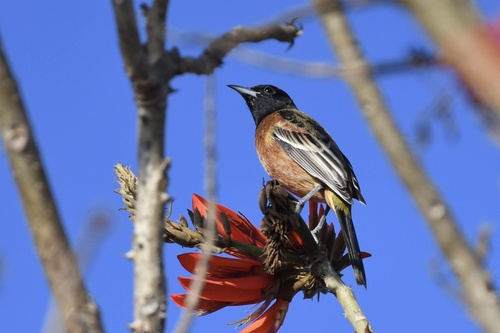 Orchard Oriole
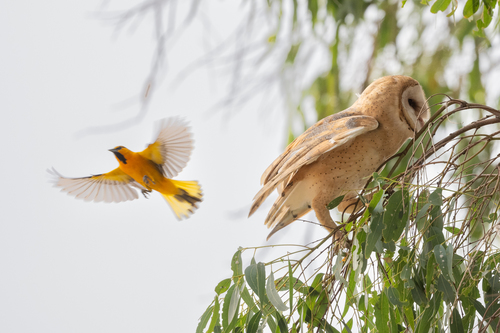 Bullock's Oriole
In short
The most reliable field mark between Orchard and Bullock's Orioles is the adult male's underpart color: Orchard Oriole males show deep chestnut (or ochre in the Mexican subspecies), while Bullock's Oriole males are bright orange or yellow-orange below. Immature and female birds are trickier, but Orchard Oriole is smaller and more olive/yellow overall, while Bullock's Oriole females and young are larger, grayer above, and have a duller yellow below. In flight or at rest, Orchard Oriole is notably more petite and compact, with a shorter wingspan and less contrasty plumage. When faced with a yellowish oriole, size, bill color, and subtle differences in wing and head pattern become key.
Identification tips
- Adult male underparts: Orchard Oriole males have deep chestnut (or ochre) underparts, never orange; Bullock's males are orange or yellow-orange below. This is the single most reliable mark in breeding plumage.
- Head pattern in adult males: Bullock's Oriole males have a bold black line from the eye to the black crown and a black throat patch; Orchard Oriole males lack the black eye-line and have a plain black head and throat.
- Female and juvenile upperparts: Orchard Oriole females and juveniles are olive-green above; Bullock's are gray-brown with an olive crown. This difference is subtle but visible in good light.
- Female and juvenile underparts: Orchard Oriole is brighter yellow below, Bullock's is duller yellow, sometimes with a grayish wash.
- Throat patch in females: Some older Bullock's females show a small dark throat patch, but never the full black bib of Orchard Oriole first-year males. Orchard Oriole females lack any dark throat.
- Bill color in young birds: Juvenile Bullock's have a pinkish or whitish bill, while Orchard Oriole juveniles have a dark bill with some blue-gray at the base of the lower mandible.
- Wing bars and coverts: Both have white wing bars, but Bullock's Oriole's wing patch is more prominent, especially in adult males. Juvenile Bullock's have fresh, dark wing coverts.
- Size and shape: Orchard Oriole is noticeably smaller and more compact, with a shorter tail and wingspan. Bullock's is longer, bulkier, and has a longer, squarer tail.
- Flight style: Orchard Oriole often flies low, close to the ground or below treetop level; Bullock's is less likely to do so.
- Habitat and range: In the breeding season, Orchard Oriole is found in the east and central US, Bullock's in the west. Out-of-range records should be scrutinized carefully.
- Courtship behavior: Bowing, seesawing, and wing-fluttering displays by females are described only for Orchard Oriole.
- Sexual dimorphism in immatures: Both species' juveniles resemble adult females, but Bullock's shows less sexual dimorphism in young birds; Orchard Oriole first-year males may show a black bib and lores.
- Tail color: Bullock's adult males have a jet black tail; Orchard Oriole's tail is black but does not contrast as sharply with the rest of the plumage.
- Face pattern: Bullock's adult males have a striking black eye-line; Orchard Oriole never does, in any age or sex.
- Vocalizations: If heard, Bullock's Oriole's song is faster and harsher than Baltimore Oriole, but song is not a reliable separator from Orchard Oriole based on these notes.
Size
Orchard Oriole is the smallest icterid in North America, measuring 15–18 cm (5.9–7.1 in) in length, weighing 16–28 g (0.6–1.0 oz), and with a wingspan of about 25 cm (9.8 in) [wikipedia]. Bullock's Oriole is distinctly larger: 17–19 cm (6.7–7.5 in) long, 28–43 g (1.0–1.5 oz), and a wingspan of 31 cm (12.2 in) [wikipedia]. In the field, Bullock's appears longer-bodied and longer-tailed, and its greater bulk is usually apparent when seen side by side or with a known reference.
Plumage
-
Juvenile and female/immature birds: Orchard Oriole females and juveniles are olive-green above and yellowish below, with white wing bars. Bullock's Oriole females and juveniles are gray-brown above, with duller yellow underparts and an olive crown; their wings are darker, and juveniles have fresh wing coverts and a paler (pinkish or whitish) bill. Bullock's females may show a small dark throat patch (older birds), but never the black eye-line of adult males. Orchard Oriole first-year males are yellow-greenish with a black bib and lores, but lack the strong orange or black contrasts of Bullock's.
-
Adult males: Orchard Oriole males are unique among North American orioles for their deep chestnut (or ochre in I. s. fuertesi) underparts, shoulder, and rump, with the rest of the plumage black. Bullock's Oriole males are strikingly orange or yellow-orange on the underparts, breast, and face, with a black back, wings, and tail, a black throat patch, and a black eye-line extending to the crown. Both species have white wing bars, but Bullock's has a more prominent white wing patch.
-
Bill color: Orchard Oriole's bill is pointed and black with some blue-gray at the base of the lower mandible. Bullock's Oriole's bill is also pointed and black, but the base of the lower mandible is bluish-gray, and juveniles may have a pinkish or whitish bill.
Behaviour
Orchard Orioles tend to fly low, swooping close to the ground or just below treetop level. Bullock's Orioles do not have a noted preference for low flight and may be seen higher in the canopy. Both species weave pendant nests, but Bullock's nests are often deeper and more conspicuous. Orchard Orioles often nest in loose colonies, while Bullock's are more solitary or in scattered pairs. Courtship displays in Orchard Oriole females include bowing, seesawing, and wing-fluttering, which are not described for Bullock's. Both species are active foragers, but Orchard Oriole is more likely to be seen feeding low or in semi-open areas.
Habitat
Orchard Oriole breeds in semi-open areas with deciduous trees, often near water (lakes, streams), and is found in eastern North America and parts of Mexico. Bullock's Oriole is a bird of western North America, breeding in riparian woodlands, open forests, and sometimes in urban parks, but generally west of the Great Plains. Overlap is minimal except in central Texas and the southern Great Plains. If you are east of the Mississippi, Bullock's is rare; if west of the Rockies, Orchard is rare. Both winter in Mexico and Central America, but their breeding ranges are the best clue in most cases.
Voice
Both species sing, and both sexes are vocal. Bullock's Oriole's song is similar to Baltimore Oriole but faster and harsher. Orchard Oriole's song is not described here. Calls are not reliably separable based on these notes.