

Olive-sided Flycatcher vs Northern Tropical Pewee
Contopus cooperi versus Contopus bogotensis
Play a quiz with Olive-sided Flycatcher and Northern Tropical Pewee
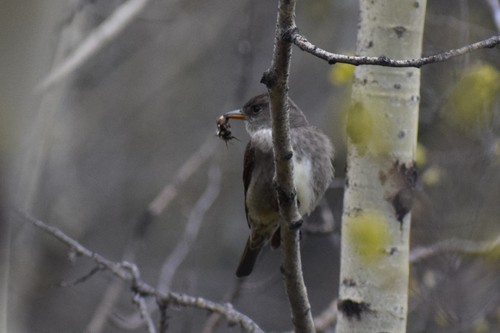 Olive-sided Flycatcher
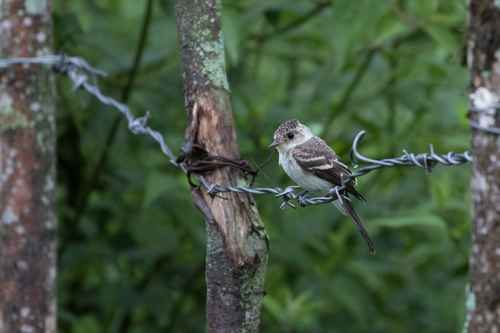 Northern Tropical Pewee
In short
The most reliable field mark for separating Olive-sided Flycatcher from Northern Tropical Pewee is the bold, dark 'vest' of dusky gray on the sides of the breast, sharply framing a white central throat and belly in Olive-sided Flycatcher of all ages. Northern Tropical Pewee lacks this vest and instead shows a more uniform pale grayish or whitish breast, with only a faint gray tinge at most. Juvenile Northern Tropical Pewees have distinctive buffy or cinnamon-edged wing coverts, which Olive-sided Flycatcher never shows. Olive-sided Flycatcher is also much larger and heavier-bodied, with a noticeably longer bill and wings. Both species perch upright on exposed branches, but Olive-sided Flycatcher typically chooses the very tops of tall snags, while Northern Tropical Pewee stays lower and often shivers its tail after landing.
Identification tips
- Look for the dark 'vest' on the breast: Olive-sided Flycatcher always shows a bold, dusky gray vest on the sides of the breast, sharply framing a white central throat and belly. Northern Tropical Pewee never shows this pattern; its breast is pale and uniform with only a faint gray tinge at most. This is the single most diagnostic mark in all ages and seasons.
- Check for wingbars and covert edges in juveniles: Juvenile Northern Tropical Pewee has broad buff or cinnamon-buff edges to the wing coverts and browner upperparts, with a brown chin. Olive-sided Flycatcher juveniles lack these warm tones and show a more uniform olive-gray upperpart and white underparts with the vest already present.
- Assess overall size and structure: Olive-sided Flycatcher is much larger and heavier-bodied than Northern Tropical Pewee, with a longer bill and wings. If the bird appears chunky, long-winged, and robust, especially compared to other Contopus, it is likely Olive-sided Flycatcher. Northern Tropical Pewee is noticeably smaller and lighter.
- Bill shape and size: Olive-sided Flycatcher has a relatively long, thick bill for a Contopus. Northern Tropical Pewee's bill is shorter and thinner, with a yellowish or orangey lower mandible (adults) or dusky orange (juveniles).
- Perching behavior: Olive-sided Flycatcher almost always chooses the highest, most exposed perch available (top of dead trees or snags) and sits very upright. Northern Tropical Pewee perches lower, often at mid-levels or forest edge, and shivers its tail after landing—a behavior not seen in Olive-sided Flycatcher.
- Head and crest: Both species can show a slight crest, but Olive-sided Flycatcher's can appear more pronounced when raised. Northern Tropical Pewee's crown is dark blackish gray with a slight crest, but this is not as distinctive as the vest mark.
- Wing pattern in adults: Northern Tropical Pewee shows two thin wingbars (grayish white to brownish gray) and a hidden white feather tuft on each side of the rump (usually concealed). Olive-sided Flycatcher lacks strong wingbars and does not have a white rump tuft.
- Facial markings: Northern Tropical Pewee has a thin white eye-ring and white to grayish white lores, giving a slightly more marked face than Olive-sided Flycatcher, which is more plain-faced.
- Underpart color: Olive-sided Flycatcher has a white throat and belly, sharply set off by the dark vest. Northern Tropical Pewee's underparts are white to yellowish white, with a pale brown undertail and no sharp contrast.
- Habitat context: Olive-sided Flycatcher prefers open, coniferous or boreal forest edges, often near water and at elevation, and is seen on the tallest perches. Northern Tropical Pewee is found at forest edges or mid-levels in forests from Mexico to northern South America, not as closely tied to water or high elevation.
- Flight jizz: Olive-sided Flycatcher appears larger and more powerful in flight, with longer wings and a more direct sallying style. Northern Tropical Pewee is lighter and more fluttery.
- Sexes: Both species are sexually monomorphic; sex is not a useful field mark.
- Seasonal variation: Olive-sided Flycatcher's olive tones are most apparent in fresh plumage and good light, but the vest is always present. Northern Tropical Pewee's plumage is more consistent year-round, with juveniles showing the most distinctive differences (buffy wingbars, brown chin).
- Vocalizations: Not covered in the available notes; do not rely on voice for separation in this context.
- Pitfalls: Beware of lighting and feather wear, which can obscure the olive tones or make the vest less obvious in Olive-sided Flycatcher, but the overall pattern remains. Juvenile Northern Tropical Pewee's buffy wingbars and brown chin are unique among these two.
Size
Olive-sided Flycatcher is substantially larger and heavier than Northern Tropical Pewee. Olive-sided Flycatcher is described as small to medium-sized, but is almost twice the weight of the smaller Contopus pewees, including Northern Tropical Pewee. Northern Tropical Pewee measures about 12–14 cm in length and weighs 8–14 g, while Olive-sided Flycatcher is distinctly bulkier and longer-winged. This size difference is often obvious in direct comparison or with experience, but can be misleading if seen alone or at a distance.
Plumage
- Juvenile/immature birds: Juvenile Northern Tropical Pewee shows obvious buff to cinnamon-buff edges on the wing coverts and browner upperparts, with a brown chin. Olive-sided Flycatcher juveniles do not show these warm buffy tones or broad covert edges; their plumage is more uniformly olive-gray above and white below, with the signature dark vest already present.
- Adults: Olive-sided Flycatcher of all ages has a bold, dark gray 'vest' on the sides of the breast, sharply contrasting with a white throat and belly. The back is olive-gray to brownish, sometimes with a greenish cast in fresh plumage. Northern Tropical Pewee adults have a sooty olive-gray back, a thin white eye-ring, and a white to grayish white lores, but the underparts are much paler and more uniform, with only a faint gray tinge to the upper breast and no vest effect. Both have slight crests, but Olive-sided Flycatcher's can appear more pronounced when raised. Northern Tropical Pewee shows two thin wingbars (grayish white to brownish gray) and a hidden white feather tuft on the rump, while Olive-sided Flycatcher lacks strong wingbars and does not show a white rump tuft.
Behaviour
Both species are classic sallying flycatchers, but Olive-sided Flycatcher is more likely to perch at the very top of tall, dead trees or snags, often in open or edge habitats, and sits very upright. Northern Tropical Pewee also perches upright, but typically chooses lower, mid-level, or edge perches and is noted for shivering its tail upon returning to a perch. Olive-sided Flycatcher is described as an agile flyer, but its sallies are often longer and more direct. Northern Tropical Pewee usually returns to the same perch after a sally and rarely joins mixed-species flocks.
Habitat
Olive-sided Flycatcher breeds in open or edge habitats of boreal and coniferous forests, often near water and at higher elevations, and is strongly associated with tall, exposed trees or snags. In contrast, Northern Tropical Pewee is found from southeastern Mexico to northern South America, typically at forest edges or mid-levels within forests, and is not as closely tied to water or high elevation. Olive-sided Flycatcher may be seen in cities or farms during migration, but always seeks out open perches. Northern Tropical Pewee is more restricted to forested or edge habitats and does not seek the highest perches.
Olive-sided Flycatcher · Northern Tropical Pewee · My Tricky Birds