

Northern Shoveler vs Tricoloured Munia
Spatula clypeata versus Lonchura malacca
Play a quiz with Northern Shoveler and Tricoloured Munia
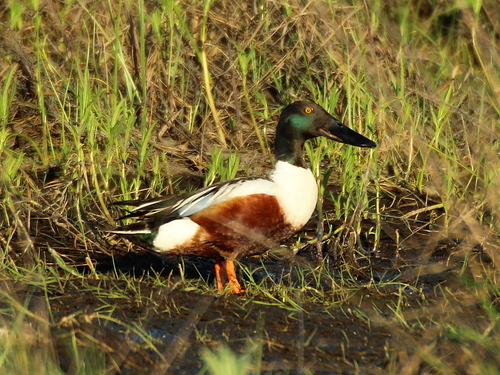 Northern Shoveler
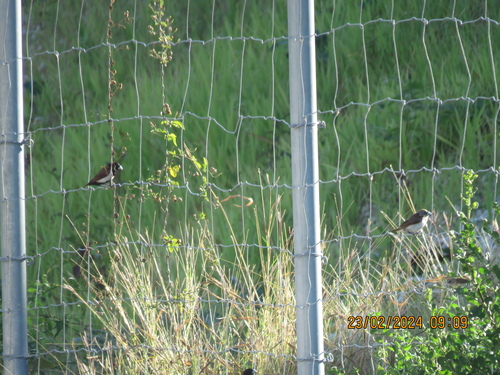 Tricoloured Munia
In short
The most reliable way to separate Northern Shoveler from Tricoloured Munia is by their dramatically different structure: the shoveler is a large, broad-bodied duck with a huge, spatulate bill, while the munia is a small, compact finch with a short, conical bill. In flight or perched, no age of munia ever shows the shoveler’s pale blue forewing or massive bill. Juvenile munias lack the adult’s sharp black-and-chestnut pattern, but even then, their size and bill shape are completely different from any shoveler. If you’re unsure, focus first on bill shape and overall size, then check for the shoveler’s unique blue forewing or the munia’s crisp tricolored adult plumage.
Identification tips
- Bill Shape: Northern Shoveler has a huge, flat, spatulate bill, unique among ducks and never matched by the short, conical finch bill of the Tricoloured Munia. This is visible at all ages and in all plumages.
- Size: Shovelers are full-sized ducks (44–52 cm), much larger than the tiny munia (11.5 cm). Even at a distance, the shoveler’s bulk is obvious.
- Wing Pattern in Flight: All ages and sexes of shoveler show a pale blue forewing in flight, bordered by white and green. Munias have plain dark brown flight feathers with no blue or green, and white to cream underwing coverts.
- Juvenile/Immature Plumage: Juvenile munias are warm brown above and buff below, lacking the adult’s black head and chestnut back, but still show no blue in the wing and have a finch bill. Juvenile shovelers are mottled brown with a grey forewing and a large spatulate bill.
- Adult Male Plumage: Breeding male shoveler has a dark green head, white breast, chestnut flanks, and black bill. Adult munia is sharply tricolored: black head and breast, white belly/flanks, chestnut back.
- Female/Eclipse Plumage: Female and eclipse male shovelers are mottled brown but always show the blue forewing and large bill. Female munias look like adult males but with paler uppertail covert fringes; bill remains small and conical.
- Leg Color: Shovelers have bright orange-red legs; munias have grey legs and feet.
- Feeding Behavior: Shovelers dabble and filter-feed on water, swinging their bills side to side. Munias feed on seeds, often perched on grasses or reeds, never dabbling.
- Habitat: Shovelers are found on open water or marshes; munias are in grassy or reedy areas near water but never swim.
- Flight Style: Shovelers have steady, direct duck flight; munias have quick, bounding finch flight.
- Group Size: Both can be in flocks, but shoveler flocks are on water, munia flocks are in vegetation.
- Context: If seen swimming or dabbling, it is a shoveler. If seen clinging to grass stems or feeding on seeds, it is a munia.
- Bill Color: Shoveler’s bill is dark (male) or grey with orange edges (female); munia’s bill is pale bluish-grey.
- Rump Color: Munias have a reddish-maroon rump and uppertail coverts; shovelers do not.
- Mistaken Identity: Even in eclipse or juvenile plumage, the shoveler’s size, bill, and blue forewing are never matched by munia. Juvenile munias can be confused with other munias but not with shovelers.
Size
Northern Shoveler is vastly larger, measuring 44–52 cm in length and weighing 500–800 g, compared to the Tricoloured Munia’s tiny 11.5 cm length and 12.6 g mass. The shoveler is a full-sized duck, often seen with other waterfowl, while the munia is a small, sparrow-sized finch. This size difference is obvious in any direct view and is especially apparent in flight or when perched near other birds for scale.
Plumage
-
Juveniles/Immatures: Juvenile Tricoloured Munias are warm brown above and buff below, lacking the adult’s black head and chestnut back, but still show no blue or green in the wing and never have a spatulate bill. Juvenile Northern Shovelers (especially females and eclipse males) are mottled brown, with a grey forewing and a large, broad bill with orange tones on the edges. In flight, even eclipse or female shovelers show a pale blue forewing, a feature absent in all munias.
-
Adult Breeding: Adult male Northern Shovelers have an iridescent dark green head, white breast, chestnut flanks, and a pale blue forewing patch bordered by white and green in flight. Females are mottled brown but still show the blue forewing and the huge bill. Adult Tricoloured Munias are sharply marked: black from head to breast, white belly and flanks, and warm chestnut upperparts, with dark brown flight feathers and a reddish-maroon rump. The bill is pale bluish-grey and conical.
-
Eclipse/Nonbreeding: Male shovelers in eclipse resemble females but always retain the blue forewing. Munias do not have an eclipse plumage; adults retain their tricolored pattern year-round.
Behaviour
Northern Shovelers are dabbling ducks, often seen swimming on open water, swinging their large bills side to side to filter food from the water’s surface. They are less gregarious than some ducks but still form small flocks. Tricoloured Munias are seed-eating finches, typically seen in flocks perched on grasses or reeds, or feeding on seeds. Munias do not swim or dabble and are rarely seen on open water. Their flight is quick and bounding, typical of small finches, while shovelers have steady, direct duck flight.
Habitat
Northern Shovelers are found on marshes, lakes, and shallow wetlands, especially those with muddy bottoms rich in invertebrates. They are widespread across the Northern Hemisphere in migration and winter. Tricoloured Munias inhabit warm, grassy areas near water, such as reedbeds, rice fields, and marsh edges, but do not use open water like ducks. In the introduced range, munias are often seen in agricultural areas and grassy wetlands, but always as landbirds, not waterfowl.