

Northern Rough-winged Swallow vs Cave Swallow
Stelgidopteryx serripennis versus Petrochelidon fulva
Play a quiz with Northern Rough-winged Swallow and Cave Swallow
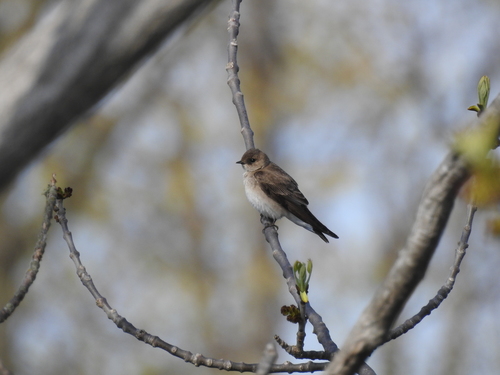 Northern Rough-winged Swallow
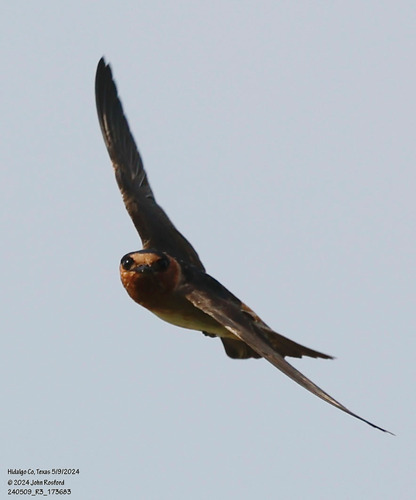 Cave Swallow
In short
The most reliable field mark between Northern Rough-winged Swallow and Cave Swallow is the throat and face color: Northern Rough-winged Swallow shows a plain, dusky or brownish-grey washed throat and face, while Cave Swallow has a bright, brown-tangerine or rufous forehead and throat that stand out in good light. Juvenile Northern Rough-winged Swallows may show faint reddish wing-bars, a feature not present in Cave Swallow. In flight, note the tail shape: Northern Rough-winged Swallow has a subtly forked tail, whereas Cave Swallow's tail is more squared-off. Cave Swallow also appears more compact and has blue-grey upperparts, unlike the uniformly brown upperparts of Northern Rough-winged Swallow. Both species may be seen near water or man-made structures, but Cave Swallow is more likely to be found nesting in caves, sinkholes, or under bridges in the southern U.S. and Mexico.
Identification tips
- Throat and forehead color (all ages): Northern Rough-winged Swallow has a plain, dusky or brownish-grey throat and forehead; Cave Swallow shows a bright brown-tangerine or rufous forehead and throat, often visible even at a distance in good light.
- Facial contrast: Cave Swallow's face is more patterned and colorful, with a distinct rufous forehead and pale cheek, while Northern Rough-winged Swallow's face is plain and lacks strong contrast.
- Juvenile wing-bars: Juvenile Northern Rough-winged Swallows may show faint reddish-brown wing-bars, a feature absent in Cave Swallow. Look for this in late summer or early fall.
- Upperparts color: Northern Rough-winged Swallow is uniformly brown above; Cave Swallow has blue-grey upperparts that can appear glossy in sunlight.
- Tail shape: Northern Rough-winged Swallow has a subtly forked tail; Cave Swallow's tail is more squared-off. This is most obvious in flight or when perched with tail spread.
- Underparts: Both are pale below, but Northern Rough-winged Swallow is cleaner white with a dusky throat, while Cave Swallow may show a warmer, buffy wash on the belly and a rufous throat.
- Bill: Both have small bills, but this is not a strong field mark for separation.
- Size and structure: Cave Swallow appears chunkier and more compact, especially when perched; Northern Rough-winged Swallow is slimmer and longer-winged.
- Flight style: Cave Swallow may appear more buoyant and fluttery in flight, while Northern Rough-winged Swallow is more direct and less erratic.
- Habitat context: In the southern U.S. and Mexico, Cave Swallow is often found nesting in caves, sinkholes, or under bridges; Northern Rough-winged Swallow prefers banks, lakeshores, and open water, sometimes using pipes or culverts but rarely caves.
- Flock size: Cave Swallow is more likely to be seen in larger, tighter colonies, especially near nest sites; Northern Rough-winged Swallow is more solitary or in loose groups.
- Seasonal occurrence: Cave Swallow is a southern specialty, with vagrants reaching the Gulf and East Coasts in fall and winter; Northern Rough-winged Swallow is widespread in spring and summer across North America.
- Sex differences: Not useful in the field; both species are similar in plumage between sexes.
- Voice: Not diagnostic based on available sources.
- Pitfalls: In poor light, Cave Swallow's rufous throat and forehead may be hard to see, making it look plainer; always check for face and throat color in good light. Juvenile Northern Rough-winged Swallows may look especially plain, but faint wing-bars can help.
Size
Northern Rough-winged Swallow is slightly lighter, with an average body mass of 13.9 g [wikidata], while Cave Swallow averages about 19 g [wikipedia]. Both are similar in length (Northern Rough-winged Swallow: 13–15 cm; Cave Swallow: 12–14 cm), but Cave Swallow tends to look chunkier and more compact, especially when perched. Wingspan is not directly compared, but Cave Swallow's North American subspecies have relatively long wings for their size.
Plumage
- Juvenile/immature birds: Juvenile Northern Rough-winged Swallows can show faint reddish-brown wing-bars, especially visible in fresh plumage; Cave Swallow juveniles lack this feature and instead resemble adults in pattern.
- Adults: Northern Rough-winged Swallow is brown above with white underparts, a dusky or brownish-grey washed throat, and a plain face. Cave Swallow has blue-grey upperparts, a contrasting brown-tangerine (rufous) forehead and throat, and a paler belly. The facial pattern is much more striking in Cave Swallow, with the rufous forehead often catching the light. Tail is subtly forked in Northern Rough-winged Swallow, but more squared in Cave Swallow. Sexes are similar in both species, but male Northern Rough-winged Swallows have longer undertail coverts (not a field mark in normal views).
Behaviour
Both species are aerial insectivores, often seen foraging over water or open areas. Northern Rough-winged Swallow tends to be solitary or in loose groups, often perching alone or in small numbers. Cave Swallow is more colonial, especially at nest sites, and may be seen in larger, tighter flocks, especially near bridges, culverts, or cave entrances. In flight, Cave Swallow can appear more buoyant and compact, while Northern Rough-winged Swallow has a more direct, less fluttery flight.
Habitat
Northern Rough-winged Swallow is widespread in North America, breeding near water, banks, and sometimes in urban settings, often nesting in burrows or cavities in banks or man-made structures. Cave Swallow is more localized in the southern U.S., Mexico, and the Caribbean, with a strong preference for nesting in caves, sinkholes, and under bridges or culverts. If seen at a cave entrance or under a highway bridge in Texas or the Southwest, Cave Swallow is more likely; Northern Rough-winged Swallow is more likely along streams, lakes, or in open country away from caves.
Northern Rough-winged Swallow · Cave Swallow · My Tricky Birds