

Northern Bobwhite vs California Quail
Colinus virginianus versus Callipepla californica
Play a quiz with Northern Bobwhite and California Quail
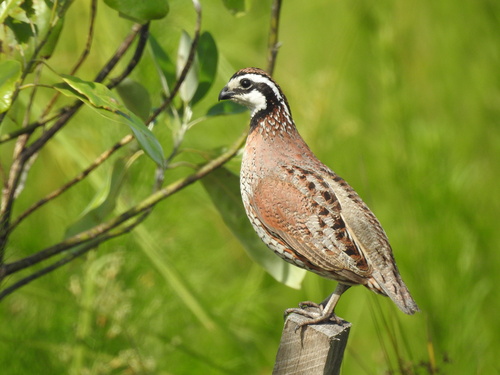 Northern Bobwhite
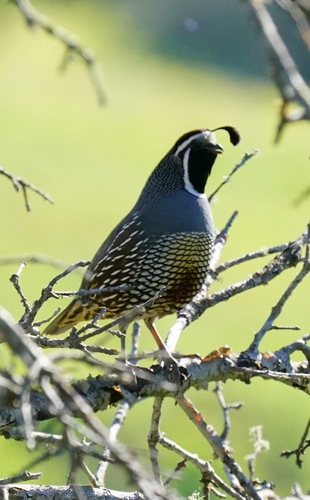 California Quail
In short
The most reliable field mark between Northern Bobwhite and California Quail is the head pattern: male Northern Bobwhite shows a crisp white throat and brow stripe bordered by black, while male California Quail has a striking black face with bold white outlines and a prominent forward-curving topknot. Females of both are plainer, but California Quail females still show the topknot, absent in bobwhite. In flight or at rest, Northern Bobwhite is more rufous and lacks the gray and scaled look of California Quail. Both are ground-dwelling, chunky quail, but their head shapes and facial patterns are the quickest way to separate them, especially at a distance or in mixed coveys.
Identification tips
- Head pattern (adult males): Look for the white throat and brow stripe bordered by black on Northern Bobwhite males; California Quail males have a black face with bold white outlines and a prominent black topknot. This is the fastest field mark at any distance.
- Topknot/plume: California Quail of both sexes have a forward-curving topknot (longer in males, shorter in females), completely absent in Northern Bobwhite. Even a short, brownish topknot on a female quail rules out bobwhite.
- Facial pattern (females): Female California Quail have a plain brown face and topknot; female bobwhites have a buffy throat and brow stripe but no plume. If you see a plain-faced, brownish quail with a small topknot, it's a California Quail.
- Body color and pattern: Northern Bobwhite is more rufous overall, with gray mottling on the wings and white scalloped stripes on the flanks. California Quail is grayer, with a scaled appearance on the belly and sides.
- Tail color: Northern Bobwhite has a gray tail; California Quail's tail is less distinctly colored but blends with the gray and brown body.
- Belly pattern: California Quail shows a scaled pattern on the belly, especially in males; bobwhite underparts are whitish with black scallops but lack the strong scaling.
- Size and shape: Both are chunky, rounded quail, similar in size. Do not rely on size for separation.
- Flight and jizz: Both flush explosively when startled. California Quail may prefer to run if possible, but this is not diagnostic.
- Habitat and range: In native ranges, Northern Bobwhite is found in the eastern/central US, California Quail in the west. Both can be found in introduced populations elsewhere, so always check plumage and head pattern.
- Covey behavior: California Quail often gather for communal dust baths, leaving circular patches in soft dirt; this is less typical of bobwhite.
- Vocalizations: The clear, rising "bob-WHITE" call is unique to Northern Bobwhite. If you hear this, you are not seeing a California Quail.
- Bill: Both have short, curved bills typical of quail; not a useful separator in the field.
- Seasonal variation: No strong seasonal plumage changes are noted for either species; head pattern and topknot are reliable year-round.
- Juvenile/immature birds: No distinctive upperwing or flight marks are described for young birds of either species; rely on head and body pattern even in immature birds.
- Pitfalls: Female and immature California Quail can appear plain and brown, but the presence of even a small topknot is diagnostic. Bobwhites never show a topknot.
Size
Both species are similar in length, with Northern Bobwhite measuring 24–28 cm and California Quail 24–27 cm. Northern Bobwhite averages 171 g in body mass [wikidata], while California Quail ranges from 140–230 g [wikipedia], so there is considerable overlap, but California Quail can be slightly heavier at the upper end. Wingspans are also close: 33–38 cm for bobwhite, 32–37 cm for California Quail. In the field, size alone is not a reliable separator.
Plumage
-
Juvenile/immature upperwing pattern: No specific notes on distinctive juvenile or immature upperwing marks for either species, so this is not a reliable separation point in flight for young birds.
-
Adult males: Northern Bobwhite males have a white throat and brow stripe bordered by black, with overall rufous plumage, gray mottling on the wings, and a gray tail. California Quail males have a black face outlined by bold white stripes and a conspicuous forward-curving black topknot (plume), with gray and brown body plumage and a scaled appearance on the belly.
-
Adult females: Both are plainer than males, but female California Quail still show a shorter, brownish topknot and a brown face lacking the crisp white and black pattern of male bobwhite. Female bobwhites are rufous with a buffy throat and brow stripe, lacking any topknot.
-
General: Northern Bobwhite appears more rufous and less patterned on the belly and flanks, while California Quail is grayer and more scaled, especially below.
Behaviour
Both species are ground-dwelling and often found in coveys. California Quail is especially noted for its sociability, often gathering in groups for communal dust baths, which leave distinctive circular indentations in soft dirt. Both species flush explosively when startled, but California Quail is described as preferring to escape on foot when possible. Northern Bobwhite is also a ground forager but is not specifically noted for communal dust bathing.
Habitat
Northern Bobwhite is native to eastern North America, favoring agricultural fields, grasslands, open woodlands, roadsides, and wood edges. California Quail is native to western North America but has been widely introduced elsewhere; it is found in a variety of open habitats, including edges of urban areas, and adapts well to disturbed environments. In the field, location is a strong clue: bobwhite in the east/central US, California Quail in the west, but both can occur in introduced populations outside their native ranges.
Voice
Northern Bobwhite has a distinctive, slow, rising whistle: "bob-WHITE" or "bob-bob-WHITE," with syllables spaced and rising in pitch by a full octave. Other calls are lisps, peeps, and rapid warning whistles. California Quail's vocalizations are not detailed in the notes, but the bobwhite's signature call is a strong separator where heard.