

New Britain Sparrowhawk vs White Hawk
Tachyspiza brachyura versus Pseudastur albicollis
Play a quiz with New Britain Sparrowhawk and White Hawk
 New Britain Sparrowhawk
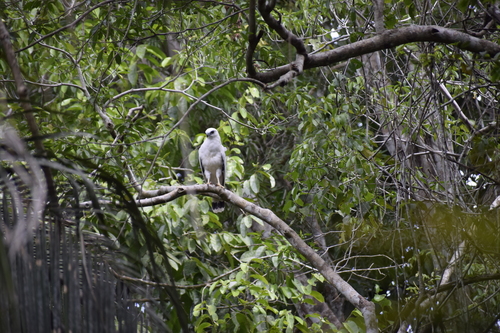 White Hawk
In short
The most reliable separation between New Britain Sparrowhawk and White Hawk is the striking white-and-black plumage of the adult White Hawk, especially the white underparts and underwings with contrasting black upperwings and tail band, versus the much less contrasting, darker, and more uniformly patterned New Britain Sparrowhawk. Immature White Hawks show extensive black spotting above and streaked whitish underparts, which is never matched by the sparrowhawk. Structurally, White Hawk is much larger and broader-winged, with a very short tail, while New Britain Sparrowhawk is a small, compact accipiter. Range is also diagnostic: White Hawk occurs only in the Americas, while New Britain Sparrowhawk is endemic to New Britain and New Ireland in Papua New Guinea. If you see a large, mostly white raptor with black upperwings and a bold tail band, you are looking at a White Hawk.
Identification tips
- Immature White Hawk shows extensive black spotting above and streaked whitish underparts—no age of New Britain Sparrowhawk has this pattern. If you see a large raptor with these marks, it is a White Hawk.
- Adult White Hawk is mostly white below with black upperwings and a broad black tail band; New Britain Sparrowhawk never shows this bold black-and-white contrast.
- White Hawk is much larger and bulkier, with very broad wings and a very short tail; New Britain Sparrowhawk is small, compact, and has the proportions typical of an accipiter (longer tail relative to body, narrower wings).
- In flight, White Hawk appears strikingly white from below with black wingtips and tail band; New Britain Sparrowhawk lacks any such white underwing or tail pattern.
- White Hawk perches in the open and soars frequently; New Britain Sparrowhawk is more secretive and rarely seen in the open.
- Bill and legs: White Hawk has a black bill and yellow legs; details for New Britain Sparrowhawk are not given, but accipiters typically have a more delicate bill and less robust legs.
- Eye color: Some White Hawk subspecies have yellow eyes (ghiesbreghti), others brown; eye color is not described for New Britain Sparrowhawk, but is unlikely to be as striking as in White Hawk.
- Tail pattern: White Hawk has a very short tail with a broad black subterminal band and white base; New Britain Sparrowhawk has a longer, more typical accipiter tail with no such bold banding.
- Geographic location is critical: White Hawk is only found in the Americas, while New Britain Sparrowhawk is restricted to two islands in Papua New Guinea. Any sighting outside these regions rules out the other species.
- Vocalization: If heard, a plaintive 'kerwee' indicates White Hawk; New Britain Sparrowhawk's call is not described and is unlikely to be similar.
- Sexual dimorphism: Both species have similar plumage between sexes, but female White Hawks are larger; this is not a useful field mark unless size is apparent.
- Subspecies variation in White Hawk: Some forms have more black on the wings and tail, but all remain mostly white from below; New Britain Sparrowhawk never approaches this pattern.
- Habitat context: White Hawk is a bird of lowland forest and woodland, often in association with foraging mammals; New Britain Sparrowhawk is a rare forest accipiter, unlikely to be seen in open or edge habitats.
- General jizz: White Hawk's flight is slow and soaring, showing broad wings and short tail; New Britain Sparrowhawk would show quick, agile, accipiter-like flight with longer tail and narrower wings.
- Pitfalls: The only likely confusion is with immature White Hawks, but their black-spotted upperparts and streaked underparts are unique. No age of New Britain Sparrowhawk shows these marks.
Size
White Hawk is dramatically larger, measuring 46–56 cm in length and weighing 650–840 g depending on sex [wikipedia]. It has very broad wings and a notably short tail. In contrast, New Britain Sparrowhawk is a small accipiter, much shorter and lighter (exact measurements not provided, but as a sparrowhawk, it is far smaller than a buteonine hawk) [wikipedia]. The size difference is so great that confusion is only likely in poor viewing conditions or with immature White Hawks.
Plumage
Immature White Hawks are distinctive: they show extensive black spotting on the upperparts and dark-streaked whitish underparts, a pattern not seen in any age of New Britain Sparrowhawk [wikipedia]. Adult White Hawks are almost entirely white below, with white head, body, and underwings, and black upperwings and a very short tail with a broad black subterminal band and a white base. Subspecies vary in the amount of black on the wings and tail, but all look mainly white from below. New Britain Sparrowhawk, by contrast, does not have any form with a mostly white plumage or such bold black-and-white contrast; its plumage is more uniformly dark and lacks the extensive white and sharp black markings of White Hawk. No details are given for immature New Britain Sparrowhawk, but as an accipiter, it would not show the white and black pattern of the White Hawk at any age.
Behaviour
White Hawk is often seen soaring high above the forest, displaying broad wings and a short tail, and is known for spectacular aerial courtship displays [wikipedia]. It frequently perches in the open and may associate with foraging mammals to catch prey. New Britain Sparrowhawk, as a typical accipiter, is likely to be more secretive, using short, rapid flights through forest and perching quietly in cover. It is rarely seen and was already considered rare in the 1930s [wikipedia].
Habitat
White Hawk inhabits lowland forests and woodlands throughout the Neotropics, from southern Mexico through Central and South America to Brazil, Bolivia, and Peru, and also on Trinidad [wikipedia]. New Britain Sparrowhawk is strictly endemic to the islands of New Britain and New Ireland in Papua New Guinea, and is very rare even within its limited range [wikipedia]. Thus, location alone is usually diagnostic.
Voice
White Hawk gives a plaintive 'kerwee' call [wikipedia]. No vocalization is described for New Britain Sparrowhawk, so voice is unlikely to be a useful field mark for separation.