

Nashville Warbler vs Mourning Warbler
Leiothlypis ruficapilla versus Geothlypis philadelphia
Play a quiz with Nashville Warbler and Mourning Warbler
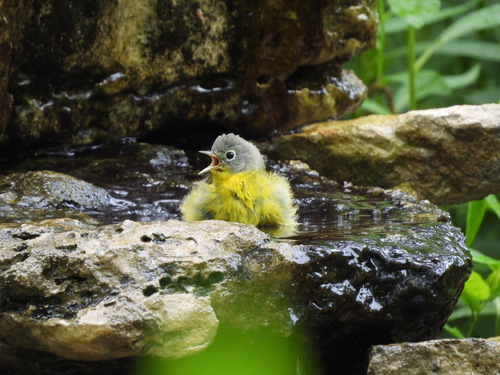 Nashville Warbler
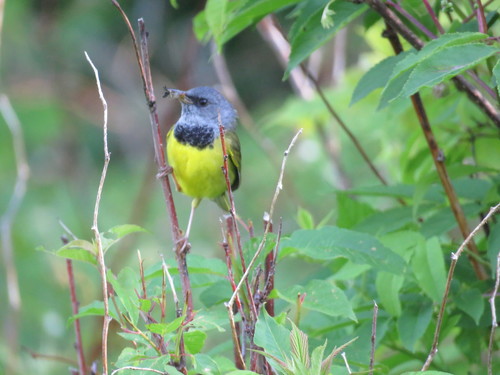 Mourning Warbler
In short
The most reliable field mark between Nashville and Mourning Warblers is the eye ring: Nashville Warbler always shows a complete, bold white eye ring, while Mourning Warbler never does—adults lack any eye ring, and immatures show only a faint, broken one. In addition, Nashville Warbler has a clean yellow throat and breast, contrasting with its gray head and greenish back, whereas Mourning Warbler males have a gray hood and a dark (blackish) throat patch, with females and immatures showing a duller, yellowish or grayish throat and only a partial eye ring. Mourning Warbler is also noticeably bulkier and longer-bodied. These differences hold across ages and seasons, but can be subtle in fall or in young birds, so careful attention to the eye ring and throat color is key.
Identification tips
- Eye ring is the single best mark: Nashville Warbler always shows a complete, bold white eye ring in all plumages and ages. Mourning Warbler adults lack an eye ring entirely; immatures show only a faint, broken eye ring. If you see a full, unbroken eye ring, it's Nashville.
- Throat color: Nashville Warbler has a clean, bright yellow throat and breast, sharply set off from the gray head. Mourning Warbler males have a gray hood and a black patch on the throat and breast; females and immatures have a yellow-gray or olive-tinged throat, never as clean or bright as Nashville's.
- Head pattern: Nashville's head is plain gray (sometimes with a hidden rusty crown patch in males), contrasting with a greenish back. Mourning males have a gray hood and black lores; females/immatures have a gray-brown head with a duller, incomplete eye ring.
- Underparts: Nashville shows a white belly and yellow vent, with a sharp division from the yellow breast. Mourning's underparts are yellow but duller and less sharply divided, often with a brown or olive tint on the breast in females/immatures.
- Back and mantle: Nashville's back is greenish, contrasting with the gray head (especially in the eastern subspecies). Mourning's upperparts are olive-green but blend more smoothly into the head, especially in females/immatures.
- Size and structure: Mourning Warbler is noticeably larger and more robust, with a heavier body and longer wings. Nashville is smaller, slimmer, and more delicate overall.
- Bill and legs: Both have thin, pointed bills, but Mourning Warbler has pink legs, which can be a subtle supporting mark.
- Activity level: Mourning Warbler is more active and robust in movement, often foraging low in dense cover. Nashville is less active and often flicks its tail.
- Wing bars: Both species lack wing bars, so this is not a useful mark for separation.
- Sex and age pitfalls: Female and immature Mourning Warblers can be confused with Nashville, but always check for the complete eye ring and clean yellow throat of Nashville. Mourning's incomplete eye ring and duller throat are key.
- Seasonal changes: In fall, Mourning Warbler males lose some of the boldness in their hood and throat patch, but still lack a complete eye ring and clean yellow throat. Nashville remains bright and contrasting, though females/immatures are duller.
- Habitat context: In dense, regenerating second-growth or thickets, especially in the east, Mourning is more likely. In more open woods or shrubby areas, especially in the north or west, Nashville is favored.
- Subspecies variation: Western Nashville Warblers (Calaveras) have a less contrasting mantle and head, but still show the complete eye ring and yellow underparts.
- No distinctive flight or upperwing pattern: Neither species shows a unique wing pattern in flight, so rely on head and underpart marks.
- Direct comparison: If both species are present, look for the smaller, brighter, and more sharply marked Nashville versus the larger, duller, and more robust Mourning.
Size
Mourning Warbler is consistently larger and heavier than Nashville Warbler. Mourning averages about 11.9 g in body mass, compared to Nashville's 8.8 g [avonet]. In the field, Mourning appears more robust and longer-bodied (10–15 cm length, 18 cm wingspan), while Nashville is smaller and more delicate (11–13 cm length, 17–20 cm wingspan) [wikipedia, wikidata]. The difference is subtle at a distance, but side-by-side, Mourning is bulkier and longer-winged.
Plumage
For all ages, the eye ring is diagnostic: Nashville Warbler always shows a complete, bold white eye ring, while Mourning Warbler adults lack any eye ring and immatures have only a faint, broken one. Adult male Nashville has a gray head, olive-green back, yellow throat and breast, and a white belly, with a usually hidden rusty crown patch. Females and immatures are duller but still show the complete eye ring and yellow underparts. Mourning Warbler adult males have a gray hood, black lores, and a black patch on the throat and breast; in fall, this hood and patch become less distinct but are still present. Females and immatures have a gray-brown head, incomplete eye ring, and a yellow-gray throat with a brown or olive tint to the breast. Mourning never shows a clean yellow throat like Nashville, and the underparts are less sharply divided. Both lack wing bars, but Nashville's plumage is brighter and more contrasting overall. No age-specific upperwing pattern is described for either species.
Behaviour
Nashville Warbler forages by gleaning in lower trees and shrubs, often flicking its tail and sometimes joining mixed-species flocks, especially in winter. Mourning Warbler also forages low in dense vegetation, but is generally more active and robust in its movements. Nashville is described as less active than Mourning, which may help in direct comparison. Both species are insectivorous but Mourning is noted for removing legs and wings from prey before eating.
Habitat
Nashville Warbler breeds in northern and western U.S. and southern Canada, favoring open woods and shrubby areas, and winters in southern California, Texas, Mexico, and Central America. Mourning Warbler breeds in eastern and central North America, preferring dense second-growth forests, thickets, and regenerating clearings, and winters further south into Central and South America. In migration, both can overlap in brushy or shrubby habitats, but Mourning is more tied to dense, regenerating areas, especially during breeding.