

Namaqua Warbler vs Bronze Mannikin
Phragmacia substriata versus Spermestes cucullata
Play a quiz with Namaqua Warbler and Bronze Mannikin
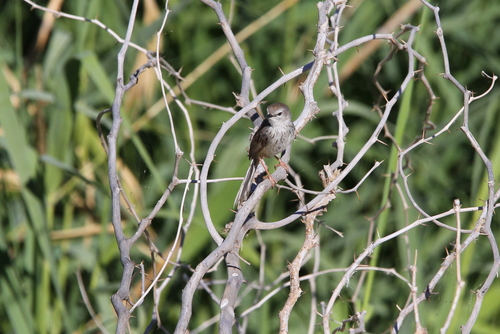 Namaqua Warbler
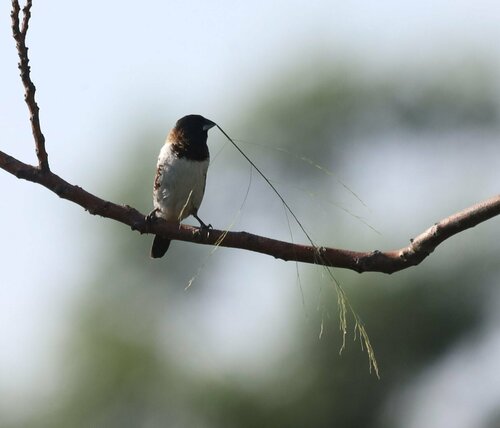 Bronze Mannikin
In short
The most reliable field mark to separate Namaqua Warbler from Bronze Mannikin is overall structure and tail: Namaqua Warbler is a slender, long-tailed warbler with a cocked, whispy brown tail, while Bronze Mannikin is a compact, stubby finch with a short black tail. Juvenile mannikins are plain brown and lack the warbler's white underparts and facial pattern. In all plumages, the warbler's white breast and supercilium contrast with the mannikin's dark face and chest. Bill shape is also diagnostic: the warbler has a thin, straight bill, while the mannikin has a thick, conical finch bill. These two are unlikely to be confused in flight, but perched birds in dense cover can cause confusion, especially juveniles.
Identification tips
- Tail length and shape: Namaqua Warbler always shows a long, brown, whispy tail, often cocked upwards; Bronze Mannikin has a short, stubby, black tail. This is the quickest structural check in any posture.
- Bill shape: Warbler has a thin, straight, black bill (insectivore type); mannikin has a thick, conical, blackish/pale grey bill (finch type). Bill shape is diagnostic at any age.
- Facial pattern: Namaqua Warbler shows a pale supercilium (eyebrow) and white lower face; mannikin has a dark (black to brownish-black) face, chin, and throat, sometimes with greenish iridescence. Juvenile mannikins lack the dark face but still lack the warbler's pale eyebrow.
- Breast and underparts: Warbler has a white throat and breast with faint streaking; mannikin has a blackish chest (adults) or plain buff (juveniles), with white belly and irregular barring on the flanks/rump. Warbler's underparts are never barred.
- Upperparts: Warbler is rich russet-brown above; mannikin is greyish brown above, lacking the rufous tones.
- Leg color: Warbler has pinkish-brown legs; mannikin's leg color is less distinctive in the field but generally dark.
- Jizz (overall impression): Warbler is slender, long-tailed, and often perches with tail cocked; mannikin is compact, short-tailed, and perches upright or huddled in flocks.
- Group size: Warbler is usually solitary or in pairs; mannikin is almost always in flocks, especially outside breeding season.
- Habitat: Warbler prefers dense, tangled scrub or reedbeds; mannikin is found in grassy edges, gardens, and forest margins, often near water.
- Flight style: Warbler is agile, often flying low and quickly between cover; mannikin has a bounding, finch-like flight, often in tight groups.
- Juvenile confusion: Juvenile mannikins are plain brown and lack facial contrast; juvenile warblers, though duller, still show pale underparts and eyebrow.
- Voice: Warbler's call is a sharp, high 'treeep-treep-trrrrrr'; mannikin gives a softer, twittering or 'rreep-rreeep' call. If heard, this is a strong clue.
- Tail color: Warbler's tail is brown and matches the back; mannikin's is black and contrasts with the back.
- Association: Mannikins may mix with other finches/waxbills; warblers do not.
- Perching behavior: Warbler often moves through low vegetation, rarely perches in the open; mannikin perches openly, often in groups, and visits exposed water edges.
Size
Namaqua Warbler is slightly larger and longer (12–13 cm) than Bronze Mannikin (9–10 cm), but the difference is most obvious in proportions: the warbler is slender with a long tail and legs, while the mannikin is compact, short-tailed, and chunky. Mannikin also weighs more for its size (7–12 g) compared to the warbler's lighter build. In the field, the warbler's tail length and posture make it appear even longer than the mannikin.
Plumage
- Juvenile/immature birds: Juvenile Bronze Mannikins are uniformly dun brown above with buffy underparts and lack the sharp facial contrast of Namaqua Warbler. Juvenile warblers are duller than adults but still show a pale supercilium and white throat/breast, unlike any mannikin age.
- Adults: Namaqua Warbler adults have rich russet-brown upperparts, a white throat and breast (with faint streaking), a pale eyebrow, and a long brown tail. Bronze Mannikin adults are dark-faced (black to brownish-black on head, chin, throat, and chest), with some greenish iridescence, greyish brown upperparts, and white underparts with irregular barring on flanks/rump. Mannikin's tail is short and black, not brown and whispy. Warbler's bill is thin and black; mannikin's is thick, conical, and blackish/pale grey.
- Flight views: No distinctive upperwing pattern is described for either species, but the warbler's long tail and overall shape are distinctive in flight, while mannikin appears stubby and short-tailed.
Behaviour
Namaqua Warbler is usually seen singly or in pairs, moving low in scrub with its tail cocked and foraging for insects. It is rarely gregarious. Bronze Mannikin is highly social, often in flocks of 8–20, feeding on seeds and visiting water to drink and bathe. Mannikins often allopreen and build communal roosting nests, sometimes associating with other finches. Warblers are more secretive and less likely to be seen in open flocks.
Habitat
Namaqua Warbler prefers dense, low scrub and reedbeds, often in arid or semi-arid regions. Bronze Mannikin is found in mesic savanna, forest margins, and gardens—generally in moister, more open or edge habitats. Mannikins are more likely around human habitation and grassy areas, while warblers stick to thick, tangled vegetation.
Voice
Namaqua Warbler gives a high-pitched 'treeep-treep-trrrrrr' call. Bronze Mannikin has a 'rreep-rreeep' in flight and a twittering, wheezy or buzzing series of notes when perched. The mannikin's song is repetitive and finch-like, while the warbler's call is sharper and higher. Vocalizations are quite different if heard well, but both can be overlooked in mixed flocks or noisy environments.