

Muscovy Duck vs Surf Scoter
Cairina moschata versus Melanitta perspicillata
Play a quiz with Muscovy Duck and Surf Scoter
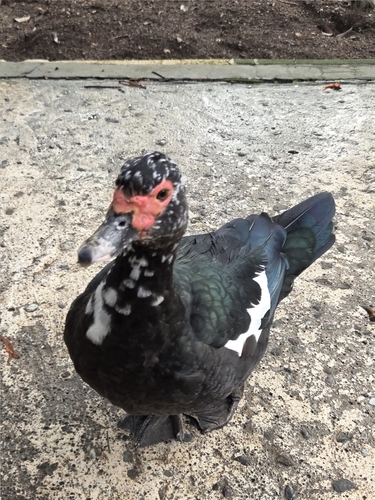 Muscovy Duck
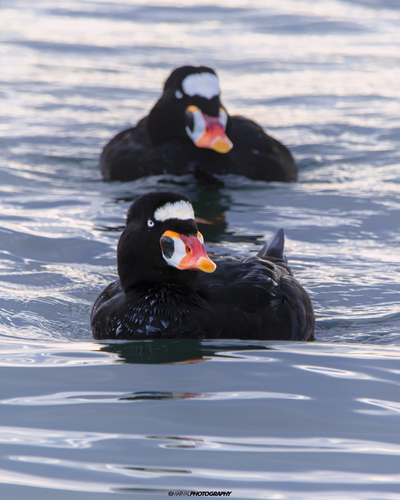 Surf Scoter
In short
The most reliable field mark to separate Muscovy Duck from Surf Scoter is the presence of a naked, red carunculated face and large white wing patches (especially in flight) on adult Muscovy, versus the Surf Scoter’s all-dark wings and distinctive white head patches in adult males. Juvenile Muscovy Ducks are duller and may lack obvious white in the wing, but still show a larger, bulkier structure and a bare facial patch, while Surf Scoter juveniles are compact, brownish, and never show bare skin on the face. In flight, Muscovy Ducks (except dull juveniles) show prominent white on the wings, while Surf Scoters always have completely dark wings. Bill shape and color, body size, and habitat context also help: Muscovy is a massive, flat-tailed, broad-billed duck of fresh water or urban ponds, while Surf Scoter is a smaller, sea duck with a swollen, multicolored bill and a more compact silhouette.
Identification tips
- Wing pattern in flight: Adult and most immature Muscovy Ducks show large white patches or bars on the wings, especially obvious in flight. Surf Scoters of all ages have completely dark wings—no white patches or bars.
- Bare facial skin: Muscovy Ducks (all ages) have a naked, red or dark carunculated area around the bill and eyes. This is absent in Surf Scoter, which always has a fully feathered face.
- Bill shape and color: Muscovy has a broad, flat bill, usually black with some pink speckling (variable in feral/domestic birds). Surf Scoter has a distinctive swollen bill with a squarish base, patterned in white, red, yellow, and black in males, and blackish with green/blue tinge in females.
- Head pattern: Adult male Surf Scoter shows bold white patches on the forehead and nape, which are never present in Muscovy. Female and juvenile Surf Scoter have paler cheek patches and sometimes a whitish nape, but never bare skin. Muscovy may have white on the head/neck in feral birds, but it is never in the form of neat forehead/nape patches.
- Body size and shape: Muscovy is much larger and bulkier, with a long neck and a broad, flat tail. Surf Scoter is more compact, with a shorter neck and a rounded tail.
- Plumage gloss: Adult male Muscovy is glossy black with iridescent back and wing feathers; Surf Scoter is velvety black without iridescence.
- Sexual dimorphism: Muscovy males are much larger than females, with a prominent knob at the bill base and a short crest. Surf Scoter males and females differ mainly in color and head pattern, not size.
- Juvenile confusion: Juvenile Muscovy is dull and may lack white in the wing, but still shows bare facial skin and a heavy build. Juvenile Surf Scoter is uniformly brownish with a whitish belly, no bare skin, and always dark wings.
- Tail: Muscovy has a wide, flat tail, often held out or wagged. Surf Scoter’s tail is shorter and less conspicuous.
- Feet and claws: Muscovy has long claws on the feet, sometimes visible when perched or walking. Surf Scoter’s feet are typical for diving ducks.
- Habitat: Muscovy is found on fresh water, often urban or farm ponds, sometimes perching in trees or on structures. Surf Scoter is almost always on saltwater, rarely venturing inland.
- Behavior: Muscovy is slow-moving, often loafing on land or perching. Surf Scoter is active on water, diving frequently, and rarely comes to land except to breed.
- Vocalizations: Muscovy males give a low breathy call, females a trilling coo. Surf Scoter’s calls are not usually heard in the field.
- Domesticated/feral Muscovy variation: Feral Muscovy may show a wide range of white on the head and neck, but always check for the bare red face and heavy structure.
- Context: If you see a large, heavy duck with a bare red face in a city park, it is a Muscovy. A black duck with white head patches and a swollen bill on the ocean is a Surf Scoter.
Size
Muscovy Duck is dramatically larger and heavier than Surf Scoter. Adult Muscovy males can weigh over 2,000 g (often up to 3–4 kg), with females about half that, while Surf Scoter averages about 950 g. Muscovy is also much longer (males 76–84 cm, females 71–76 cm) and has a much broader wingspan (137–152 cm) compared to Surf Scoter’s 44–48 cm length and 76–77 cm wingspan. Even a female or juvenile Muscovy will look bulkier and longer-necked than any Surf Scoter.
Plumage
-
Juvenile/immature birds in flight: Juvenile Muscovy Ducks are dull overall and may lack the white wing patches typical of adults, but still show a large, heavy body and bare facial skin. Juvenile Surf Scoters are paler brown with a whitish belly and breast, but always have completely dark wings in flight—no white patches or bars. This is a key separation for flying birds of any age: Muscovy (except dull juveniles) shows obvious white in the wings, Surf Scoter never does.
-
Adult males: Muscovy males are glossy black with large white patches on the wings (especially visible in flight), a naked red or dark carunculated face, and a short crest. Surf Scoter males are velvety black overall with distinctive white patches on the forehead and nape, but no white in the wings or on the face. The bill is swollen and multicolored in Surf Scoter, black with a pinkish speckling in Muscovy.
-
Adult females: Female Muscovy is smaller, drabber, but still has a feathered face and may show some white in the wings. Female Surf Scoter is brownish, with paler cheek patches and sometimes a whitish nape, but no white in the wings and no bare facial skin.
-
Domesticated/feral Muscovy: Plumage is variable, but always look for the bare red facial skin and heavy structure. White patches on the neck and head may be extensive, but the wing pattern remains a key mark.
Behaviour
Muscovy Ducks are often seen loafing on land, perching on logs or even in trees, and may nest in tree cavities or on the ground in urban parks or farms. They are slow-moving, with a heavy, waddling gait, and often sleep on water at night. Surf Scoters are sea ducks, usually seen in flocks on open water, diving frequently for food. Their flight is direct and fast, with rapid wingbeats, and they rarely perch on land or in trees. Muscovy’s flight is heavy and labored compared to the swift, low-slung flight of Surf Scoter.
Habitat
Muscovy Ducks are birds of freshwater habitats—ponds, lakes, rivers, and urban parks, especially in warm climates. Feral birds are common in city parks and farmyards. Surf Scoters are strictly associated with large bodies of saltwater in winter—coastal bays, estuaries, and the open sea. They breed far north in Canada and Alaska, but in migration and winter are almost never found away from saltwater. If you see a large duck with a bare red face in a city pond, it is a Muscovy; a black duck with white head patches on the ocean is a Surf Scoter.
Voice
Muscovy males give a low, breathy call, while females have a quiet trilling coo. Surf Scoter vocalizations are not described in the provided sources, but are not likely to be a practical field separation in most circumstances.