
Murphy's Petrel vs Soft-plumaged Petrel
Pterodroma ultima versus Pterodroma mollis
Play a quiz with Murphy's Petrel and Soft-plumaged Petrel
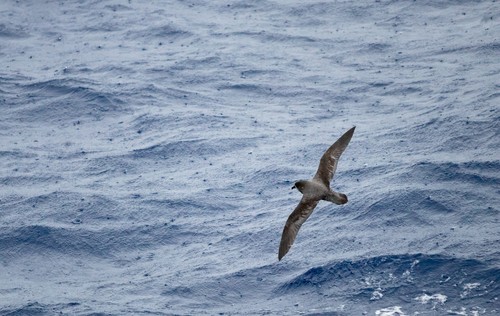 Murphy's Petrel
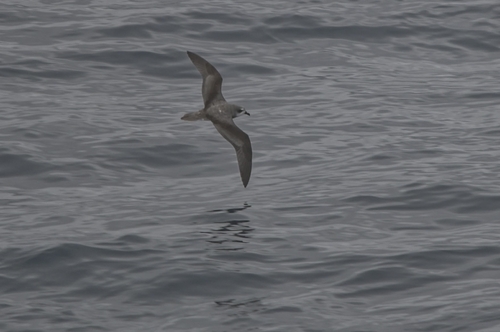 Soft-plumaged Petrel
In short
The most reliable way to separate Murphy's Petrel from Soft-plumaged Petrel is plumage: Murphy's is almost entirely dark sooty-grey with only a pale chin, while Soft-plumaged Petrel shows a strong contrast between dark upperparts and a mostly white underside, with white cheeks and throat. In flight, Soft-plumaged Petrel's narrow wings and pointed tail also stand out, especially when compared to the more uniformly dark Murphy's. Both species have pinkish legs, but only Soft-plumaged Petrel shows black on the outer webs and toes. Structural and size differences are subtle, so focus on plumage contrasts, especially in the head, underparts, and wing pattern.
Identification tips
- Overall plumage tone: Murphy's Petrel is almost entirely dark sooty-grey, with only a pale chin; Soft-plumaged Petrel is much more contrasting, with dark upperparts and mostly white underparts. This is the single most reliable field mark at any distance and in any light.
- Head pattern: Soft-plumaged Petrel shows a dark grey head with prominent white cheeks and throat, white speckling on the forehead, and a bold dark eye patch. Murphy's Petrel lacks these contrasts, appearing uniformly dark with a pale chin at most.
- Underparts: Soft-plumaged Petrel has a mostly white underside, sharply contrasting with its upperparts and underwings. Murphy's Petrel is dark below as well, except for the chin.
- Wing and tail shape in flight: Soft-plumaged Petrel has narrow wings and a pointed tail, which can be distinct in flight. Murphy's Petrel's wings and tail do not show these features as distinctly.
- Leg color and pattern: Both species have pinkish legs, but only Soft-plumaged Petrel has black on the outer webs and toes. This is a subtle mark, best seen in good light or on close photos.
- Bill: Soft-plumaged Petrel's bill is black, sharply hooked, and about 25–32 mm long. Murphy's Petrel's bill is not described as a field mark, so do not rely on this feature unless seen very well.
- Sexual dimorphism: Neither species shows sexual dimorphism; all field marks apply to both sexes.
- Juvenile/immature birds: No age-specific wing or upperwing pattern is described for either species, so use the same marks for all ages.
- Dark morph Soft-plumaged Petrel: Even the dark morph of Soft-plumaged Petrel shows more contrast than Murphy's Petrel, especially on the face and underparts. Beware of confusing very dark individuals, but look for any sign of white on the cheeks or throat.
- Size and structure: Murphy's Petrel is slightly heavier, but this is not a reliable field mark in the field. Both are medium-sized petrels with similar proportions.
- Flight style: Soft-plumaged Petrel's narrow wings and pointed tail may give it a more agile or buoyant flight, but this is subtle and best used as supporting evidence.
- Vocalizations: Only Soft-plumaged Petrel is described as vocal, but calls are rarely heard at sea. Do not rely on voice for field separation unless at a breeding colony.
- Context and range: Both species are pelagic and overlap in oceanic habitats; do not use location alone for identification.
- Pitfalls: The main pitfall is overlooking the white on Soft-plumaged Petrel's face and underparts, or overestimating the darkness of Murphy's Petrel. Always look for contrast, especially on the head and belly.
- Lighting and distance: In poor light or at great distance, both may appear dark. Use multiple features—especially the presence or absence of white on the face and underparts—before making an identification.
Size
Murphy's Petrel is slightly heavier (about 360 g) compared to Soft-plumaged Petrel (about 300 g) [wikipedia][wikidata], but this difference is not likely to be obvious in the field. Both are medium-sized gadfly petrels, and their overall length and wingspan are similar (Murphy's: 38–41 cm length, 97 cm wingspan). Structural differences are subtle and not reliable for field separation at a distance.
Plumage
-
Adults and all ages: Murphy's Petrel is almost uniformly dark sooty-grey, with only a pale chin breaking the darkness; there is no strong contrast between upperparts and underparts. Soft-plumaged Petrel, by contrast, has a dark grey head with prominent white on the cheeks and throat, white speckling on the forehead, and a bold dark eye patch. Its underparts are mostly white, sharply contrasting with the dark upperparts and underwings. The wings are narrow and the tail is pointed, especially noticeable in flight. The bill of Soft-plumaged Petrel is black and hooked, while Murphy's is less distinctly described but not noted as a field mark. Both have pinkish legs, but only Soft-plumaged Petrel has black on the outer webs and toes. Soft-plumaged Petrel also has a dark morph, but even this morph shows more contrast than Murphy's overall uniform darkness.
-
Juvenile/immature plumage: No specific juvenile or immature wing pattern is described for either species, so rely on the adult-like contrasts above for all ages.
Behaviour
Both species are pelagic gadfly petrels and are likely to be seen gliding low over the ocean. Murphy's Petrel is noted for taking long feeding trips during incubation, but this is not a field mark. In flight, Soft-plumaged Petrel's narrow wings and pointed tail may give it a slightly more buoyant or agile appearance, but behavioral differences are subtle and not reliable for quick field separation.
Habitat
Both species are oceanic and occur in similar pelagic habitats. Habitat is not a reliable separator between these two species in the field.
Voice
Only Soft-plumaged Petrel is described as vocal, with medium-pitched moans and shrill squeaks. Murphy's Petrel's voice is not described in the available notes. However, vocalizations are rarely heard at sea and are not a practical field mark for most observers.