

Moustached Warbler vs Common Reed Warbler
Acrocephalus melanopogon versus Acrocephalus scirpaceus
Play a quiz with Moustached Warbler and Common Reed Warbler
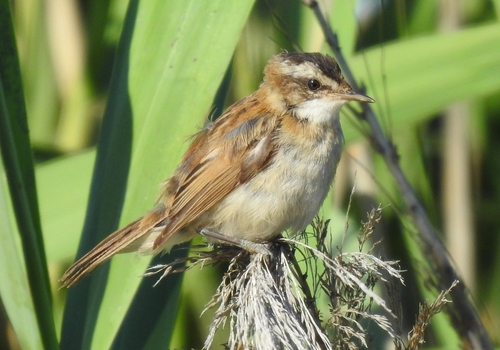 Moustached Warbler
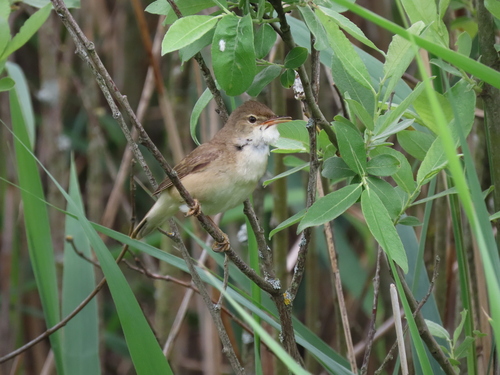 Common Reed Warbler
In short
The most reliable field mark between Moustached Warbler and Common Reed Warbler is the presence of fine streaking on the back and sometimes breast of Moustached Warbler, especially in juveniles and immatures, versus the completely unstreaked brown back of Common Reed Warbler of all ages. Moustached Warbler also shows a more prominent whitish supercilium and grey ear coverts, while Common Reed Warbler's face is plainer. Both species are similar in size and structure, but subtle differences in plumage and song can help separate them, especially when seen well or heard. Juvenile and immature birds are the main pitfall, as young Moustached Warblers can be especially streaky below, while young Common Reed Warblers are richer buff but never streaked.
Identification tips
- Back streaking is key: Look for fine streaks on the back—present in all ages of Moustached Warbler, absent in Common Reed Warbler. This is the most reliable field mark, especially in good light.
- Juvenile breast streaking: Juvenile Moustached Warblers often show streaks on the breast, while juvenile Common Reed Warblers are plain below (though richer buff in tone).
- Supercilium and face: Moustached Warbler has a prominent whitish supercilium and contrasting grey ear coverts, giving a more marked facial pattern. Common Reed Warbler's supercilium is weaker, and the face is plainer brown.
- Underparts color: Moustached Warbler adults are white below; Common Reed Warbler adults are buff below. Juvenile Common Reed Warbler is especially rich buff, but never streaked.
- Ear coverts: Grey ear coverts are a subtle but useful feature of Moustached Warbler, contrasting with the supercilium; Common Reed Warbler's ear coverts are not distinct from the rest of the face.
- Bill shape and size: Both have strong, pointed bills of similar size and shape; not a useful separation point.
- Song differences: Moustached Warbler's song is softer, faster, and more melodious, with nightingale-like phrases and no flight song. Common Reed Warbler's song is slower, chattier, and less musical.
- Flight and wing pattern: No distinctive upperwing or flight marks for either species are noted; do not rely on wing pattern in flight.
- Perched jizz: Both species perch similarly on reed stems; posture and movement are not reliable for separation.
- Habitat overlap: Both can be found in the same reedbed habitats; do not use habitat alone to separate them where ranges overlap.
- Season and range: If in southern Europe or southern Asia, consider Moustached Warbler; if further north or in sub-Saharan Africa in winter, Common Reed Warbler is more likely. However, both can occur together in southern Europe.
- Sex differences: Both sexes are alike in both species; do not use sex as a field mark.
- Size: Moustached Warbler is slightly smaller, but the difference is subtle and not reliable in the field.
- Confusion risk: Young Moustached Warblers are the main pitfall due to their streaked appearance; always check for streaking above and below when dealing with a juvenile Acrocephalus in southern Europe or Asia.
- When in doubt: If the bird is plain brown above and below (even if rich buff), and lacks a strong supercilium and grey ear coverts, Common Reed Warbler is more likely. If there is any streaking or a marked face, suspect Moustached Warbler.
Size
Both species are very similar in size, with Moustached Warbler slightly smaller (12–13 cm) compared to Common Reed Warbler (13 cm). Both have similar proportions and structure, with no major difference in bill size or wing shape noted in the sources. Body mass for Common Reed Warbler is about 12 g; no mass given for Moustached Warbler, but it is expected to be similar or slightly less. Size alone is not a reliable field mark between these two.
Plumage
- Juvenile/immature birds: Moustached Warbler juveniles are heavily streaked above and often show streaking on the breast, which can be quite bold. In contrast, juvenile Common Reed Warblers are never streaked above or below; instead, they are a richer buff color on the underparts but remain plain brown above.
- Adults: Adult Moustached Warbler has a finely streaked brown back, white underparts, a prominent whitish supercilium, and grey ear coverts. Adult Common Reed Warbler is unstreaked brown above, with buff underparts and a much less distinct supercilium; the face is generally plainer and lacks the grey tones.
- Face pattern: Moustached Warbler's supercilium is more prominent and contrasts with the grey ear coverts, while Common Reed Warbler's supercilium is weaker and the ear coverts blend into the face.
- No mention of distinctive upperwing or flight marks for either species in the sources.
Behaviour
Both species are typical Acrocephalus warblers, often skulking in dense reeds and sedges. No major behavioral differences are noted in the sources. Moustached Warbler does not sing in flight, while Common Reed Warbler may sing from exposed perches but is not noted for flight song either. Both may be seen clinging to reed stems or moving through low vegetation.
Habitat
Both species breed in reedbeds and similar wetland habitats. Moustached Warbler is more restricted to southern Europe, southern temperate Asia, and northwest Africa, while Common Reed Warbler is widespread across Europe and the western Palearctic, wintering in sub-Saharan Africa. In areas of overlap, both can occur in the same reedbed habitats, making habitat alone unreliable for separation.
Voice
Moustached Warbler's song is fast, soft, and more melodious than Common Reed Warbler, often including nightingale-like phrases and some mimicry. It does not sing in flight. Common Reed Warbler's song is slower, a chattering 'jit-jit-jit' with typical Acrocephalus whistles and mimicry, but less musical overall. Both can mimic other species, but the overall tone and pace are subtly different, with Moustached Warbler being softer and more varied.