

Common Reed Warbler
Acrocephalus scirpaceus
Reed Warblers and Allies (Acrocephalidae) · Passeriformes · Reed Warblers and Allies
Play a quiz with Common Reed Warbler and similar species
View all photos, video and sound
Reviewed
How to identify Common Reed Warbler
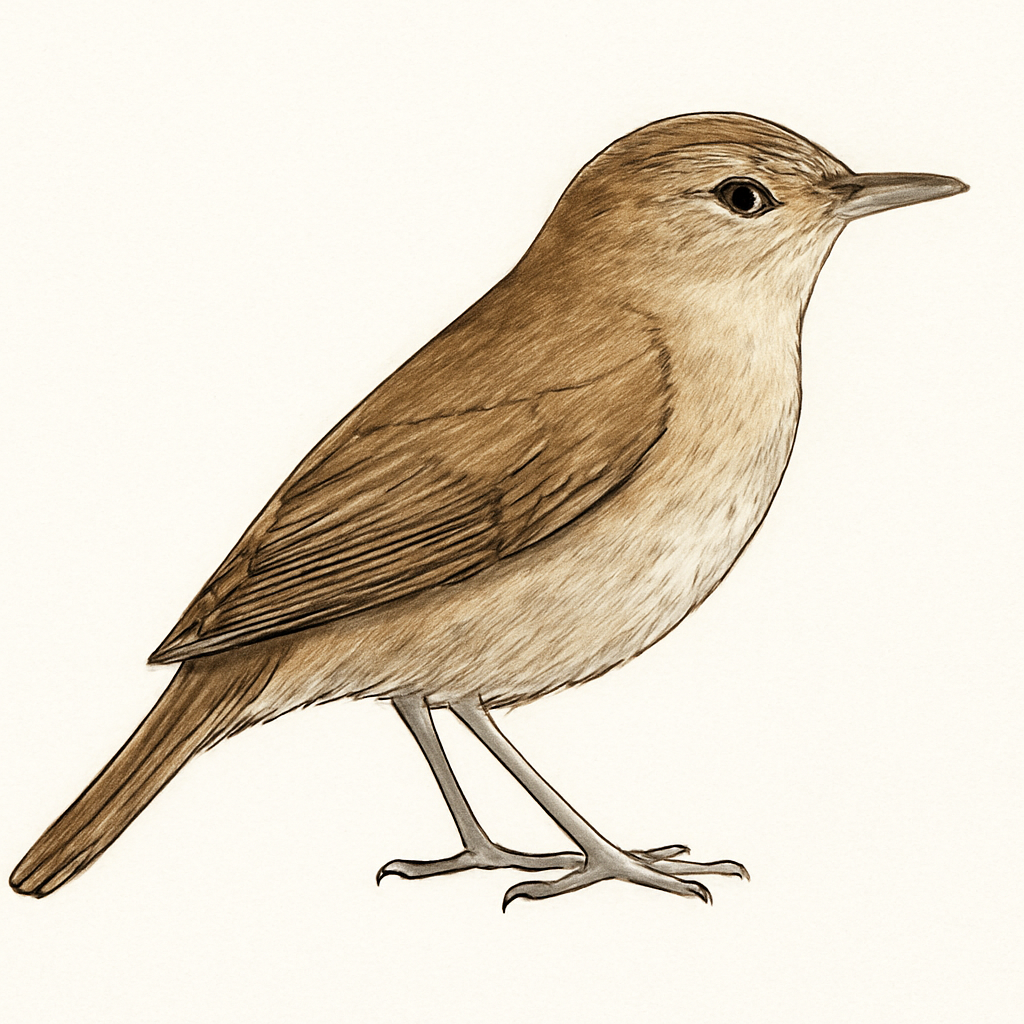
The Common Reed Warbler is a plain, medium-sized warbler with unstreaked brown upperparts and buff underparts, lacking a strong supercilium.
The Common Reed Warbler is a medium-sized, slender warbler with a flattened forehead and a strong, pointed bill. Adults show plain, unstreaked brown upperparts and warm buff underparts, with no strong facial markings. The sexes look alike, while juveniles are similar but show a richer buff tone below.
The bird's back is uniform brown, and the underparts are clean and unmarked, helping to separate it from streaked or boldly marked warblers. The face is plain, lacking a pronounced supercilium (eyebrow), and the overall impression is of a rather featureless, warm-toned warbler. The wings are also plain, without obvious wing bars or pale edges.
Its song is a slow, chattering sequence with 'jit-jit-jit' notes, interspersed with acrocephaline whistles and some mimicry. This vocalization, along with its preference for reedbeds, can help confirm identification.
Similar species
- Marsh Warbler: Common Reed Warbler has plainer, browner upperparts and buff underparts, while Marsh Warbler is often greener above and whiter below; Marsh Warbler also has a more varied, imitative song. → How to tell them apart
- Great Reed Warbler: Much larger and bulkier, with a much stronger supercilium and a heavier bill than Common Reed Warbler. → How to tell them apart
- Sedge Warbler: Sedge Warbler has a bold pale supercilium and often shows dark streaks on the back, unlike the plain-faced, unstreaked Common Reed Warbler. → How to tell them apart
- Blyth's Reed Warbler: Blyth's Reed Warbler is generally colder brown above and greyer below, with shorter primary projection and a more rounded wing-tip than Common Reed Warbler. → How to tell them apart
- Aquatic Warbler: Aquatic Warbler shows a strong pale crown stripe and bold streaking on the back, both absent in Common Reed Warbler. → How to tell them apart
- Savi's Warbler: Savi's Warbler is more uniformly brown above and below, with no contrast between upper- and underparts, and lacks the buff underparts of Common Reed Warbler. → How to tell them apart
Often mixed up with
In quizzes, players most often confuse Common Reed Warbler with these birds—either this species was picked by mistake, or the other way around.
| Species | Mix-ups |
|---|---|
| Marsh Warbler Acrocephalus palustris | 913 |
| Great Reed Warbler Acrocephalus arundinaceus | 312 |
| Sedge Warbler Acrocephalus schoenobaenus | 228 |
| Savi's Warbler Locustella luscinioides | 215 |
| Blyth's Reed Warbler Acrocephalus dumetorum | 173 |
Family
The Acrocephalidae (the reed warblers, marsh- and tree-warblers, or acrocephalid warblers) are a family of oscine passerine birds, in the superfamily Sylvioidea. The species in this family are usually rather large "warblers". Most are rather plain olivaceous brown above with much yellow to beige below.
Order
A passerine () is any bird of the order Passeriformes (; from Latin passer 'sparrow' and formis '-shaped'), which includes more than half of all bird species. Sometimes known as perching birds, passerines generally have an anisodactyl arrangement of their toes (three pointing forward and one back), which facilitates perching. With more than 140 families and some 6,500 identified species, Passeriformes is the largest order of birds and one of the most diverse clades of terrestrial vertebrates, representing 60% of …