

Mourning Dove vs Purple Martin
Zenaida macroura versus Progne subis
Play a quiz with Mourning Dove and Purple Martin
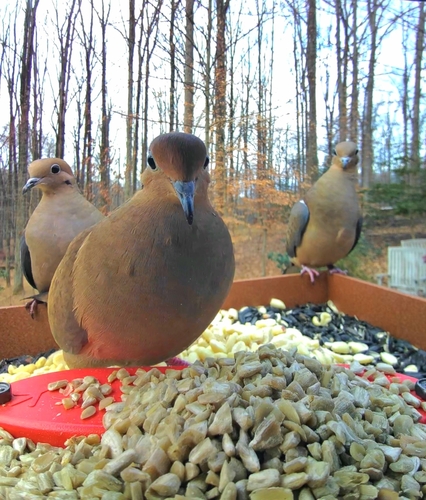 Mourning Dove
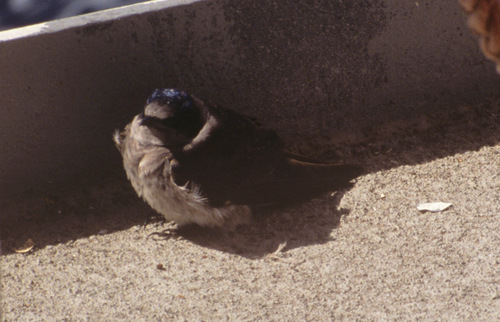 Purple Martin
In short
The most reliable way to separate Mourning Dove from Purple Martin is by overall shape and plumage: Mourning Dove is a slender, long-tailed dove with pale, soft brown tones and black-spotted wings, while Purple Martin is a chunky, short-tailed swallow with glossy blue-black (male) or dusky and pale (female/immature) plumage. Mourning Doves show a long, pointed tail with white edges in flight, whereas Purple Martins have a slightly forked, much shorter tail. Juvenile Mourning Doves appear scaly and dark, unlike any Purple Martin. Behavior and context also help: doves perch upright and walk on the ground, martins are nearly always seen flying or perching on wires/houses. Voice is very different: doves coo, martins chatter.
Identification tips
- Tail shape and pattern in flight: Mourning Dove shows a long, pointed tail with white outer edges and black centers, obvious in all ages and especially in flight. Purple Martin's tail is short and only slightly forked, never pointed or with white edges.
- Juvenile plumage: Juvenile Mourning Doves are dark and scaly above, with black wing spots—no Purple Martin of any age is scaly or spotted like this.
- Adult male color: Adult male Purple Martin is glossy blue-black all over, with no brown or pale areas. Mourning Dove is always soft brownish-gray, never glossy or black.
- Adult female/immature martin: Female and immature Purple Martins are dusky above with some blue sheen and pale below, but never show the dove's pinkish wash, black wing spots, or long white-edged tail.
- Wing pattern: Mourning Dove has black spots on the wings (adults and juveniles); Purple Martin's wings are plain and unmarked in all ages.
- Bill shape: Mourning Dove has a short, dark, slightly decurved bill typical of doves; Purple Martin has a short, broad, flat bill suited for catching insects.
- Leg color: Mourning Dove has short, reddish legs; Purple Martin's legs are dark and less noticeable, rarely seen except when perched.
- Perching posture: Mourning Doves perch upright and often walk on the ground; Purple Martins perch more horizontally and are rarely seen on the ground.
- Flight style: Mourning Dove flies with strong, direct wingbeats and glides, often showing the long tail; Purple Martin is agile, with rapid flapping and gliding, and a short tail.
- Habitat context: Mourning Doves are common in open areas, parks, and on the ground; Purple Martins are usually near water, in open areas with nest boxes, and rarely on the ground.
- Vocalization: Mourning Dove gives a slow, mournful coo; Purple Martin gives rapid, chattering calls. If you hear a coo, it's a dove.
- Size impression: Mourning Dove is much larger and heavier than Purple Martin, but this is most obvious when seen side-by-side.
- Sex differences: Mourning Dove males have a bluish crown and iridescent neck patches; Purple Martin males are uniformly glossy blue-black, females/immatures are never as brown as a dove.
- Seasonal context: In migration, Purple Martins may be seen in large flocks; Mourning Doves are present year-round in most areas and do not form such dense aerial flocks.
- Common pitfalls: Female/immature martins can look brownish from a distance, but never show the dove's tail shape, wing spots, or upright posture.
Size
Mourning Dove is much larger and heavier: about 31 cm (12 in) long with a 37–45 cm wingspan, and weighing 112–170 g (typically 128 g) [wikipedia]. Purple Martin is smaller and lighter: 19–20 cm (7.5–7.9 in) long, wingspan 39–41 cm, and weighs 45–60 g [wikidata, wikipedia]. This size difference is obvious in direct comparison, but less so at a distance or with lone birds.
Plumage
Juvenile Mourning Doves are dark and scaly overall, with black spots on the wings and a long, pointed tail with white edges—this scaly look is unique and not matched by any Purple Martin age. Adult Mourning Doves are soft gray-brown above, with a pinkish wash below, black wing spots, and a long, tapered tail with white outer feathers and black inner feathers. Adult male Mourning Doves have a bluish crown and iridescent purple-pink neck patches; females are browner and duller. Purple Martins are sexually dimorphic: adult males are entirely glossy blue-black, with no pale or brown areas, while adult females and immatures are dusky above with some blue sheen, and pale below. Subadult males and females can be browner above, but never show the dove's scaly or spotted pattern, nor the long pointed tail with white edges. Martins have a short, slightly forked tail and lack any wing spots or scaly pattern.
Behaviour
Mourning Doves perch upright on wires, branches, or the ground, often walking or feeding on seeds. Their flight is strong and direct, with broad, elliptical wings and a long, pointed tail. Purple Martins are highly aerial, rarely seen on the ground, and are most often observed in fast, agile flight catching insects, or perched in groups on wires or martin houses. Their flight is rapid, with frequent gliding and swooping, and their tail is short and only slightly forked.
Habitat
Mourning Doves are widespread and common in open habitats, suburbs, farmland, and city parks. They are often seen on the ground or perched in open areas. Purple Martins breed in open areas near water, especially where there are nest boxes or martin houses, and are rarely seen away from such sites during the breeding season. Outside breeding, martins form large aerial flocks and are mostly seen in flight.
Voice
Mourning Dove gives a slow, mournful cooing: cooOOoo-wooo-woo-woooo, often mistaken for an owl at a distance. Purple Martin gives a series of rapid, chattering notes and gurgles, never a slow coo. The two are very different and not easily confused by ear.