

Mexican Violetear vs Amethyst-throated Mountain-gem
Colibri thalassinus versus Lampornis amethystinus
Play a quiz with Mexican Violetear and Amethyst-throated Mountain-gem
 Mexican Violetear
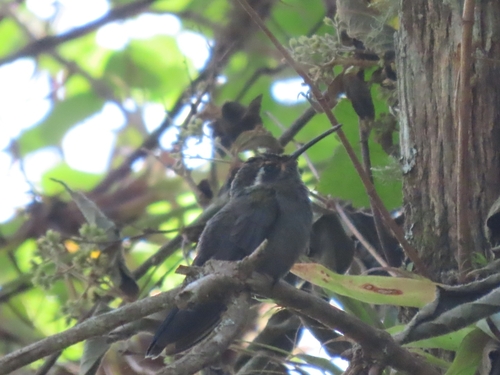 Amethyst-throated Mountain-gem
In short
The most reliable field mark to separate Mexican Violetear from Amethyst-throated Mountain-gem is the throat color: Mexican Violetear of all ages shows a glittering green throat and chest, while adult male Amethyst-throated Mountain-gem has a brilliant rosy pink (or violet to royal blue in some subspecies) gorget and females/juveniles show a cinnamon or duller throat. In addition, Mexican Violetear has a prominent violet ear-patch and a metallic blue-green tail with a black subterminal band, while the mountain-gem has a whitish post-ocular stripe, dark auriculars, and a broad, slightly forked black tail with gray tips. Structurally, the mountain-gem is bulkier, with a slightly longer body and a broader tail, and often shows a pale buff undertail. Both species overlap in range in Mexico, but the mountain-gem is more restricted to higher elevation montane forests. If you see a hummingbird with a green throat and violet ear-patch, it's a violetear; if the throat is rosy, cinnamon, or violet and there's a white stripe behind the eye, it's the mountain-gem.
Identification tips
- Throat color is key: Mexican Violetear always shows a glittering green throat and chest; adult male Amethyst-throated Mountain-gem has a brilliant rosy pink, reddish purple, or violet/blue gorget (depending on subspecies), while females and juveniles have a cinnamon or duller throat. This is the single most reliable mark for all ages.
- Violet ear-patch: Only the violetear has a prominent violet patch on the sides of the neck; the mountain-gem lacks this feature entirely.
- White post-ocular stripe: Amethyst-throated Mountain-gem of all ages and sexes shows a distinct whitish stripe behind the eye, contrasting with dark auriculars. Mexican Violetear never shows this feature.
- Tail pattern: Mexican Violetear has a metallic blue-green tail with bronzy central feathers and a bold black subterminal band. Mountain-gem's tail is black with gray tips on the outer feathers and is slightly forked; it lacks the metallic blue-green and bronzy tones.
- Undertail coverts: Mountain-gem shows pale buff undertail coverts, especially in females and juveniles; violetear's undertail is shining green, matching the belly.
- Bill shape: Both have straight black bills, but the violetear's is slightly more decurved. This is subtle and rarely diagnostic in the field.
- Crown and back: Violetear is shining green above; mountain-gem males have a dark green crown and back with a bronze rump, and some subspecies show more bronzy green or purple rumps.
- Size and structure: Mountain-gem is slightly larger and bulkier, with a broader, slightly forked tail, but this is only apparent with direct comparison.
- Sexual dimorphism: Mountain-gem shows strong sexual dimorphism in throat color (brilliant gorget in males, cinnamon/dull in females); violetear sexes are similar.
- Juvenile/immature confusion: Juvenile mountain-gems resemble females but may show a few pink gorget feathers; violetear juveniles look like adults, with green throats and violet ear-patch.
- Subspecies variation: Mountain-gem subspecies can shift gorget color (L. a. margaritae males have violet to royal blue gorgets and are darker overall), but always lack the violetear's violet ear-patch and green throat.
- Habitat context: In high-elevation pine-oak or evergreen forest, especially above 900 m, mountain-gem is more likely; violetear is more widespread and can occur at lower elevations or in a wider range of forest types.
- Vocalizations: If you hear a quiet, complex chatter or a series of shrill whistles, it's the mountain-gem. Violetear's song is not described here.
- Display behavior: Mountain-gem males perform aerial display flights in circles and dives; violetear's display is not described.
- Pitfalls: Do not rely on overall green coloration or size alone, as both are medium-sized, greenish hummingbirds. Focus on throat color, ear-patch, and face pattern for reliable separation.
Size
Mexican Violetear is a medium-sized hummingbird, measuring 9.7–12 cm in length and weighing 4.8–5.6 g. Amethyst-throated Mountain-gem is slightly larger and heavier overall: 11.5–12.5 cm long, with males weighing 5–7.8 g and females 5–5.8 g. The mountain-gem is thus a bit bulkier and longer, especially in males, but the size difference is subtle and not always reliable in the field unless both are seen side by side. Both have straight, medium-length black bills, but the violetear's bill is slightly more decurved.
Plumage
No age-specific upperwing or flight pattern marks are described for either species, so separation relies on head, throat, and tail features. Mexican Violetear of all ages is shining green above, with a glittering green throat and chest, a prominent violet ear-patch on the side of the neck, and a metallic blue-green tail with bronzy central feathers and a bold black subterminal band. Amethyst-throated Mountain-gem adult males have a dark green crown and back, bronze rump, blackish uppertail coverts, and a brilliant rosy pink (or violet/blue in some subspecies) gorget; the tail is black with gray tips and slightly forked. Females and juveniles have a cinnamon or duller throat, dark auriculars, a whitish post-ocular stripe, and a pale buff undertail. Subspecies variation in the mountain-gem can shift gorget color from reddish purple to violet/royal blue (especially in L. a. margaritae), and both sexes of this subspecies are much darker overall. The violetear never shows a white post-ocular stripe, cinnamon throat, or black tail with gray tips.
Behaviour
Both species feed on nectar and are active, but the mountain-gem is less territorial and often seen performing display flights with parallel, circular movements and dives, especially during courtship. The violetear's behavior is less described here, but it is typically found in forested areas and may move seasonally. The mountain-gem may be seen at forest edges and in the interior, often perching conspicuously. These behavioral differences are subtle and not always diagnostic in the field.
Habitat
Mexican Violetear is found in forested areas from Mexico to Nicaragua, often at a variety of elevations, and can wander widely, sometimes appearing far north of its usual range. Amethyst-throated Mountain-gem is more restricted to montane evergreen and pine-oak forests from 900–3,000 m elevation in Mexico, Guatemala, Honduras, and El Salvador. In Mexico, the mountain-gem is more likely at higher elevations and in denser montane forest, while violetear can be found in a broader range of wooded habitats, including lower elevations. Overlap is possible in Mexican mountains, but context can help: a hummingbird in high-elevation pine-oak forest is more likely to be a mountain-gem.
Voice
The mountain-gem's song is a quiet, complex chatter with a two-syllable introductory phrase and up to nine complex phrases, sung by both sexes. It also gives a persistent buzzing feeding call, a series of short, rapid clicking territorial calls, and a display call of 7–10 shrill whistles. No vocalization details are provided for Mexican Violetear here, so song is only diagnostic if you hear the mountain-gem's distinctive chatter or display calls.
Mexican Violetear · Amethyst-throated Mountain-gem · My Tricky Birds