

Mealy Amazon vs Sulphur-winged Parakeet
Amazona farinosa versus Pyrrhura hoffmanni
Play a quiz with Mealy Amazon and Sulphur-winged Parakeet
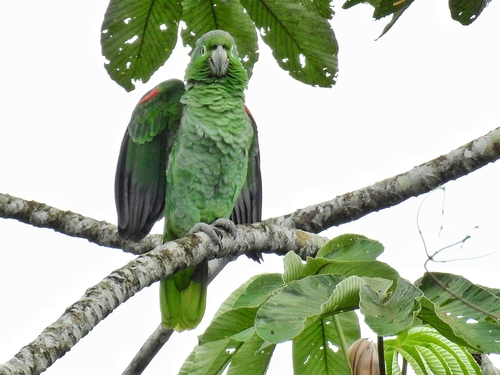 Mealy Amazon
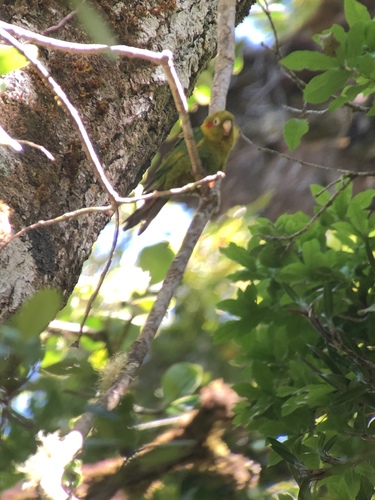 Sulphur-winged Parakeet
In short
The most reliable way to separate Mealy Amazon from Sulphur-winged Parakeet is by size and overall structure: Mealy Amazon is an exceptionally large, heavy-bodied parrot with a short, square tail, while Sulphur-winged Parakeet is much smaller and slimmer, with a proportionally longer tail. In flight, adult Mealy Amazons show a broad bluish-black trailing edge and a red speculum on the wing, whereas Sulphur-winged Parakeets display yellow primary coverts and blue outer primaries, but lack the heavy trailing edge. Perched, Mealy Amazons have a pale, 'flour-dusted' look with a whitish nape and back, while Sulphur-winged Parakeets are bright green with yellow and orange touches on the head and breast. Even at a distance, the difference in bulk and tail shape is striking. Vocalizations are also distinct: Mealy Amazons have deep, harsh calls, while Sulphur-winged Parakeets give high-pitched, shrill notes.
Identification tips
- Size and bulk: Mealy Amazon is more than twice as heavy and much longer than Sulphur-winged Parakeet. If the bird appears massive, thick-necked, and broad-winged, it's a Mealy Amazon; if slim, small, and long-tailed, it's a Sulphur-winged Parakeet. This is the most reliable field mark in all ages and seasons.
- Tail shape: Mealy Amazon has a short, square tail, typical of Amazona parrots. Sulphur-winged Parakeet has a proportionally longer, more pointed tail. This is obvious in flight and when perched.
- Flight pattern: Mealy Amazon flies with deep, slow wingbeats, appearing heavy and deliberate. Sulphur-winged Parakeet is much more agile and rapid in flight, with quick, shallow wingbeats.
- Adult wing pattern (in flight): Mealy Amazon shows a broad bluish-black trailing edge to the wing and a red speculum (red patch on the wing), best seen in good light. Sulphur-winged Parakeet lacks the trailing edge; instead, look for yellow primary coverts and inner primaries, blue outer primaries, and no red speculum. Works best for adults.
- Juvenile/immature plumage: Immature Sulphur-winged Parakeets are duller, with less yellow on the wings and less orange on the breast. Mealy Amazon immatures are not described in detail, but the 'mealy' whitish tinge is present in most ages.
- Head and face: Mealy Amazon may show a few yellow feathers on the crown, but never as much as Yellow-crowned Amazon. It has a broad white eye-ring and a pale, frosted look to the nape and back. Sulphur-winged Parakeet has yellow inclusions on the head and nape, bright terracotta ear coverts, and a white eye-ring, but the head is never frosted or 'mealy.'
- Breast color: Mealy Amazon is plain green below. Sulphur-winged Parakeet has a dull orange wash on the breast (adults), which can be a subtle but helpful mark at close range.
- Tail color: Mealy Amazon's tail is bi-colored: green at the base, paler yellow at the tip. Sulphur-winged Parakeet's tail is rufous-olive above with green fringes and reddish-brown below.
- Bill size and shape: Mealy Amazon has a large, heavy bill typical of Amazona parrots. Sulphur-winged Parakeet's bill is much smaller and more delicate.
- Vocalizations: Mealy Amazon gives deep, harsh calls, especially at dawn and dusk. Sulphur-winged Parakeet gives high-pitched, shrill "krree krree krree" calls, often in noisy flocks. If you hear a shrill, piercing chatter, it's the parakeet.
- Habitat and elevation: Mealy Amazon is a lowland forest bird; Sulphur-winged Parakeet is a montane species, usually above 1600 m. If you're in highland forest, expect Sulphur-winged Parakeet; in lowland humid forest, Mealy Amazon.
- Social behavior: Mealy Amazons are often in large, slow-moving flocks or pairs, sometimes with macaws. Sulphur-winged Parakeets are in small, active flocks, often chattering in flight.
- Perched posture: Mealy Amazon appears upright, heavy, and broad-chested. Sulphur-winged Parakeet is more horizontal, slim, and active.
- Feeding habits: Both eat fruits and seeds, but Mealy Amazon may be seen feeding on crops (especially corn) in lowland plantations; Sulphur-winged Parakeet forages in the canopy of montane forests.
- Pitfalls: Rarely, Mealy Amazon may lack obvious yellow on the crown, and Sulphur-winged Parakeet immatures may lack yellow on the wings. Always check size, structure, and wing/tail pattern in flight for confirmation.
Size
Mealy Amazon is among the largest Amazona parrots, measuring 38–41 cm in length and weighing 540–700 g (often heavier in captivity) [wikipedia]. In contrast, Sulphur-winged Parakeet is much smaller at 23–24 cm and about 82 g [wikidata]. The difference is dramatic in the field: Mealy Amazon appears massive and broad, with a thick bill and short, square tail, while Sulphur-winged Parakeet is slim, light, and long-tailed. Even without direct comparison, the Mealy Amazon's bulk and size are unmistakable among Neotropical parrots.
Plumage
- Juvenile/immature wing pattern: No specific juvenile upperwing pattern is described for either species, but age-related dullness is noted for Sulphur-winged Parakeet (immatures have duller scaling, less orange on breast, and much less yellow on wings) [wikipedia].
- Adult Mealy Amazon: Mainly green with a characteristic whitish or 'mealy' tinge on the back and nape, giving a frosted look. In flight, shows a bluish-black trailing edge to the wing and a conspicuous red speculum. Tail is distinctly bi-colored: basal half green, distal half paler yellow. Occasional yellow feathers on the crown, but much less than Yellow-crowned Amazon. Broad white eye-ring [wikipedia].
- Adult Sulphur-winged Parakeet: Mostly green, but with yellow inclusions on head, nape, and throat; bright terracotta ear coverts; dull orange wash on breast; yellow primary coverts and inner primaries, blue outer primaries; tail upperside rufous-olive with green fringes, underside reddish-brown. Immatures are duller overall, with less yellow and orange [wikipedia].
- Key contrast: Mealy Amazon's 'flour-dusted' look and bi-colored tail are unique. Sulphur-winged Parakeet's yellow wing panels and blue primaries are distinctive in flight, but lack the heavy trailing edge and red speculum of Mealy Amazon.
Behaviour
Mealy Amazons are social, often seen in pairs or large flocks, and sometimes mix with other parrots like macaws. They are usually quiet but can be loud at dawn and dusk. In captivity, they are known for being gentle and calm [wikipedia]. Sulphur-winged Parakeets forage in small flocks, often in the forest canopy, and are generally more active and agile, with frequent flock movements and noisy flight calls. Both species can be seen in groups, but the parakeet's flocks are smaller and more frenetic, while Mealy Amazons are slower and heavier in flight.
Habitat
Mealy Amazon occurs in humid to semi-humid lowland forests and plantations across tropical Central and South America, rarely venturing into deciduous forest and absent from open/dry habitats except for gallery forest [wikipedia]. Sulphur-winged Parakeet is restricted to montane forests and adjacent shrubby or secondary growth in Costa Rica and western Panama, usually above 1600 m elevation [wikipedia]. Thus, Sulphur-winged Parakeet is a highland species, while Mealy Amazon is a lowland forest bird. Overlap is minimal except possibly at mid-elevations in southern Central America.
Voice
Mealy Amazon has a deep, harsh voice, typically not high-pitched, and is usually quiet except at dawn and dusk [wikipedia]. Sulphur-winged Parakeet gives a series of high-pitched, shrill notes ("krree krree krree"), both perched and in flight, and flocks can be noisy and piercing. The parakeet's calls are shrill but not screechy, and much higher-pitched than the Mealy Amazon's. If you hear a deep, harsh call, suspect Mealy Amazon; if you hear a shrill, rapid chatter, it's likely Sulphur-winged Parakeet.