

Motmot

Magnificent Frigatebird vs Great Frigatebird

Fregata magnificens versus Fregata minor

Play a quiz with Magnificent Frigatebird and Great Frigatebird
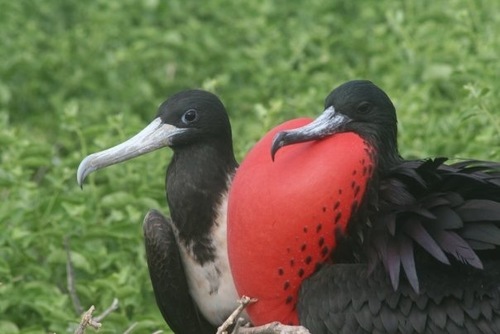
Magnificent Frigatebird (Fregata magnificens) Magnificent Frigatebird
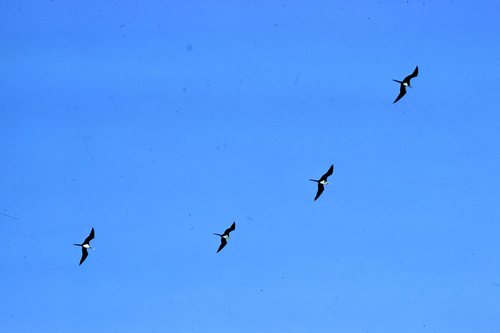
Great Frigatebird (Fregata minor) Great Frigatebird

Media

Loading…

In short

The most reliable field mark for separating Magnificent and Great Frigatebirds is the color of iridescence on adult males' scapular feathers: Magnificent shows a purple sheen, while Great shows green. For females and immatures, focus on the pattern and extent of white on the head, breast, and belly, as well as the color of the eye-ring: Magnificent females have a blue eye-ring and a more extensive white breast, while Great females have a red eye-ring and a white throat and breast. Juvenile Magnificent Frigatebirds have a distinctive diamond-shaped white belly patch, lacking in Great. Both species are very similar in structure and flight, but Magnificent is slightly larger overall. In overlapping ranges, careful attention to these subtle plumage and soft part differences is essential.

Identification tips

  1. Juvenile underparts: Juvenile Magnificent Frigatebirds show a distinctive diamond-shaped white belly patch, lacking in Great. This is the most reliable mark for immatures in flight.
  2. Adult male scapular iridescence: In good light, Magnificent males show a purple sheen on the scapulars, while Great males show green. This is subtle and requires close views.
  3. Female eye-ring color: Magnificent females have a blue eye-ring; Great females have a red eye-ring. This is best seen at close range or in photos.
  4. Female breast pattern: Magnificent females have a white breast and lower neck sides, often with a brown band on the wings. Great females have a white throat and breast but lack the brown wing band.
  5. Juvenile head and throat: Great Frigatebird juveniles have a rust-tinged white face, head, and throat, while Magnificent juveniles have a whiter head and underparts without the rusty tinge.
  6. Size: Magnificent is slightly larger overall, but this is rarely useful unless birds are side by side.
  7. Gular sac: Both males have a red inflatable throat pouch in breeding season; this is not a separating feature.
  8. Flight structure: Both species have extremely long, narrow wings and a deeply forked tail; structural differences are minimal and not reliable for separation.
  9. Upperwing pattern: No strong difference in upperwing pattern for adults; both are uniformly dark above.
  10. Range: If seen in the Americas (especially Atlantic coast), Magnificent is more likely; in the central Pacific or Indian Ocean, Great is more likely. In Galápagos and some Atlantic islands, both occur—use plumage marks.
  11. Behavior: Both species soar and kleptoparasitize other seabirds. Only Great Frigatebird females are noted to hunt seabird chicks at colonies, but this is not a field mark.
  12. Perched views: Eye-ring color and breast pattern are most useful on perched females.
  13. Mixed flocks: In areas of overlap, carefully check each bird for the above marks; do not rely on flock composition alone.
  14. Voice: Not useful for separation in the field; both are silent in flight.
  15. Pitfalls: Immature birds are often misidentified; always look for the diamond-shaped belly patch (Magnificent) or rusty head (Great) in juveniles, and check eye-ring color and scapular sheen in adults when possible.

Size

Magnificent Frigatebird is the largest frigatebird, measuring 89–114 cm in length with a wingspan of 2.17–2.44 m and weighing 1.1–1.59 kg. Great Frigatebird is slightly smaller, at 85–105 cm in length, wingspan 2.05–2.30 m, and weight 1.0–1.59 kg (males lighter than females). In the field, this size difference is subtle and rarely diagnostic except in direct comparison, as both are large, long-winged, and deeply forked-tailed seabirds.

Plumage

Juveniles and immatures are best separated by underpart pattern: juvenile Magnificent Frigatebirds have a distinctive white diamond-shaped belly patch, while Great Frigatebird juveniles have a rust-tinged white face, head, and throat but lack the diamond belly. Adult males of both species are all-black with an inflatable red throat pouch, but the iridescence differs: Magnificent shows a purple sheen on scapulars, Great shows green. Adult females of Magnificent have a white breast and lower neck sides, a brown band on the wings, and a blue eye-ring; Great females have a white throat and breast, a red eye-ring, and lack the brown wing band. Both species' males have the red gular sac, but the surrounding feather iridescence is the key. In flight, both show long, narrow wings and a deeply forked tail, with no strong difference in upperwing pattern for adults.

Behaviour

Both species are highly aerial, spending days on the wing, and are silent in flight. They often soar on thermals and forage by snatching prey from the ocean surface or harassing other seabirds. Magnificent Frigatebird is noted for covering long distances and sometimes flying at very high speeds. Great Frigatebird females are known to hunt seabird chicks at colonies, a behavior not mentioned for Magnificent. Both species display the red gular sac during courtship, with males inflating it and displaying to attract females.

Habitat

Magnificent Frigatebird is found over tropical and subtropical waters off the Americas (Pacific: Mexico to Peru; Atlantic: Florida to southern Brazil, Galápagos, Cape Verde). Great Frigatebird is more widespread in the tropical Pacific (Hawaii, Galápagos), Indian Ocean (Seychelles, Mauritius), and has a small South Atlantic presence (St. Helena, Ascension). Where ranges overlap (notably Galápagos), careful ID is required. Both species are pelagic, rarely seen inland, and nest colonially on remote islands.

Voice

Both species are silent in flight. Magnificent Frigatebird makes various rattling sounds at the nest, but these are not useful for field separation at a distance or in flight. No distinctive vocal differences are described for Great Frigatebird in the sources.

Submit a better description

Use the same sections as the comparison. Your text is published immediately.

The most reliable field mark for separating Magnificent and Great Frigatebirds is the color of iridescence on adult males' scapular feathers: Magnificent shows a purple sheen, while Great shows green. For females and immatures, focus on the pattern and extent of white on the head, breast, and belly, as well as the color of the eye-ring: Magnificent females have a blue eye-ring and a more extensive white breast, while Great females have a red eye-ring and a white throat and breast. Juvenile Magnificent Frigatebirds have a distinctive diamond-shaped white belly patch, lacking in Great. Both species are very similar in structure and flight, but Magnificent is slightly larger overall. In overlapping ranges, careful attention to these subtle plumage and soft part differences is essential.

  1. Juvenile underparts: Juvenile Magnificent Frigatebirds show a distinctive diamond-shaped white belly patch, lacking in Great. This is the most reliable mark for immatures in flight.
  2. Adult male scapular iridescence: In good light, Magnificent males show a purple sheen on the scapulars, while Great males show green. This is subtle and requires close views.
  3. Female eye-ring color: Magnificent females have a blue eye-ring; Great females have a red eye-ring. This is best seen at close range or in photos.
  4. Female breast pattern: Magnificent females have a white breast and lower neck sides, often with a brown band on the wings. Great females have a white throat and breast but lack the brown wing band.
  5. Juvenile head and throat: Great Frigatebird juveniles have a rust-tinged white face, head, and throat, while Magnificent juveniles have a whiter head and underparts without the rusty tinge.
  6. Size: Magnificent is slightly larger overall, but this is rarely useful unless birds are side by side.
  7. Gular sac: Both males have a red inflatable throat pouch in breeding season; this is not a separating feature.
  8. Flight structure: Both species have extremely long, narrow wings and a deeply forked tail; structural differences are minimal and not reliable for separation.
  9. Upperwing pattern: No strong difference in upperwing pattern for adults; both are uniformly dark above.
  10. Range: If seen in the Americas (especially Atlantic coast), Magnificent is more likely; in the central Pacific or Indian Ocean, Great is more likely. In Galápagos and some Atlantic islands, both occur—use plumage marks.
  11. Behavior: Both species soar and kleptoparasitize other seabirds. Only Great Frigatebird females are noted to hunt seabird chicks at colonies, but this is not a field mark.
  12. Perched views: Eye-ring color and breast pattern are most useful on perched females.
  13. Mixed flocks: In areas of overlap, carefully check each bird for the above marks; do not rely on flock composition alone.
  14. Voice: Not useful for separation in the field; both are silent in flight.
  15. Pitfalls: Immature birds are often misidentified; always look for the diamond-shaped belly patch (Magnificent) or rusty head (Great) in juveniles, and check eye-ring color and scapular sheen in adults when possible.

Magnificent Frigatebird is the largest frigatebird, measuring 89–114 cm in length with a wingspan of 2.17–2.44 m and weighing 1.1–1.59 kg. Great Frigatebird is slightly smaller, at 85–105 cm in length, wingspan 2.05–2.30 m, and weight 1.0–1.59 kg (males lighter than females). In the field, this size difference is subtle and rarely diagnostic except in direct comparison, as both are large, long-winged, and deeply forked-tailed seabirds.

Juveniles and immatures are best separated by underpart pattern: juvenile Magnificent Frigatebirds have a distinctive white diamond-shaped belly patch, while Great Frigatebird juveniles have a rust-tinged white face, head, and throat but lack the diamond belly. Adult males of both species are all-black with an inflatable red throat pouch, but the iridescence differs: Magnificent shows a purple sheen on scapulars, Great shows green. Adult females of Magnificent have a white breast and lower neck sides, a brown band on the wings, and a blue eye-ring; Great females have a white throat and breast, a red eye-ring, and lack the brown wing band. Both species' males have the red gular sac, but the surrounding feather iridescence is the key. In flight, both show long, narrow wings and a deeply forked tail, with no strong difference in upperwing pattern for adults.

Both species are highly aerial, spending days on the wing, and are silent in flight. They often soar on thermals and forage by snatching prey from the ocean surface or harassing other seabirds. Magnificent Frigatebird is noted for covering long distances and sometimes flying at very high speeds. Great Frigatebird females are known to hunt seabird chicks at colonies, a behavior not mentioned for Magnificent. Both species display the red gular sac during courtship, with males inflating it and displaying to attract females.

Magnificent Frigatebird is found over tropical and subtropical waters off the Americas (Pacific: Mexico to Peru; Atlantic: Florida to southern Brazil, Galápagos, Cape Verde). Great Frigatebird is more widespread in the tropical Pacific (Hawaii, Galápagos), Indian Ocean (Seychelles, Mauritius), and has a small South Atlantic presence (St. Helena, Ascension). Where ranges overlap (notably Galápagos), careful ID is required. Both species are pelagic, rarely seen inland, and nest colonially on remote islands.

Both species are silent in flight. Magnificent Frigatebird makes various rattling sounds at the nest, but these are not useful for field separation at a distance or in flight. No distinctive vocal differences are described for Great Frigatebird in the sources.

Discard your changes?

You have unsaved edits. If you leave now, those changes will be lost.

Magnificent Frigatebird · Great Frigatebird · My Tricky Birds