

Long-billed Murrelet vs Pigeon Guillemot
Brachyramphus perdix versus Cepphus columba
Play a quiz with Long-billed Murrelet and Pigeon Guillemot
 Long-billed Murrelet
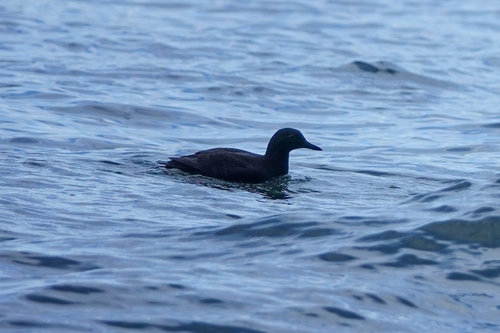 Pigeon Guillemot
In short
The most reliable field mark between Long-billed Murrelet and Pigeon Guillemot is the presence of a bold, broken white wing patch with a dark wedge in all plumages of Pigeon Guillemot, versus the plain, dark upperwing of Long-billed Murrelet. This difference is especially clear in flight or on the water, even for juveniles and non-breeding birds. Structurally, Long-billed Murrelet is smaller, chunkier, with a finer, longer bill and lacks the bright red legs and feet of Pigeon Guillemot. In breeding plumage, Long-billed Murrelet is brown and scaly with a pale throat and white eye ring, while Pigeon Guillemot is dark brown-black with a striking white wing patch. In winter, Long-billed Murrelet is white below with a black crown and back, lacking the guillemot's wing patch and red legs.
Identification tips
- White wing patch (all ages/seasons): Pigeon Guillemot always shows a bold white wing patch with a dark wedge, visible in flight and at rest. Long-billed Murrelet never shows this; its wings are plain dark above.
- Juvenile/First-winter confusion: Even juvenile guillemots have the white wing patch (though smaller), while juvenile murrelets have plain dark wings. In flight, this is the fastest separation.
- Underwing color: Pigeon Guillemot has plain, dark underwings in all plumages. Murrelet's underwings are not specifically described, but lack the guillemot's white patch.
- Bill structure: Long-billed Murrelet has a slender, longer bill compared to Marbled Murrelet, but Pigeon Guillemot also has a long black bill. Bill shape is not the best separator unless seen well; focus on wing pattern.
- Leg and foot color: Pigeon Guillemot has bright red legs and feet in all plumages, visible when perched or swimming. Long-billed Murrelet's legs are dark.
- Breeding plumage body color: Long-billed Murrelet is brown with pale feather edges (scaly), a pale throat, and a white eye ring. Pigeon Guillemot is uniformly dark brown-black with a glossy sheen and no pale throat or scaly look.
- Non-breeding plumage: Murrelet is white below with a black crown, nape, and back, lacking the guillemot's wing patch and red legs. Guillemot is white below and dark above, but always with the white wing patch.
- White eye ring: Long-billed Murrelet shows a white eye ring, especially in breeding plumage; guillemot's eye ring is thin and white but less conspicuous.
- Pale throat (breeding): Only Long-billed Murrelet shows a pale throat in breeding plumage; guillemot's throat is dark.
- Scaling on body: Murrelet's breeding plumage is weakly scaled due to pale feather edges; guillemot is smooth and glossy.
- Flight jizz: Pigeon Guillemot has shorter, rounder wings and a bulkier body; Long-billed Murrelet is smaller, chunkier, with pointed wings.
- Walking posture: Guillemot often stands upright on land or rocks; murrelet is rarely seen walking.
- Habitat clues: Guillemot is almost always coastal, often near rocks or harbors. Murrelet can be offshore or, as a vagrant, far inland.
- Vagrancy: If found far from the ocean or in unusual locations, suspect Long-billed Murrelet, which is prone to vagrancy; guillemot is not.
- Size impression: Guillemot is noticeably larger and heavier than murrelet. If seen together, size difference is clear, but overlap with other auks can cause confusion.
Size
Long-billed Murrelet is smaller and lighter: about 25 cm long and 20% lighter than Marbled Murrelet, making it distinctly smaller than Pigeon Guillemot, which measures 30–37 cm and weighs 450–550 g [wikipedia]. The guillemot is noticeably bulkier and longer-bodied, especially at close range or when seen side-by-side. Bill length is longer in Long-billed Murrelet, but the guillemot's bill is also long and black, so this is subtle unless seen well. The guillemot's legs and feet are bright red, a size and color cue absent in murrelet.
Plumage
-
Juvenile/First-winter/Non-breeding: Pigeon Guillemot of all ages shows a distinctive white wing patch broken by a dark wedge, visible in flight and at rest. Its underwings are plain and dark. Juvenile guillemots have brown-tipped underpart feathers (barring) and more brown on upperparts, but the wing patch is always present, though smaller. Long-billed Murrelet never shows a white wing patch; its upperwings are plain dark in all plumages. In non-breeding (winter), murrelet is white below with a black crown, nape, and back, and lacks the guillemot's white wing patch and red legs. Murrelet also lacks the white collar seen in Marbled Murrelet.
-
Breeding plumage: Long-billed Murrelet is mostly brown with pale feather edges (scaly look), a pale throat, and a white eye ring. Pigeon Guillemot is uniformly dark brown-black with a glossy sheen and the bold white wing patch with a dark wedge. The guillemot's legs and feet are red in all seasons, while murrelet's are dark.
-
Flight: The guillemot's white wing patch is diagnostic in all ages and seasons. Murrelet in flight shows plain dark wings, no white patch or wedge.
Behaviour
Pigeon Guillemot is more likely to be seen walking well on land or rocks, often upright and resting on its tarsi. It is a strong swimmer and diver, using both wings and feet, and can take off rapidly but may need a runway on calm water. Long-billed Murrelet is more secretive, rarely seen on land except at nest sites, and is less likely to be seen walking. Both species dive for food, but the guillemot's behavior is more conspicuous near shorelines and rocky coasts.
Habitat
Long-billed Murrelet is a North Pacific species, usually found offshore or near forested coastlines, but is prone to vagrancy and can turn up far inland or away from typical habitat. It nests far inland in old-growth forests, unlike most auks. Pigeon Guillemot is coastal, favoring rocky shorelines, islands, and sea cliffs, and is rarely found far from saltwater. It is more likely to be seen close to shore, even in harbors and bays, and is not prone to long-distance vagrancy.