

Long-billed Hermit vs Stripe-throated Hermit
Phaethornis longirostris versus Phaethornis striigularis
Play a quiz with Long-billed Hermit and Stripe-throated Hermit
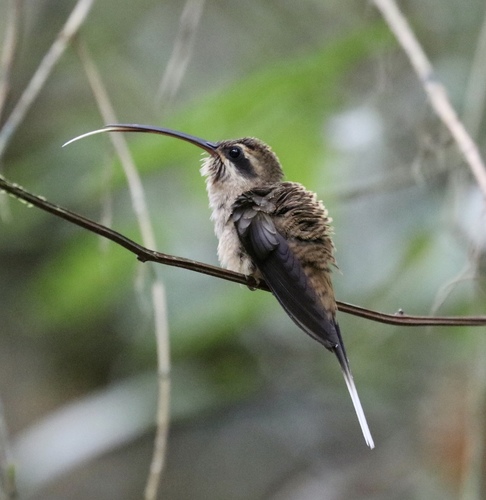 Long-billed Hermit
 Stripe-throated Hermit
In short
The most reliable way to separate Long-billed Hermit from Stripe-throated Hermit is by size and bill structure: Long-billed Hermit is much larger and has a noticeably longer, more strongly decurved bill, especially in males. Stripe-throated Hermit is small and compact, with a much shorter bill and a distinctive pale rufous rump. Both species have similar overall hermit patterns, but Stripe-throated Hermit shows a faintly streaked throat and a more obvious pale supercilium and malar stripe, while Long-billed Hermit has a plainer throat and longer central tail feathers. Juvenile Stripe-throated Hermits are especially rufous above, which is never matched by Long-billed. Voice, habitat, and behavior can help, but size and bill shape are the most decisive in the field.
Identification tips
- Size is the fastest check: Long-billed Hermit is much larger and longer than Stripe-throated Hermit. If the bird looks small, compact, and delicate, suspect Stripe-throated. If it looks lanky and elongated, especially in the tail and bill, suspect Long-billed.
- Bill shape and length: Long-billed Hermit has a very long, strongly decurved bill, especially in males. Stripe-throated Hermit has a much shorter, less dramatically curved bill. Females of Long-billed have a shorter but more curved bill than males, but still longer than Stripe-throated.
- Juvenile upperparts: Juvenile Stripe-throated Hermits have a pale rufous back, which is never seen in Long-billed Hermit of any age. This is a key mark for immatures.
- Central tail feathers: Long-billed Hermit has very long central tail feathers with prominent white tips, often extending well beyond the rest of the tail. Stripe-throated Hermit has a shorter tail with less pronounced central feathers and tips that are whitish to ochraceous but not as long or striking.
- Face pattern: Stripe-throated Hermit shows a strong blackish mask, bordered by a pale supercilium above and a pale malar stripe below. Long-billed Hermit has a less contrasting face, lacking the sharply defined mask and stripes.
- Throat pattern: Stripe-throated Hermit has a pale greyish-brown throat with fine dark streaks (though sometimes faint). Long-billed Hermit has a plain throat without streaks.
- Rump color: Stripe-throated Hermit has a pale rufous rump, which can be a quick field mark from behind. Long-billed Hermit lacks this feature.
- Uppertail coverts: Long-billed Hermit shows dark and ochre bands on the uppertail coverts, which Stripe-throated lacks.
- Underparts color: Long-billed Hermit has brownish to grayish underparts, while Stripe-throated Hermit shows buff flanks and a paler belly.
- Bill color: Stripe-throated Hermit has a yellow basal half to the lower mandible, with the rest of the bill black. Long-billed Hermit's bill is all dark.
- Sex differences: Long-billed Hermit shows sexual dimorphism in bill length and curvature; Stripe-throated Hermit sexes are virtually identical.
- Vocalizations: If heard singing, Long-billed Hermit gives upslurred, piercing 'sweeup' notes or sparrow-like chips (depending on subspecies); Stripe-throated Hermit gives a high-pitched, squeaky, monotonous song. Calls are less reliable but can support identification.
- Behavior at leks: Long-billed Hermit males gather in larger communal leks and display with tail-wiggling. Stripe-throated Hermit is more solitary outside of lekking.
- Habitat overlap: Both occur in humid forest understory and edges; do not rely on habitat alone where both are possible.
- Pitfalls: Immature Stripe-throated Hermits may appear duller and less streaked on the throat, but the rufous back is still diagnostic. Female Long-billed Hermits can have a more curved bill, but still longer than any Stripe-throated. In poor light, size and bill shape remain the most reliable checks.
Size
Long-billed Hermit is significantly larger, measuring 13–16 cm in length and weighing 4–7.5 g depending on sex. Stripe-throated Hermit is among the smallest hermits, at just 9–10 cm and 2–3 g. The size difference is striking when seen side-by-side or with experience; Long-billed Hermit appears lanky and elongated, while Stripe-throated Hermit is compact and delicate.
Plumage
Juvenile Stripe-throated Hermits have an entirely pale rufous back, which is never seen in Long-billed Hermit of any age. In adults, Stripe-throated Hermit shows dull iridescent green upperparts, a pale rufous rump, buff flanks, and a pale greyish-brown throat with fine dark streaks (though these streaks can be faint and hard to see). Its face is marked by a strong blackish mask bordered by a whitish-buff supercilium and malar stripe. The tail is blackish with whitish to ochraceous tips. Long-billed Hermit adults have greenish-brown upperparts, brownish to grayish underparts, and uppertail coverts with dark and ochre bands. The central tail feathers are much longer and have long white tips. The throat is plain, lacking the fine streaks of Stripe-throated. Subtle variation exists among Long-billed Hermit subspecies but does not overlap with the rufous or streaked features of Stripe-throated.
Behaviour
Both species are trap-line feeders, moving through circuits to visit flowers for nectar, and both males display at leks. Long-billed Hermit males are notable for their communal lekking, where they sing and wiggle their long tails for hours. Stripe-throated Hermit is more solitary outside of lekking and appears even more delicate and quick in its movements. Both build hanging nests from plant fibers and spider silk, but nest structure is not a reliable field mark.
Habitat
Both species inhabit the understory and edges of humid forests and second growth, often overlapping in Central America and northwestern South America. Long-billed Hermit ranges from Mexico to Peru, occurring from sea level up to 2,500 m depending on region, and is found in a wider range of forest types, including gallery and cloud forest. Stripe-throated Hermit is generally common in similar habitats but is more strictly associated with lowland and foothill forests, and is not found as far north or south as Long-billed Hermit. Habitat alone is not reliable for separation where both occur.
Voice
Long-billed Hermit northern subspecies sing a continuous series of single, piercing, upslurred 'sweeup' notes, with a sharp, explosive 'week!' call, often in flight. The southern subspecies (baroni) gives a series of sparrow-like 'tchee..tchee..tchee..' notes and a thin 'seep' call. Stripe-throated Hermit sings a high-pitched, squeaky, monotonous song that varies by region but is generally less piercing and more squeaky than Long-billed Hermit's. Calls are not always diagnostic, but the overall impression is that Long-billed Hermit is sharper and more piercing, while Stripe-throated is higher and squeakier.
Long-billed Hermit · Stripe-throated Hermit · My Tricky Birds