

Livingstone's Turaco vs Knysna Turaco
Tauraco livingstonii versus Tauraco corythaix
Play a quiz with Livingstone's Turaco and Knysna Turaco
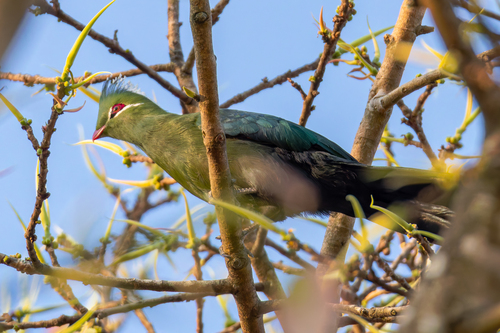 Livingstone's Turaco
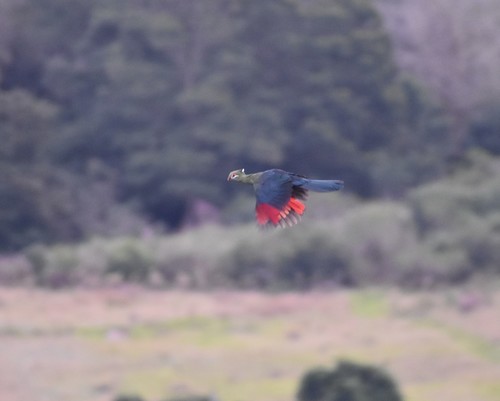 Knysna Turaco
In short
The most reliable field mark between Livingstone's Turaco and Knysna Turaco is the Knysna's distinctive white-tipped green crest and bold white line under the eye, features not seen on Livingstone's. In flight, both show crimson primary feathers, but Knysna's red is especially conspicuous and used as a predator distraction. Juvenile Knysna Turacos have a shorter, untipped crest, while adults always show the white tip. Both are mainly green birds with long tails and red in the wings, but careful attention to facial pattern and crest shape is key. Range and habitat also help: Knysna is tied to mature evergreen forests in southern/eastern South Africa and Eswatini, while Livingstone's is found further north and east, from Tanzania to Mozambique and coastal South Africa.
Identification tips
- Crest shape and color: Knysna Turaco always shows a tall green crest with a distinct white tip in adults; juveniles have a shorter, untipped crest. Livingstone's Turaco lacks the white-tipped crest at all ages.
- White facial line: Only Knysna Turaco has a bold white line running just under the eye, a highly visible mark at close range or in good light. Livingstone's Turaco does not have this feature.
- Eye-ring color: Knysna Turaco has a deep red eye-ring around a brown eye, which can be seen at close range. Eye color and ring are not specified for Livingstone's, so absence of a strong red ring may suggest Livingstone's.
- Bill: Both have orange-red bills, but Knysna's is described as small and thick. This is subtle and not always reliable in the field.
- Flight pattern: Both species show crimson primary feathers in flight, but Knysna's red is especially vivid and is used as a predator distraction. Watch for the sudden disappearance of red as Knysna lands and folds its wings.
- Juvenile crest: Juvenile Knysna Turacos lack the white tip on the crest, but still show the white facial line and red in the wings. Livingstone's juveniles are not described in detail but should lack both the white-tipped crest and white facial line.
- Plumage: Both are mainly green, but Knysna's combination of white-tipped crest and white facial line is unique. Livingstone's is green without these facial highlights.
- Habitat: Knysna Turaco is almost always in mature evergreen forest in southern/eastern South Africa and Eswatini. Livingstone's is in subtropical lowlands from Tanzania to Mozambique and coastal South Africa. If seen outside deep forest, especially further north, Livingstone's is more likely.
- Range: If you are in southernmost South Africa or Eswatini in evergreen forest, Knysna is expected. In Mozambique, Malawi, or Tanzania, it will be Livingstone's.
- Behavior: Knysna's predator-avoidance behavior (flashing red wings in flight, then hiding them on landing) is a subtle behavioral clue, but not exclusive.
- Tail and structure: Both are long-tailed and robust, with similar jizz. Tail shape is not a separator.
- Season and sex: Both sexes are similar in both species; Knysna's white-tipped crest is present year-round in adults. No seasonal or sexual dimorphism is described for either.
- Vocalization: Not described in the available notes; do not rely on voice for separation.
- Pitfalls: In poor light, the green plumage and red wings can make both species appear similar. Always look for the white-tipped crest and facial line for Knysna, and remember that juveniles may lack the crest tip but still show the facial line.
- Museum specimens: The green and red pigments in both species deepen with age in preserved specimens, but this does not affect field identification.
Size
Livingstone's Turaco averages 318g in body mass [wikidata], while no specific mass is given for Knysna Turaco, but both are described as large turacos of similar overall structure. Knysna Turaco is 40–42 cm long including the tail [wikipedia], which is typical for the genus. In the field, size is not a reliable separator between these two, as both are robust, long-tailed birds with similar proportions.
Plumage
- Juvenile/immature birds: Juvenile Knysna Turacos have a shorter crest lacking the white tip seen in adults, but still show the white line under the eye and the red primary feathers in flight. No specific juvenile marks are described for Livingstone's Turaco, so assume they resemble adults but lack the Knysna's distinctive facial and crest features.
- Adult birds: Knysna Turaco stands out with a tall green crest tipped white, a prominent white line under the eye, and a deep red eye-ring. Livingstone's lacks both the white-tipped crest and the white facial line. Both species have mainly green plumage and show crimson in the wings when flying, but Knysna's red is especially bold and is thought to serve as a predator distraction. Bill color is orange-red and similar in both, but Knysna's is described as thick and small. Eye color is brown in Knysna, with a deep red eye-ring, not specified for Livingstone's.
Behaviour
Both species are often inconspicuous in the treetops, moving quietly through dense foliage. Knysna Turaco is noted for using its red wing feathers as a decoy when escaping predators: the red is highly visible in flight but disappears when the bird lands and folds its wings. This behavior is less emphasized for Livingstone's Turaco. Both are arboreal and rarely seen on the ground.
Habitat
Knysna Turaco is a resident breeder in mature evergreen forests of southern and eastern South Africa and Eswatini, rarely straying far from this habitat. Livingstone's Turaco is found in subtropical lowlands further north and east, from southern Tanzania through Malawi, Mozambique, eastern Zimbabwe, and the subtropical coast of South Africa. Overlap is limited to the far southeast, and habitat preference (deep evergreen forest for Knysna vs. broader subtropical lowland for Livingstone's) is a strong clue.