

Little Bronze-Cuckoo vs Plaintive Cuckoo
Chalcites minutillus versus Cacomantis merulinus
Play a quiz with Little Bronze-Cuckoo and Plaintive Cuckoo
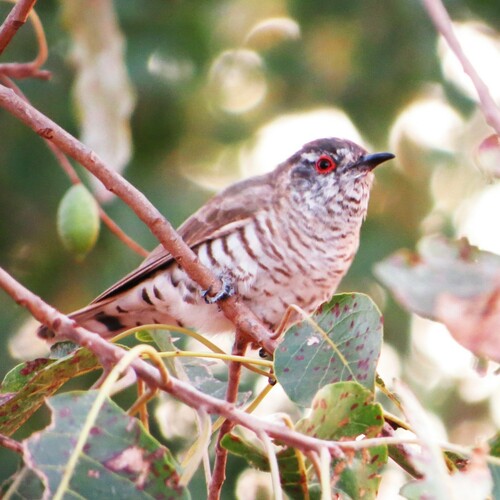 Little Bronze-Cuckoo
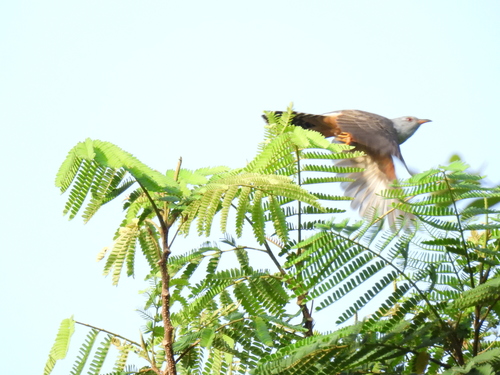 Plaintive Cuckoo
In short
The most reliable field mark to separate Little Bronze-Cuckoo from Plaintive Cuckoo is size: Little Bronze-Cuckoo is the world's smallest cuckoo, extremely compact and slender, while Plaintive Cuckoo is noticeably larger and bulkier. If you see a very small, metallic-green cuckoo with a white spot behind the eye and strong white barring below, it's Little Bronze-Cuckoo; a larger bird with orange underparts and a gray or rufous head is Plaintive. Juveniles of both can be confusing, but the Little Bronze-Cuckoo stays much smaller and more bronzy above. Structure and tail pattern also help: Little Bronze-Cuckoo is more delicate with a longer tail relative to its size, while Plaintive Cuckoo has a broader tail with white tips and a stouter bill. Habitat overlap is possible, but Plaintive Cuckoo is more often in open woodland and gardens, while Little Bronze-Cuckoo prefers denser vegetation.
Identification tips
- Size is the most immediate clue: Little Bronze-Cuckoo is tiny (15–16 cm), much smaller than Plaintive Cuckoo (21–24 cm). If the bird looks sparrow-sized, it's Little Bronze-Cuckoo.
- Structure: Little Bronze-Cuckoo is slender with a proportionally long tail and fine bill; Plaintive Cuckoo is bulkier, with a stouter bill and broader, white-tipped tail.
- Upperparts color: Little Bronze-Cuckoo is metallic bronze-green above; Plaintive Cuckoo is gray-brown (male) or rufous with dark bars (hepatic female), never metallic.
- Underparts pattern: Little Bronze-Cuckoo is white with strong dark barring; Plaintive Cuckoo is orange below (male) or pale with faint barring (hepatic female), never strongly barred white.
- Head pattern: Little Bronze-Cuckoo has a distinctive white spot behind the eye; Plaintive Cuckoo may show a pale eyebrow (hepatic female/juvenile) but never a white eye-spot.
- Tail pattern: Plaintive Cuckoo's tail is broad with white tips and dark bars (especially in hepatic female/juvenile); Little Bronze-Cuckoo's tail is long and slender, lacking strong white tips or full-length barring.
- Orbital ring: Male Little Bronze-Cuckoo has a red orbital ring, absent in Plaintive Cuckoo.
- Juvenile confusion: Juvenile Little Bronze-Cuckoo is duller but still bronzy above and lacks strong head streaking; juvenile Plaintive Cuckoo is paler rufous with dark streaks on the crown and throat and a pale supercilium.
- Flight style: Little Bronze-Cuckoo is direct and agile, often weaving through dense foliage; Plaintive Cuckoo is less rapid and more likely to perch in the open.
- Habitat context: Dense, tangled vegetation favors Little Bronze-Cuckoo; open woodland, farmland, or gardens suggest Plaintive Cuckoo.
- Vocalization: Plaintive Cuckoo gives repeated, plaintive whistles; Little Bronze-Cuckoo's voice is not described, so if you hear the classic call, it's Plaintive.
- Sexual dimorphism: Plaintive Cuckoo females are variable, with many in a rufous 'hepatic' morph—never matched by Little Bronze-Cuckoo.
- Host species: If you observe the cuckoo near Geryone hosts, it may indicate Little Bronze-Cuckoo, though this is not always reliable.
- Bill color: Plaintive Cuckoo has a black upper mandible and yellow lower mandible; Little Bronze-Cuckoo's bill is not described as bicolored.
- Mobbed by small birds: Plaintive Cuckoo is often mobbed in open areas, which may help in context.
Size
Little Bronze-Cuckoo is dramatically smaller, measuring just 15–16 cm in length and weighing 14.5–17 g [wikipedia][avonet]. Plaintive Cuckoo is much larger at 21–24 cm long [wikipedia]. Even at a distance, the size gap is obvious if you have a reference. Little Bronze-Cuckoo is not only shorter but also much slimmer and lighter in build, with a proportionally longer tail. Plaintive Cuckoo appears bulkier, with a deeper body and heavier bill.
Plumage
-
Juveniles: Both species' juveniles can be confusing, but Little Bronze-Cuckoo juveniles are duller versions of adults, lacking flank mottling and with less brightness overall. Plaintive Cuckoo juveniles resemble hepatic females: reddish-brown above with dark streaks (not bars) on the crown and throat, paler below with faint barring, and a pale supercilium. Juvenile Plaintive Cuckoo's tail is barred and tipped white.
-
Adult males: Little Bronze-Cuckoo is metallic bronze-green above, white below with strong dark barring, and a distinctive white spot behind the eye. Plaintive Cuckoo adult males are gray-brown above, orange below, with a gray head, throat, and upper breast, and white-tipped tail feathers. No metallic sheen or white eye-spot.
-
Adult females: Little Bronze-Cuckoo females are similar to males but slightly larger and lack the red orbital ring. Plaintive Cuckoo females are variable: some resemble males, but many are in 'hepatic' morph—rich rufous above with dark barring, paler below with faint barring, a pale eyebrow, and a strongly barred tail. Little Bronze-Cuckoo never shows this rufous/barring combination or pale eyebrow.
-
In flight: Little Bronze-Cuckoo is described as direct and swift, with a slender, long-tailed look. Plaintive Cuckoo is bulkier, with a broader, white-tipped tail and less metallic upperparts.
Behaviour
Little Bronze-Cuckoo is agile and swift, weaving through dense vegetation with a direct, slightly undulating flight. It is often hard to spot except when moving between cover. Plaintive Cuckoo is usually solitary and secretive but frequents more open habitats, perching conspicuously at times. Both are brood parasites, but Plaintive Cuckoo is more likely to be mobbed by small birds in open areas. Little Bronze-Cuckoo's smaller size and slender build make its movements more delicate and rapid.
Habitat
Little Bronze-Cuckoo prefers dense vegetation, including forest edges and thickets, and is often associated with areas where its Geryone host species nest. Plaintive Cuckoo is more of a habitat generalist, found in forest edge, open woodland, scrub, grassland, farmland, parks, and gardens. If you see a bronze-green cuckoo deep in tangled foliage, suspect Little Bronze-Cuckoo; a larger cuckoo in open country or gardens is more likely Plaintive.
Voice
Plaintive Cuckoo is named for its song: a series of plaintive, whistling calls—ascending three-note phrases and longer descending series. Little Bronze-Cuckoo's voice is not described in the notes, so vocalization is diagnostic mainly for Plaintive Cuckoo: if you hear a distinctive, repeated, plaintive whistle, it's likely Plaintive Cuckoo.