
Lesser Whitethroat vs Common Whitethroat
Curruca curruca versus Curruca communis
Play a quiz with Lesser Whitethroat and Common Whitethroat
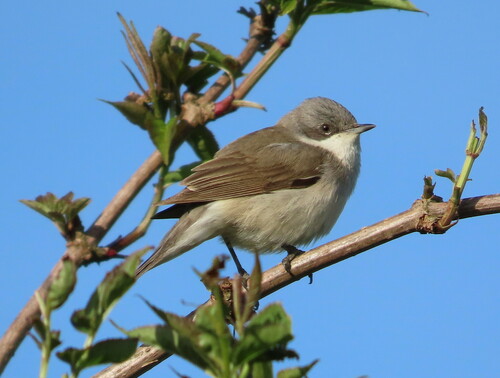 Lesser Whitethroat
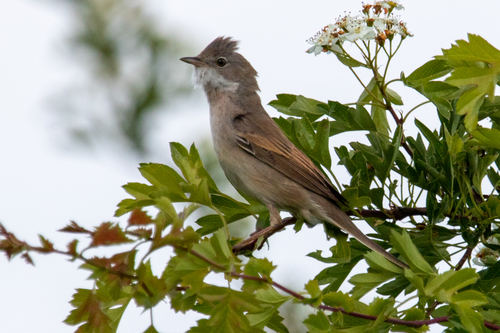 Common Whitethroat
In short
The most reliable field mark between Lesser Whitethroat and Common Whitethroat is the presence or absence of chestnut fringes on the wing feathers: Common Whitethroat shows obvious chestnut on the wings, while Lesser Whitethroat lacks this and instead has a strong contrast between a dark head-side and a white throat. Lesser Whitethroat is slightly smaller, with sexes looking nearly identical, whereas Common Whitethroat males have a distinct grey head and white throat, and females are browner and duller. Both are small, active warblers, but careful attention to head pattern and wing color is key, especially in perched or close views. In flight or at a distance, size and structure are less helpful than these plumage contrasts.
Identification tips
- Chestnut wing panel: Look for chestnut fringes on the secondary wing feathers—present in all ages and sexes of Common Whitethroat, absent in Lesser Whitethroat. This is the most reliable mark in perched birds and sometimes visible in flight.
- Head pattern: Lesser Whitethroat shows a strong contrast between a dark grey head-side (with a 'bandit mask' through the eye) and a white throat. Common Whitethroat males have a grey head but lack the sharp mask, and females are browner and less contrasting.
- Sexual dimorphism: Lesser Whitethroat sexes are nearly identical, making head pattern consistent across ages and sexes. In Common Whitethroat, males have a grey head and white throat, while females are browner and duller, with less contrast.
- Upperparts color: Lesser Whitethroat is generally greyer above, while Common Whitethroat is browner, especially on the back and wings.
- Underparts: Both species have whitish or buff underparts, but Lesser Whitethroat tends to be cleaner white, while Common Whitethroat is more buff, especially in females and immatures.
- Wing pattern in flight: If you glimpse the upperwing in flight, chestnut panels in Common Whitethroat can be a giveaway; Lesser Whitethroat's wings are plainer grey-brown.
- Size: Common Whitethroat is slightly larger and heavier, but this is subtle and not usually diagnostic unless birds are side by side.
- Voice: Lesser Whitethroat's song is a fast rattle ('tet' or 'che'), while Common Whitethroat's is scratchy and scolding. Calls are also distinct: Common Whitethroat gives hoarse, nasal notes and a rough warning cry.
- Habitat: Overlap is extensive; both use shrubby, edge habitats. Do not rely on habitat alone for separation.
- Bill and structure: No strong differences are noted; both are slim, small warblers with similar proportions.
- Tail: No diagnostic tail shape or length differences are described.
- Seasonal variation: Chestnut in Common Whitethroat's wings is present year-round, though may be fresher and brighter after molt. Head pattern in Lesser Whitethroat is consistent across seasons and sexes.
- Pitfalls: Female Common Whitethroat can look dull and less contrasting, but still shows chestnut in the wings. Immature Common Whitethroat may be especially confusing but retain the chestnut wing panel. Lesser Whitethroat never shows chestnut in the wings.
- Direct comparison: When both species are present, Lesser Whitethroat appears neater and more sharply marked on the head, while Common Whitethroat is warmer, browner, and shows the chestnut wing panel.
- When in doubt: Focus on the wing panel and head pattern; these are the most consistent and reliable field marks across all ages and sexes.
Size
Common Whitethroat is slightly larger and heavier (body mass around 14.5g [wikidata]), while Lesser Whitethroat is marginally smaller, though exact mass is not provided. In the field, this size difference is subtle and rarely diagnostic except in direct comparison. Both species are small, slim warblers with similar proportions, so size alone is not a reliable separator.
Plumage
- Juvenile/Immature/Non-breeding birds: No specific juvenile wing pattern is described for either species, but the most important difference for all ages is the presence of chestnut fringes on the secondary wing feathers in Common Whitethroat, which are absent in Lesser Whitethroat. This mark is visible in perched birds and sometimes in flight, especially in good light.
- Adults: Lesser Whitethroat shows a grey back, white or whitish underparts, a grey head with a darker 'bandit mask' through the eyes, and a white throat. The head-side contrast is strong. Common Whitethroat males have a grey head and white throat, but the rest of the upperparts are browner, and the wings have obvious chestnut fringes. Females are browner overall, lack the male's grey head, and have a duller throat, but still show chestnut in the wings. Lesser Whitethroat lacks the chestnut wing panel and has a more uniform grey head and back, with sexes looking almost identical.
- Key contrast: Chestnut in the wings (present only in Common Whitethroat) and the strong, dark head-side/white throat contrast (most pronounced in Lesser Whitethroat) are the best field marks.
Behaviour
Both species are active, often skulking warblers that forage in shrubs and low trees. Their general behavior is similar, with quick movements and frequent tail flicking. No diagnostic behavioral differences are noted in the sources.
Habitat
Both species breed in temperate Europe and western/central Palearctic, and both winter in Africa, Arabia, and parts of Asia. Habitat overlap is extensive: both use shrubby areas, hedgerows, and woodland edges. Lesser Whitethroat is absent from southwest Europe, but this is not a reliable field mark within overlapping ranges. Habitat is not a strong separator in the field.
Voice
Lesser Whitethroat has a fast, rattling song made up of 'tet' or 'che' calls, quite different from the Common Whitethroat's song, which is fast, scratchy, and has a scolding tone. The Common Whitethroat's call is described as hoarse and slightly nasal ('wed-wed' or 'woid-woid'), with a rough, long-pulled warning cry ('tschehr'). Song and call are helpful if heard well, as they are quite distinct.