

Lesser Spotted Eagle vs Black Kite
Clanga pomarina versus Milvus migrans
Play a quiz with Lesser Spotted Eagle and Black Kite
 Lesser Spotted Eagle
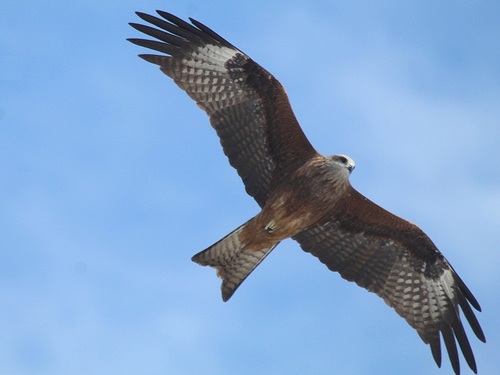 Black Kite
In short
The most reliable field mark between Lesser Spotted Eagle and Black Kite is the combination of upperwing and tail pattern in flight: Lesser Spotted Eagle (especially juveniles and adults) shows a distinct white 'V' on the rump and lacks a forked tail, while Black Kite has a shallowly forked tail and lacks any white rump mark. Juvenile Lesser Spotted Eagles also show prominent white spots on the remiges but lack covert spotting, whereas Black Kite juveniles do not show these features. Structurally, the eagle is bulkier with a smaller head and bill for its size, while the kite appears more slender and buoyant in flight. Both can appear brownish at a distance, but careful attention to wing and tail shape, as well as flight style, will separate them in most conditions.
Identification tips
- White 'V' on Rump (Lesser Spotted Eagle): In all ages except the youngest juveniles, look for a clear white 'V' on the rump in flight; Black Kite never shows this mark.
- Tail Shape: Black Kite always has a shallowly forked tail, best seen when the bird fans its tail in flight or when perched; Lesser Spotted Eagle's tail is straight or slightly rounded.
- Juvenile Wing Pattern: Juvenile Lesser Spotted Eagles show prominent white spots on the remiges (flight feathers) but lack covert spotting; Black Kite juveniles lack these white spots and have more uniform brown wings.
- Cream Neck Patch (Lesser Spotted Eagle Juvenile): Juvenile eagles show a pale or cream-colored patch on the neck, absent in kites.
- Upperwing Markings: Lesser Spotted Eagle adults often show a white patch on the upperwing; Black Kite never does.
- Head and Bill Structure: The eagle has a proportionally smaller head and bill for its size, giving it a less 'hooked' look than the kite. The kite's head is paler but not strikingly small.
- Flight Style: Black Kite is more buoyant and agile, often gliding with wings held in a shallow V; Lesser Spotted Eagle soars with slower, deeper wingbeats and less flexed wings.
- Plumage Tone: Both are brown, but the eagle's head and wing coverts are paler and contrast with the darker body; the kite is more uniformly dark with some paler streaking on the head and underparts.
- Perched Posture: Eagles are bulkier, more upright, and solid-looking when perched; kites are slimmer and often sit more horizontally.
- Habitat Context: If seen near urban areas, refuse sites, or in large groups, Black Kite is much more likely; Lesser Spotted Eagle avoids such settings.
- Vocalization: If heard, the eagle gives a dog-like yip, while the kite produces a shrill whistle and whinnying call.
- Relative Abundance: Black Kite is far more common and widespread, especially in migration or winter; Lesser Spotted Eagle is scarcer and more local.
- Bill Color: Both have dark bills, but the kite's cere and gape are yellow, which can be seen at close range.
- Leg Color: Both have yellow legs, not a key separator.
- Hybrid Pitfall: Rare hybrids between the two eagle species (not kite) can be confusing, but Black Kite hybrids are not a concern here.
Size
Lesser Spotted Eagle is significantly heavier (average 1475.5g) than Black Kite (average 828g), making it a bulkier bird overall. Both species have similar wingspans (around 150 cm), but the eagle is more robust, with a heavier body and deeper chest. The eagle's head and bill are proportionally small for its size, while the kite is more slender and lighter, with a longer, more flexible tail. In perched birds, the eagle appears more upright and solid, while the kite is slimmer and often sits with a more horizontal posture.
Plumage
- Juvenile/immature birds in flight: Lesser Spotted Eagle juveniles lack covert spotting but show prominent white spots on the remiges (flight feathers) and a cream-colored neck patch. The white 'V' on the rump is present even in adults, though less defined in juveniles. Black Kite juveniles do not show these white remige spots or rump marks; their plumage is overall brown with paler head and neck, and a streaked appearance on the body.
- Adults: Lesser Spotted Eagle adults have pale brown head and wing coverts contrasting with darker body and wings, and a white 'V' on the rump. Black Kite adults are dark brown overall, with a paler head and neck, and a shallowly forked tail. The kite's upperwing lacks any white patches or rump marks, and its tail is always forked (not square or rounded as in the eagle).
- Tail: Eagle's tail is straight or slightly rounded, never forked; Black Kite's tail is distinctly shallowly forked, visible both perched and in flight.
- Underparts: Both are brownish, but the kite often appears streaked due to dark feather shafts, while the eagle is more uniform below.
Behaviour
Lesser Spotted Eagle is wary and tends to hunt over open or lightly wooded country, often soaring high but with more powerful, slower wingbeats and less buoyant flight than the kite. Black Kite is much more agile and buoyant in the air, often seen gliding and circling with wings held in a shallow dihedral (V-shape), and is more likely to be seen near human habitation, scavenging or hunting over varied habitats. Kites are also more likely to be seen in groups, especially near food sources, while the eagle is more solitary or seen in pairs.
Habitat
Lesser Spotted Eagle prefers open or lightly wooded countryside, often away from dense human settlement, and breeds in Central and Eastern Europe, southeast to Turkey and Armenia, wintering in Africa. Black Kite is highly adaptable, found in a wide range of habitats from open country to urban areas, and is much more likely to be seen near towns, cities, and water bodies. Both may overlap in migration or wintering grounds, but the kite is far more abundant and tolerant of human presence.
Voice
Lesser Spotted Eagle gives a dog-like yip, which is quite different from the Black Kite's distinctive shrill whistle followed by a rapid, whinnying call. Vocalizations are rarely diagnostic at a distance, but if heard well, the difference is clear.