

Lesser Grey Shrike vs Masked Shrike
Lanius minor versus Lanius nubicus
Play a quiz with Lesser Grey Shrike and Masked Shrike
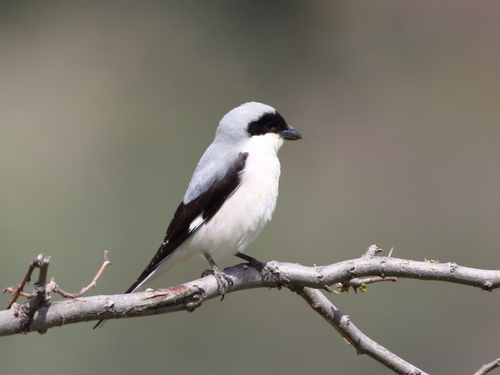 Lesser Grey Shrike
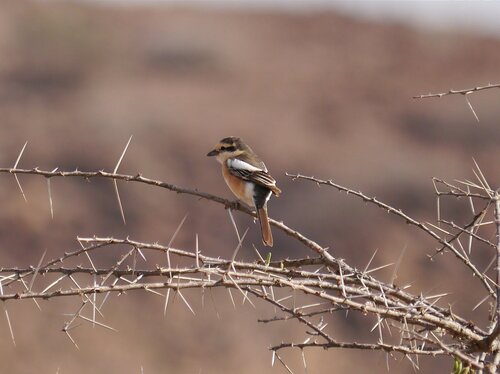 Masked Shrike
In short
The most reliable field mark between Lesser Grey Shrike and Masked Shrike is the head pattern in adults: Lesser Grey Shrike has a dark (black or dark grey) crown and nape with a pale bluish-grey back, while Masked Shrike shows a striking white crown, forehead, and supercilium contrasting with black upperparts. Juveniles are trickier, but Masked Shrike juveniles have a paler face and more extensive barring above and below, plus a longer tail. Lesser Grey Shrike is noticeably bulkier and heavier, with a more robust jizz and a tendency to perch in the open, while Masked Shrike is smaller, more slender, and often keeps to less exposed perches. Both can show white in the wings, but the pattern and context differ.
Identification tips
- Head pattern in adults: Lesser Grey Shrike has a black (male) or dark grey (female) crown and nape, with a pale bluish-grey back. Masked Shrike shows a white crown, forehead, and supercilium, sharply contrasting with black upperparts. This is the single most reliable mark in adults.
- Juvenile plumage: Masked Shrike juveniles have a paler face, more extensive barring above and below, and a longer tail than Lesser Grey Shrike juveniles, which are browner overall with faint barring and lack the grey back and rump.
- Wing pattern in flight (juveniles): Masked Shrike juveniles show a prominent white patch on the primaries, while Lesser Grey Shrike juveniles have less contrast and lack a strong white primary patch.
- Size and structure: Lesser Grey Shrike is much bulkier and heavier, with a stouter bill and a more robust, powerful appearance. Masked Shrike is smaller, slender, and long-tailed, with a relatively small, fine bill.
- Tail: Masked Shrike's tail is longer in proportion to its body, and the outer tail feathers are white. Lesser Grey Shrike's tail is shorter and broader, with a more even black-and-white pattern.
- Bill: Lesser Grey Shrike has a thicker, more powerful bill typical of large shrikes. Masked Shrike's bill is finer, with a distinctive tomial tooth and a triangular ridge, but this detail is hard to see in the field.
- Underparts: Lesser Grey Shrike adults have white underparts with a pinkish flush on the lower breast and belly (especially males). Masked Shrike adults have white underparts with orange flanks and breast, which can appear as a distinct patch of color.
- Back and rump: Lesser Grey Shrike adults have a pale bluish-grey back and rump; Masked Shrike adults have a dark rump and black upperparts, with white confined to the head and wing patches.
- Perching behavior: Lesser Grey Shrike perches openly on wires or exposed branches; Masked Shrike prefers less exposed perches within bushes or trees.
- Habitat: In open country, especially in drier lowlands, Lesser Grey Shrike is more likely. In open woodland with scattered trees and bushes, especially where shrikes are less conspicuous, Masked Shrike is favored.
- Flight style: Lesser Grey Shrike's flight is low and undulating, with occasional glides and upward swoops to perches. Masked Shrike's flight is less described but is generally more delicate, matching its build.
- Sex differences: Female Lesser Grey Shrike is duller, with a dark grey head and brownish-grey upperparts; female Masked Shrike is browner above, with less contrast and a buff or grey tinge to the white areas.
- Vocalizations: If heard, Masked Shrike's song is more melodic and warbler-like, while Lesser Grey Shrike's calls are harsher and more typical of shrikes.
- Exposure: If the bird is very conspicuous and aggressive, especially in open country, suspect Lesser Grey Shrike. If it is more retiring and keeps to cover, suspect Masked Shrike.
- Season and location: Both are migrants, but Masked Shrike is more likely in southeastern Europe and the eastern Mediterranean, while Lesser Grey Shrike is more widespread in central and eastern Europe and western Asia. Both are rare vagrants elsewhere.
Size
Lesser Grey Shrike is significantly larger and heavier (body mass ~46 g) than Masked Shrike (~25 g). Lesser Grey Shrike measures about 20 cm in length with a 13 cm wing, while Masked Shrike is 17–18.5 cm long with a 24–26.5 cm wingspan. The difference is obvious in direct comparison: Lesser Grey Shrike appears bulkier and more powerful, with a stouter bill, whereas Masked Shrike is notably slender, long-tailed, and fine-billed for a shrike.
Plumage
-
Juveniles: Lesser Grey Shrike juveniles are overall more brown, with pale brown and faintly barred upperparts, lacking the adult's grey back and rump. Underparts are white and cream, without pink. Masked Shrike juveniles have grey-brown upperparts with darker barring from head to rump, a paler grey forehead, and barred off-white underparts. Their brown wings show white primary patches. Masked Shrike juveniles also have a longer tail and paler face than Lesser Grey Shrike juveniles.
-
Adult males: Lesser Grey Shrike males have a black nape, cheeks, ear and eye coverts, and front crown, with a pale bluish-grey back and rump, white underparts with pinkish lower breast and belly, and a black-and-white tail. Masked Shrike males have mainly black upperparts, but with a bold white crown, forehead, and supercilium, large white patches on shoulders and primaries, and white underparts with orange flanks and breast. The tail is long with white outer feathers.
-
Adult females: Both species' females are duller than males. Lesser Grey Shrike females have a dark grey head, brownish-black ear coverts, brownish-grey upperparts, and less pink below. Masked Shrike females are browner above, with a grey or buff tinge to shoulder patches and underparts.
-
In flight: Both species show white in the wings, but Masked Shrike's white primary patch is more prominent, especially in juveniles. Lesser Grey Shrike has a white base to the primaries and a more uniform pale grey back in adults.
Behaviour
Lesser Grey Shrike often perches conspicuously on wires or exposed branches, scanning for prey, and has a low, undulating flight with occasional glides. It is bold and aggressive, frequently fanning and flicking its tail. Masked Shrike is more secretive, preferring to perch in less exposed spots within open woodland or among bushes, and is generally less conspicuous. Its behavior is more delicate, matching its smaller, slender build.
Habitat
Lesser Grey Shrike favors dry, open lowlands and is often seen on telephone wires or prominent perches in open country. Masked Shrike prefers open woodland with bushes and some large trees, avoiding very open habitats and often remaining less visible within foliage. Their ranges overlap in southeastern Europe, but Masked Shrike is more tied to habitats with scattered trees and denser cover.
Voice
Masked Shrike's calls are short and grating, but its song is more melodic and warbler-like. Lesser Grey Shrike's vocalizations are not described in detail here, but are generally harsher and less musical than Masked Shrike. In practice, Masked Shrike's song is more likely to be confused with a warbler than with another shrike.