

Lesser Blue-eared Starling vs Greater Blue-eared Starling
Lamprotornis chloropterus versus Lamprotornis chalybaeus
Play a quiz with Lesser Blue-eared Starling and Greater Blue-eared Starling
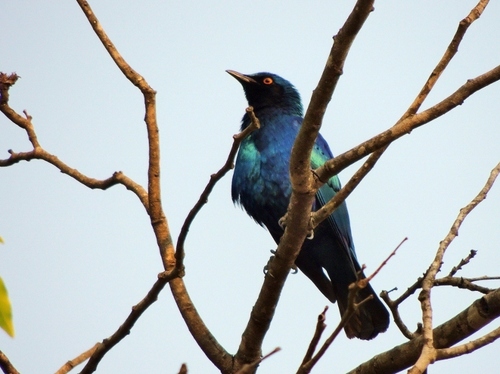 Lesser Blue-eared Starling
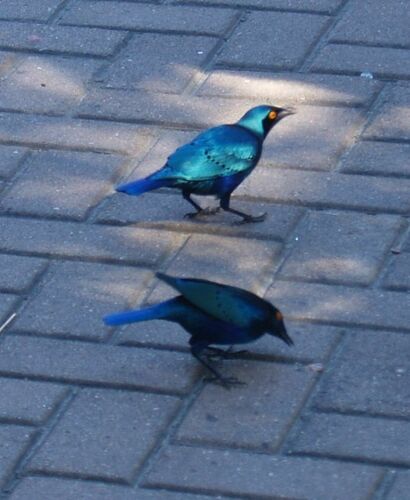 Greater Blue-eared Starling
In short
The most reliable field mark for separating Lesser and Greater Blue-eared Starlings is the extent of blue coloration on the belly: Greater Blue-eared Starling shows blue extending forward of the legs onto the lower breast, while Lesser Blue-eared Starling's blue belly stops at or behind the legs. Both species are glossy blue-green with striking yellow or orange eyes, but Greater is noticeably bulkier and has a slightly shorter tail. Juveniles of both are duller, but the belly color boundary remains a key distinction. Structure and habitat overlap heavily, so careful attention to belly color and overall size is essential, especially in mixed flocks.
Identification tips
- Belly color boundary is key: In Greater Blue-eared Starling, the blue of the belly extends forward of the legs onto the lower breast; in Lesser, the blue stops at or just behind the legs. This works for all ages and is the single most reliable mark.
- Size and build: Greater is noticeably heavier and a bit longer, appearing more robust; Lesser is slimmer and lighter. Use this only when birds are side by side or in direct comparison.
- Tail length: Greater has a slightly shorter tail relative to body size, but this is subtle and not always obvious.
- Juvenile plumage: Juvenile Greater Blue-eared Starlings are duller overall with blackish brown underparts, but the belly color boundary still applies. Juvenile Lesser is not described in detail, but expect a similar pattern with the same belly mark.
- Iris color: Both species have bright yellow or orange eyes as adults, so this is not useful for separation.
- Ear patch: Both show a blue ear patch; not a separator.
- Glossy blue-green upperparts: Both species are glossy blue-green above; do not rely on overall gloss or hue for separation.
- Flocking and behavior: Both are gregarious and may be seen in mixed flocks; Greater may be more likely to perch on livestock, but this is not diagnostic.
- Habitat overlap: Both occur in open woodland and savanna; do not use habitat alone for ID.
- Vocalizations: Only Greater's call is described ('squee-ar'), but voice is not a reliable separator without more information.
- Flight views: No distinctive upperwing or flight pattern differences are noted; focus on belly color even in flight if possible.
- Pitfalls in poor light: In shadow or at distance, the belly color boundary can be hard to judge; use size as a secondary clue if possible.
- Mixed flocks: When both species occur together, check each individual for the belly mark rather than assuming based on flock composition.
- No sexual dimorphism: Males and females are similar in both species; do not use sex for ID.
- No seasonal plumage change: No evidence of significant seasonal change in either species; the key marks apply year-round.
Size
Greater Blue-eared Starling is distinctly heavier (85.8g vs 73.1g) and slightly longer (22 cm for Greater; Lesser is somewhat smaller but precise length not given). In the field, Greater appears more robust and stockier, while Lesser is a touch more delicate. Tail length is proportionally shorter in Greater, but this is subtle and not always reliable at distance. Both species have similar proportions, so size is best used in combination with plumage.
Plumage
For all ages, the most diagnostic plumage difference is the extent of blue on the belly: Greater Blue-eared Starling has blue that extends forward of the legs onto the lower breast, while in Lesser Blue-eared Starling, the blue belly stops at or just behind the legs, leaving the upper breast a different color (not described in detail, but not blue). Both adults are glossy blue-green overall, with a blue ear patch and bright yellow or orange irises. Juveniles of Greater Blue-eared Starling are duller, with blackish brown underparts, but the belly color boundary remains a useful mark. No distinctive age-specific upperwing or flight marks are described for either species. Sexes are similar in both. In poor light or at distance, the belly color boundary may be hard to judge, but in good views, it is the best separation point.
Behaviour
Both species are highly gregarious, often forming large flocks and sometimes mixing with other starlings. Greater Blue-eared Starling is especially noted for its flocking behavior and communal roosting, sometimes with other species. Both forage mainly on the ground for insects but will also take fruit. Greater Blue-eared Starling is known to perch on livestock to feed on insects or ectoparasites, a behavior not specifically noted for Lesser. Both nest in holes, but Greater is mentioned as using stick nests of large birds as well. Behavioral differences are subtle and not usually diagnostic in the field.
Habitat
Both species inhabit open woodland and savanna across much of sub-Saharan Africa, with large range overlap. Greater Blue-eared Starling is described as very common in open woodland and is known to undertake some seasonal migration. Lesser Blue-eared Starling's range is similarly broad, and both can be found in similar habitats, so habitat alone is not a reliable separator.
Voice
Greater Blue-eared Starling has a range of musical or grating calls, with the most familiar being a nasal 'squee-ar.' There is no specific description of Lesser Blue-eared Starling's voice in the provided notes. Vocalizations are not a reliable field separator based on available information.
Lesser Blue-eared Starling · Greater Blue-eared Starling · My Tricky Birds