

Lesser Antillean Flycatcher vs Grey Kingbird
Myiarchus oberi versus Tyrannus dominicensis
Play a quiz with Lesser Antillean Flycatcher and Grey Kingbird
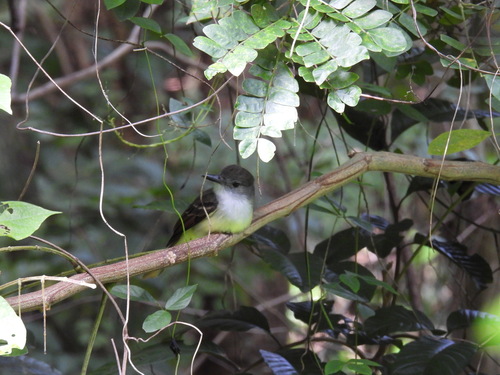 Lesser Antillean Flycatcher
 Grey Kingbird
In short
The most reliable field mark is the underparts: Grey Kingbird shows bright white underparts with only a faint gray wash on the chest, while Lesser Antillean Flycatcher has a gray breast and throat, with yellow belly and undertail coverts. Juvenile Grey Kingbirds show rufous edges on the wing coverts, rump, and tail, which Lesser Antillean Flycatchers lack. Structurally, Grey Kingbird is bulkier, longer, and has a heavier bill. In flight or perched, look for the kingbird's strong gray-white contrast and mask versus the flycatcher's olive and yellow tones. Both can be confused in the Caribbean, but careful attention to these marks will separate them in the field.
Identification tips
- Underparts color: Grey Kingbird has bright white underparts with only a faint gray wash on the chest; Lesser Antillean Flycatcher has a gray throat and breast with yellow belly and undertail coverts. This is the best mark on perched birds of all ages.
- Facial pattern: Grey Kingbird shows a bold dusky mask through the eye and a pale gray face; Lesser Antillean Flycatcher has a grayer olive-green face without a strong mask.
- Upperparts: Lesser Antillean Flycatcher is dark olive-green above with rufous edges on the wings and tail; Grey Kingbird is gray above with brownish wings and tail, lacking rufous edges in adults.
- Juvenile/immature wing and tail: Juvenile Grey Kingbirds have rufous edges on the wing coverts, rump, and tail, which Lesser Antillean Flycatcher never shows. If you see rufous on the rump or tail of a young bird, it's a kingbird.
- Wing bars: Lesser Antillean Flycatcher shows two faint wing bars from pale or rufous-tipped coverts; Grey Kingbird lacks distinct wing bars, especially in adults.
- Tail pattern: Lesser Antillean Flycatcher has a wide rufous stripe on the inner vanes of the tail feathers (except sclateri subspecies, which has no rufous in the tail); Grey Kingbird's tail is brownish and lacks rufous.
- Bill size and shape: Grey Kingbird has a heavier, stouter bill compared to the more slender bill of Lesser Antillean Flycatcher. This is most apparent in close views or photos.
- Size and structure: Grey Kingbird is larger, bulkier, and longer (23 cm, 43.8 g) than Lesser Antillean Flycatcher (19–22 cm, 35 g). The kingbird's robust jizz is especially noticeable when perched.
- Crest: Lesser Antillean Flycatcher has a dark olive-green crown that forms a crest, while Grey Kingbird's crown is gray and lacks a noticeable crest (though it has a concealed yellow crown stripe).
- Behavior: Grey Kingbird is more aggressive and likely to be seen mobbing larger birds or perching in very exposed locations. Lesser Antillean Flycatcher is more retiring and less conspicuous.
- Habitat context: If seen on a wire or in a very open, coastal area, especially in the Greater Antilles or widespread islands, suspect Grey Kingbird. Lesser Antillean Flycatcher is more restricted to the Lesser Antilles and less likely in open, urban settings.
- Vocalizations: If you hear a loud, rolling 'pipiri, pipiri' trill, it's Grey Kingbird. Lesser Antillean Flycatcher's voice is not described here, so this call is diagnostic for kingbird.
- Subspecies caution: If you are on Saint Lucia (sanctaeluciae) or see a Lesser Antillean Flycatcher without rufous in the tail (sclateri), rely more on underparts color and structure.
- Sex and season: Both species have similar plumage in both sexes and throughout the year, so sex and season are not helpful for separation.
- Pitfalls: Beware of juvenile Grey Kingbirds with rufous-edged wings and tail, which might suggest Myiarchus flycatchers; check for white underparts and the kingbird's mask to confirm.
Size
Grey Kingbird is distinctly larger and heavier than Lesser Antillean Flycatcher. Grey Kingbird averages about 23 cm in length and 43.8 g in mass, while Lesser Antillean Flycatcher is 19–22 cm and about 35 g. The kingbird also appears bulkier, with a stouter bill and generally more robust jizz, especially noticeable when perched or in direct comparison.
Plumage
- Juvenile/immature birds: Juvenile Grey Kingbirds show rufous edges on the wing coverts, rump, and tail, a feature not present in any age of Lesser Antillean Flycatcher. This is a key separation point for young birds, especially in flight or at rest.
- Adults: Grey Kingbird adults have uniform gray upperparts, brownish wings and tail, a bold dusky mask, and a white underside with only a faint gray chest wash. Lesser Antillean Flycatcher adults have dark olive-green upperparts with rufous edges on the wings and tail, a grayer olive-green face, gray throat and breast, and yellow belly/undertail coverts. The flycatcher's wing bars are faint and formed by grayish white or rufous tips on the coverts, while the kingbird lacks distinct wing bars but has a more uniform wing appearance.
- Tail: Lesser Antillean Flycatcher shows a wide rufous stripe on the inner vanes of the tail feathers (except sclateri subspecies, which lacks rufous in the tail), while Grey Kingbird's tail is brownish with no such rufous pattern. Both have dark tails, but the kingbird's is more uniformly colored.
Behaviour
Grey Kingbird is notably aggressive and territorial, often seen mobbing much larger birds, including raptors. It tends to perch very conspicuously on wires or exposed branches and sallies out in bold, direct flights. Lesser Antillean Flycatcher is less aggressive and more retiring, typically foraging from mid-level perches and not engaging in conspicuous mobbing behavior. Both are flycatchers and sally for insects, but the kingbird's behavior is more assertive and visible.
Habitat
Both species occur in the Caribbean, but their ranges only overlap in some islands. Lesser Antillean Flycatcher is restricted to the Lesser Antilles (Barbuda, Dominica, Guadeloupe, Martinique, Nevis, Saint Kitts, Saint Lucia), while Grey Kingbird is more widespread in the region. Both can be found in open woodlands, forest edges, and sometimes near human habitation, but the kingbird is more likely to be seen in open, exposed sites such as wires, roadsides, and coastal areas.
Voice
Grey Kingbird has a loud, rolling trill described as 'pipiri, pipiri,' which is distinctive and gives rise to many of its local names. Lesser Antillean Flycatcher's vocalizations are not described in the provided notes, so voice is only diagnostic if the kingbird's loud, trilled call is heard.
Lesser Antillean Flycatcher · Grey Kingbird · My Tricky Birds