

Lesser Antillean Bullfinch vs Black-faced Grassquit
Loxigilla noctis versus Melanospiza bicolor
Play a quiz with Lesser Antillean Bullfinch and Black-faced Grassquit
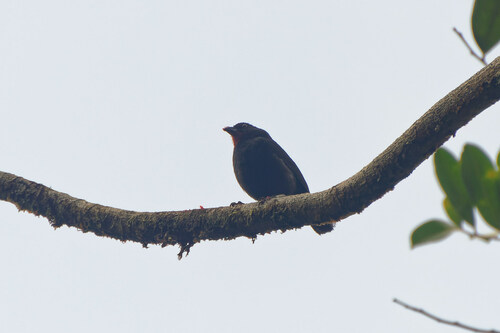 Lesser Antillean Bullfinch
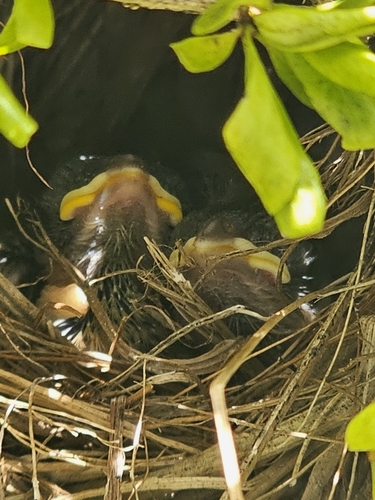 Black-faced Grassquit
In short
The most reliable field mark to separate Lesser Antillean Bullfinch from Black-faced Grassquit is overall plumage color and pattern, especially in adult males: bullfinch males are mostly black with a red supercilium and orangish-red throat, while grassquit males have a black face and throat but greenish upperparts and wings. Females are trickier, but bullfinch females are warm brown with rusty edges on the wings and undertail, whereas grassquit females are drab olive-green above and duller below. Juveniles of both species resemble their respective females, so focus on wing and undertail color. The bullfinch is noticeably heavier and bulkier, with a stouter bill, while the grassquit is smaller and more slender. Both species can occur in similar habitats, so careful attention to structure and plumage is essential.
Identification tips
- Adult male bullfinch is mostly black with a red supercilium and orangish-red throat—look for this combination, which is never shown by grassquit males.
- Adult male grassquit has a black face, throat, and underparts but greenish upperparts and wings—the greenish cast above is diagnostic and separates it from the all-black bullfinch male.
- Female and juvenile bullfinch are warm brown above with rusty edges on the greater coverts and rusty undertail coverts—check for these rufous tones, especially in flight or when perched with fanned tail.
- Female and juvenile grassquit are drab olive-green above, browner or grayer below, and lack rusty or rufous on wings and undertail—any hint of rufous suggests bullfinch.
- Bullfinch is larger and bulkier, with a noticeably heavier, more conical bill—if you see a chunky, big-headed finch, it's likely the bullfinch.
- Grassquit is smaller, lighter, and more delicate in build—often appears petite and quick-moving.
- Bullfinch males may show a red or orange throat patch and supercilium, but the size and intensity vary by subspecies—some subspecies have smaller or duller patches, so absence of bright red does not rule out bullfinch.
- Grassquit males never show red or orange on the face or throat—any such color points to bullfinch.
- Bullfinch females have a warm brown head with rusty lores; grassquit females are plain olive-green with no contrasting facial markings.
- In flight, look for rusty or rufous edges on the bullfinch's wings and undertail (all ages except adult males, which may have black in the undertail); grassquit shows uniform greenish or olive tones with no rufous.
- Both species have dark irises and dark legs, but bullfinch's legs may be darker grayish or black, while grassquit's are dusky pinkish—not always visible in the field.
- Bill color can help: bullfinch males have a black or dark brown bill; grassquit males have a black bill, but females of both species have a paler mandible—not always diagnostic.
- Grassquit males may perform aerial display flights with wing vibration and song—behavior not described for bullfinch.
- Habitat overlap is common, so do not rely on location alone unless you are outside the range of one species.
- If you hear a buzzy, emphatic song, it is likely grassquit; bullfinch song is not described here—use with caution unless you know the songs well.
Size
Lesser Antillean Bullfinch is significantly larger and heavier, averaging 18.4 g in body mass and measuring 14–15.5 cm in length. In contrast, Black-faced Grassquit is smaller and lighter, weighing 7–13 g and measuring 10.2–11.5 cm. The bullfinch appears bulkier with a more robust, conical bill, while the grassquit is more petite and delicate overall. This size difference is often apparent when both species are seen side by side, but can be subtle in isolation unless you have a good sense of local bird sizes.
Plumage
- Juveniles and Females: Both species are sexually dimorphic, but females and juveniles can cause confusion. Female and juvenile bullfinches are warm brown above with rusty edges on the greater coverts (wing) and rusty undertail coverts. Female and juvenile grassquits are drab olive-green above, browner or grayer below, and lack any rusty or rufous tones on the wings or undertail. This difference in wing and undertail color is a key field mark for non-males.
- Adult Males: Bullfinch males are mostly black with a red supercilium and orangish-red throat (amount varies by subspecies), sometimes with rufous-chestnut undertail coverts. Grassquit males have a black face, throat, and underparts, but their upperparts, wings, and tail are greenish (not black), and rear flanks are dark greenish. Some grassquit subspecies have brighter or paler olive-green upperparts, but none are all-black above.
- Subspecies Variation: Bullfinch subspecies differ mainly in the size and intensity of the red/orange throat and supercilium and the amount of rufous in the undertail. Grassquit subspecies vary in the brightness of olive-green upperparts and extent of black on the underparts, but all retain the greenish upperparts.
Behaviour
Both species are generally unobtrusive and forage low in vegetation or on the ground. The bullfinch, being larger and heavier, may appear more deliberate and robust in its movements, often feeding on seeds and fruit. The grassquit is more likely to be seen in small flocks or loose colonies, especially during the breeding season, and males sometimes perform short aerial displays with wing vibrations. Both species can be seen perched or foraging, but the grassquit's smaller size and more active, fluttery behavior may be noticeable with experience.
Habitat
Both species inhabit similar environments across the Lesser Antilles and nearby islands, including scrub, gardens, and open woodland. The grassquit is often found in grassy or weedy areas, sometimes in loose colonies, and can nest on or near the ground. The bullfinch is more associated with shrubby or wooded habitats but can also be found in gardens. Habitat is not a reliable separator where ranges overlap, so focus on plumage and structure.
Voice
Only the grassquit's vocalizations are described in the notes: its song is a buzzy, emphatic series, sometimes described as 'tse-tsee-tsee-tsizzle-tsizzle-tsizzle' or a thin 'tsit'l, tzil'ti, ti'teet', with a soft musical 'tsip' call. The bullfinch's vocalizations are not detailed in the provided notes, so voice is not a reliable separator unless you are familiar with their songs from experience.
Lesser Antillean Bullfinch · Black-faced Grassquit · My Tricky Birds