

Least Sandpiper vs Semipalmated Sandpiper
Calidris minutilla versus Calidris pusilla
Play a quiz with Least Sandpiper and Semipalmated Sandpiper
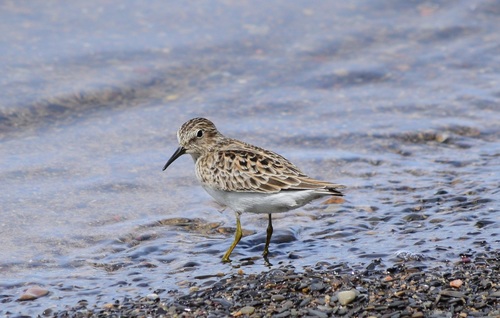 Least Sandpiper
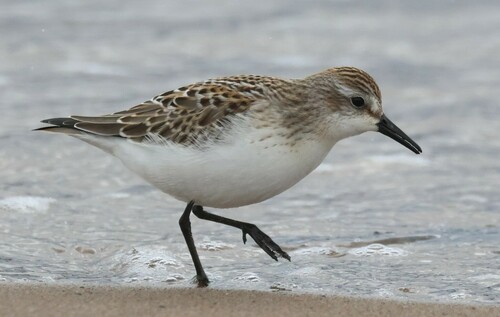 Semipalmated Sandpiper
In short
The most reliable field mark to separate Least Sandpiper from Semipalmated Sandpiper is leg color: Least Sandpiper always shows yellow-green legs, while Semipalmated Sandpiper has black legs. This difference is visible at all ages and seasons, though mud can sometimes obscure leg color. Juvenile Least Sandpipers are more rufous and boldly patterned above than juvenile Semipalmateds, which are plainer. Structurally, Least is slightly smaller, more compact, and has a finer, slightly decurved bill, while Semipalmated is bulkier with a thicker, straighter bill. Both species are small 'peeps' and can be confusing, especially in mixed flocks, but careful attention to legs, bill, and upperpart pattern will usually clinch the ID.
Identification tips
- Leg color is the most reliable field mark: Least Sandpiper has yellow-green legs (never black), while Semipalmated Sandpiper has black legs. Check this first, but beware of mud staining.
- Bill shape and thickness: Least Sandpiper has a fine, slightly decurved bill; Semipalmated's bill is thicker at the base, shorter, and usually straight. Bill shape is best judged in profile and at close range.
- Juvenile upperpart pattern: Juvenile Least Sandpipers are brighter and more rufous above, with crisp white mantle stripes and a scaly look; juvenile Semipalmateds are duller gray-brown, with less contrast and little to no rufous.
- Supercilium (eyebrow): Least Sandpiper shows a more obvious pale line above the eye, especially in juveniles and breeding adults. Semipalmated's supercilium is less distinct.
- Face and crown: Least has a darker, more contrasting crown and a paler face; Semipalmated is plainer and more uniform across the head.
- Size and structure: Least is smaller, more compact, and shorter-necked. Semipalmated is bulkier, with a proportionally larger head and longer wings. This is subtle and best used in direct comparison.
- Primary projection: Semipalmated often shows longer primary projection beyond the tertials, giving a longer-winged look at rest; Least appears shorter-winged.
- Toe structure (advanced): Semipalmated Sandpiper has partial webbing (semipalmation) between the toes, but this is rarely visible in the field. Least Sandpiper lacks this webbing.
- Feeding behavior: Least Sandpiper may feed closer to vegetation or at the muddy edge, while Semipalmated is more likely to wade into open mud or shallow water. Not diagnostic, but can help in context.
- Flock composition: Large, dense flocks in migration are more likely to be Semipalmated; Least is often in smaller groups or scattered at the edge of mixed flocks.
- Plumage in winter: Both species become grayer above, but Least remains paler and more delicate; Semipalmated is darker and plainer. Leg color remains a key separator.
- Flight views: Both show a narrow white wingbar, but this does not separate them. Use leg color and structure if visible.
- Voice: Not described in the provided notes; do not rely on vocalizations for separation based on this information.
- Pitfalls: Mud can obscure leg color, and lighting can make bill shape hard to judge. Juvenile Semipalmateds can appear slightly warmer above, but never as rufous or crisply marked as juvenile Least.
- Seasonal context: Both species migrate together and can be found in the same habitats. Juvenile Least Sandpipers are especially bright and distinctive in late summer and early fall.
Size
Least Sandpiper is the smallest North American shorebird, measuring 13–15 cm in length with a wingspan of 27–28 cm and weighing 19–30 g [wikipedia]. Semipalmated Sandpiper is slightly larger, at 15–18 cm long, with a wingspan of 35–37 cm and weight of 18–51.5 g [wikipedia]. In the field, this size difference is subtle and often masked in mixed flocks, but Semipalmated generally appears bulkier and longer-winged, especially in direct comparison.
Plumage
- Juvenile/first-autumn birds: Least Sandpiper juveniles are distinctly rufous above, with bright mantle stripes and a crisp, scaly pattern; Semipalmated juveniles are duller, more gray-brown above, with less contrast and lacking strong rufous tones. Least also shows a more obvious pale supercilium (eyebrow).
- Adults (breeding): Least Sandpiper is brown above with dark streaks and a pale line above the eye; Semipalmated is darker gray-brown above, with a less distinct supercilium and a generally plainer face.
- Adults (non-breeding/winter): Both species become grayer above, but Least retains a paler, more delicate look, while Semipalmated is darker and plainer. Leg color remains diagnostic year-round.
- Flight/upperwing: No unique upperwing pattern is described for either species in these sources, so focus on structure and leg color in flight. Both show a narrow white wingbar, but this is not a reliable separator.
Behaviour
Both species forage actively on mudflats, picking at the surface or probing for small invertebrates. Least Sandpipers often appear more delicate and precise in their movements, sometimes feeding at the very edge of muddy pools or in slightly more vegetated areas. Semipalmated Sandpipers can form very large, dense flocks and may be more likely to wade into shallow water. In mixed flocks, Least Sandpipers may be slightly more scattered and less tightly packed than Semipalmateds.
Habitat
Habitat overlap is extensive during migration, with both species using mudflats, shorelines, and the edges of ponds. Least Sandpiper may be more likely to use slightly muddier or more vegetated microhabitats, while Semipalmated prefers open, wetter mud or sand. However, this is not a reliable field separator where both occur together.