

Laysan Albatross vs Black-browed Albatross
Phoebastria immutabilis versus Thalassarche melanophris
Play a quiz with Laysan Albatross and Black-browed Albatross
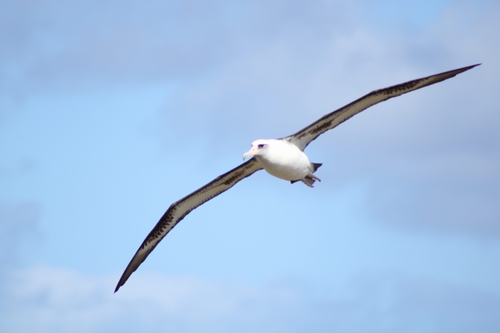 Laysan Albatross
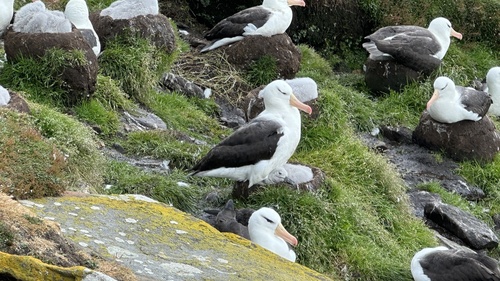 Black-browed Albatross
In short
The most reliable field mark to separate Laysan Albatross from Black-browed Albatross is the underwing pattern: Laysan shows variable, usually narrow black margins and some black in the underwing coverts, while Black-browed has broad, bold black edges to the underwing, especially in adults. Juveniles of both species have darker underwings, but Black-browed's are more extensively and uniformly dark-edged. Structurally, Laysan is slightly smaller and has a pink bill with a dark tip, while Black-browed has a yellow-orange bill with a darker orange tip. In perched or close views, Laysan's black eye smudge is less pronounced than the Black-browed's strong dark eyebrow. Both are large, two-toned albatrosses, but careful attention to underwing pattern, bill color, and facial markings will separate them in almost all field situations.
Identification tips
- Underwing pattern in flight (all ages): Laysan shows narrow, variable black margins and some black in the underwing coverts; Black-browed has a broad, bold, irregular black edge to the underwing. This is the single most reliable mark, especially at a distance or in flight.
- Juvenile underwing: Juvenile Black-browed has more extensively dark underwings with broad black margins, while juvenile Laysan's are patchier and less bold. Use this for immatures seen in flight.
- Bill color (adults): Laysan has a pink bill with a dark tip; Black-browed has a yellow-orange bill with a darker orange tip. This is obvious at close range but can be hard to judge at sea.
- Bill color (juveniles): Juvenile Laysan has a gray bill; juvenile Black-browed has a dark horn-colored bill with a dark tip. If you see a gray bill, think Laysan.
- Facial markings: Laysan has a black smudge around the eye, but Black-browed has a much more pronounced dark eyebrow (the 'brow'), giving a more striking facial expression. If the eyebrow is bold and obvious, it's Black-browed.
- Head and collar (juveniles): Juvenile Black-browed shows a gray head and collar, while Laysan juveniles have a white head with only a dark eye smudge.
- Upperwing and back: Both have dark upperwings, but Laysan's mantle and back are blackish-gray with a white head and underparts. Black-browed's upperwing is dark gray with a white rump and underparts, but this is subtle and not diagnostic alone.
- Rump color: Laysan has a white lower rump; Black-browed has a white rump that contrasts with the dark saddle, but this is not a strong field mark unless seen well.
- Size and structure: Black-browed is slightly larger and bulkier, with a longer wingspan, but the difference is subtle and not reliable unless both are together.
- Habitat and range: In the North Pacific, Laysan is vastly more likely; Black-browed is a Southern Ocean species and a true vagrant in the North Pacific. Use range as a strong supporting clue.
- Behavior at colony: Black-browed is noisy, braying and cackling, and uses its fanned tail in displays. Laysan's courtship is elaborate but not described as noisy in the notes.
- Sex and age effects: Both species show sexual size dimorphism (males larger), but this is not useful in the field. Juvenile and immature marks (underwing, bill color, head pattern) are more reliable than adult differences.
- Hybridization: Laysan can hybridize with Black-footed Albatross, but not with Black-browed; hybrids are not a concern here.
- Pitfalls: Do not rely on overall darkness or size alone. Focus on underwing pattern, bill color, and facial markings for confident separation.
- When marks fail: In poor light or at extreme distance, range and underwing pattern are your best clues. If in the North Pacific, default to Laysan unless the underwing and eyebrow are a perfect match for Black-browed.
Size
Laysan Albatross is slightly smaller, averaging 81 cm in length with a 195–203 cm wingspan and males weighing 2.4–4.1 kg (females 1.9–3.6 kg) [wikipedia][avonet]. Black-browed Albatross is 80–95 cm long, with a 200–240 cm wingspan and weighs 2.9–4.7 kg [wikipedia][avonet]. The overlap is considerable, but Black-browed is usually bulkier and longer-winged, especially compared to female Laysans. In the field, size alone is rarely diagnostic unless both species are side by side.
Plumage
- Juvenile/immature plumage (flight views):
- Laysan juveniles have a gray bill, dark upper rump, and variable black in the underwing coverts, but the black is usually less extensive than in Black-browed. Their underwing margins are narrower and more variable, sometimes appearing patchy or uneven.
- Black-browed juveniles have a dark horn-colored bill with a dark tip, a gray head and collar, and dark underwings with broad, irregular black margins—much more extensive and bold than in Laysan. The head and collar can appear dusky, and the underwing pattern is a strong field mark at all ages.
- Adult plumage:
- Laysan adults have a white head and underparts, blackish-gray upperwings and back, and a pink bill with a dark tip. The black eye smudge is present but not as bold as Black-browed's eyebrow. Underwing pattern is variable but never as broad-edged as Black-browed.
- Black-browed adults have a striking dark eyebrow, white head, and a yellow-orange bill with a darker tip. The underwing is white with a broad, irregular black margin—this is the key mark. The upperwing saddle is dark gray, contrasting with a white rump and underparts.
- Key contrast: Underwing pattern (especially in flight) is the most reliable: Laysan = narrow, variable black; Black-browed = broad, bold black edge.
Behaviour
Both species are colonial nesters and can be seen soaring over the ocean with long, stiff-winged glides. Laysan is described as 'gull-like' in flight, with a two-toned appearance and slightly more buoyant flight. Black-browed is often seen braying and cackling at colonies, using its fanned tail in courtship displays. In the field, flight style is very similar and not a strong separator, but Black-browed may appear slightly heavier and more powerful in direct comparison.
Habitat
Laysan Albatross is overwhelmingly found in the North Pacific, especially around the Northwestern Hawaiian Islands, and is the second most common seabird in Hawaii [wikipedia][ebird]. Black-browed Albatross is a Southern Ocean species, breeding on subantarctic islands and rarely appearing as a vagrant in the North Atlantic or Pacific. If seen in the North Pacific, Laysan is vastly more likely; Black-browed is a true rarity there. Both species nest colonially, but Black-browed often uses steep grassy slopes or cliffs, while Laysan nests on sandy or vegetated low islands.
Voice
Black-browed Albatross is noted for its noisy colonies, with braying and harsh cackling calls, especially during territory defense and courtship. Laysan's vocalizations are not described in the provided notes, and are not a reliable field mark for separation at sea.