

Large-tailed Nightjar vs Jerdon's Nightjar
Caprimulgus macrurus versus Caprimulgus atripennis
Play a quiz with Large-tailed Nightjar and Jerdon's Nightjar
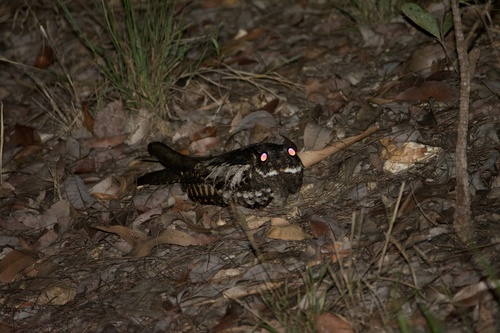 Large-tailed Nightjar
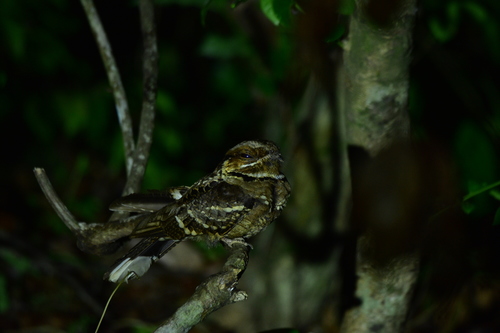 Jerdon's Nightjar
In short
The most reliable field mark to separate Large-tailed Nightjar from Jerdon's Nightjar is the tail: Large-tailed Nightjar has a distinctly longer, broader tail with prominent white patches on the outer feathers (especially in flight), while Jerdon's Nightjar has a noticeably shorter tail with less extensive white. In flight, adult male Large-tailed Nightjars show large white patches on both primaries and outer tail feathers, whereas Jerdon's Nightjar males have a white wing patch but a shorter, less striking tail. Perched, Large-tailed Nightjar appears bulkier and longer-tailed, with a pale crown and bold scapular pattern, while Jerdon's Nightjar is more compact, with a uniform crown and a blackish collar. Vocalizations are also very different and can be diagnostic if heard. Both species are cryptic and can be challenging to separate on plumage alone, especially females and immatures, but structural and flight marks are key.
Identification tips
- Tail length and structure: Large-tailed Nightjar has a much longer and broader tail than Jerdon's Nightjar. This is especially obvious in flight or when the tail is spread; use this as your first check in all ages and sexes.
- Tail pattern in flight: Adult male Large-tailed Nightjar shows large white patches on the outer tail feathers, while Jerdon's Nightjar's tail is shorter with less extensive white. Females of both species have less white, but the tail length difference remains reliable.
- Primary patch in flight: Large-tailed Nightjar males have large white patches on the primaries, visible as bold flashes in flight. Jerdon's Nightjar males have a white wing patch, but it is less extensive and the shorter tail is a giveaway.
- Crown and scapulars (perched): Large-tailed Nightjar males have a pale crown with a dark median stripe and a prominent row of black scapulars with broad buff or whitish fringes. Jerdon's Nightjar has a more uniform crown with fine vermiculations and a blackish collar, lacking the bold scapular contrast.
- Gorget and collar: Both species have a white gorget, but Jerdon's Nightjar's is unbroken and bordered by a blackish collar, while Large-tailed Nightjar's is set off by a paler crown and more contrasty scapulars.
- Body size and jizz: Large-tailed Nightjar is noticeably larger and bulkier, with a more elongated silhouette and longer tail. Jerdon's Nightjar is smaller, more compact, and shorter-tailed. This is apparent both perched and in flight.
- Sexual dimorphism: Female Large-tailed Nightjars are paler and greyer with smaller buff wing patches and less vibrant tail patches, but still longer-tailed than Jerdon's Nightjar females. Female Jerdon's are drabber and shorter-tailed.
- Flight style: Both species have silent, fluttering flight, but Large-tailed Nightjar's longer tail gives a more languid, trailing impression, while Jerdon's Nightjar appears more moth-like and compact.
- Habitat context: If seen in dense forest, plantations, or agricultural land in Southeast Asia or Australia, Large-tailed Nightjar is more likely. In southern India or Sri Lanka, especially in open woodland or scrub, Jerdon's Nightjar is more likely.
- Roosting behavior: Jerdon's Nightjar is less likely to be found on roads at night and may perch on bushes, while Large-tailed Nightjar is more often found on the ground or low perches.
- Vocalizations: Large-tailed Nightjar's song is a monotonous, deep 'wroww' or 'wrrrog', while Jerdon's Nightjar gives a wooden-plank-like call or fast 'ch-woo-woo.' If you hear the call, this is diagnostic.
- Geographic range: If you are outside southern India/Sri Lanka, Large-tailed Nightjar is far more likely. In areas of overlap (northeast Indian peninsula), rely on structure and vocalizations.
- Plumage pitfalls: Both are cryptic and can appear similar when roosting. Focus on tail length, wing patches, and crown pattern for reliable separation.
- Age/season: No distinctive juvenile/immature upperwing pattern is described for either species, so use adult marks for all ages unless more detail is available.
- When in doubt: If the bird is silent and partially obscured, prioritize tail length and structure, then look for crown and scapular contrast, and finally consider habitat and range.
Size
Large-tailed Nightjar is the larger of the two, measuring about 31.5–33 cm in length [wikipedia], while Jerdon's Nightjar is smaller at around 26 cm [wikipedia]. This size difference is noticeable in the field, especially when comparing perched birds or birds in flight side by side. Large-tailed Nightjar also appears bulkier and longer-tailed, contributing to a more elongated silhouette, whereas Jerdon's Nightjar is more compact and proportionally shorter-tailed.
Plumage
- Juvenile/Immature/First-winter (where known): No explicit juvenile/immature wing pattern differences are described for these species in the sources, so focus falls on adult and sex-based differences.
- Adult males: Large-tailed Nightjar males have a pale crown with a dark median stripe, a prominent row of black scapular feathers edged with broad buff or whitish-buff, a white throat patch, and a long, broad brown tail with uneven dark bars and large white patches on the primaries and outer tail feathers (especially visible in flight). Jerdon's Nightjar males have a more uniform crown with fine vermiculations, a blackish collar, a white wing patch, and a shorter, barred tail with less extensive white. Both species have cryptic, variegated brown and buff plumage, but Large-tailed Nightjar is more boldly marked overall.
- Adult females: Female Large-tailed Nightjars are paler and greyer than males, with smaller buff wing patches and less vibrant tail patches, giving a drabber look. Female Jerdon's Nightjars are also cryptic and variegated, but with a shorter tail and less contrast overall. Both species have a white gorget, but Jerdon's is unbroken and the collar is blackish.
- In flight: Large-tailed Nightjar shows large white patches on primaries and outer tail feathers (especially in males), while Jerdon's Nightjar shows a white wing patch but a shorter tail with less white. The tail length and pattern are the most reliable features in flight.
Behaviour
Both species are nocturnal and highly cryptic, roosting on the ground during the day and relying on camouflage. Large-tailed Nightjar is more likely to be found in secondary forests, forest edges, plantations, and even agricultural areas, sometimes perching in open or semi-open sites. Jerdon's Nightjar prefers open woodland, scrub, and cultivation, but is less likely to rest on roads at night (unlike some other nightjars), often alighting on bushes and calling from trees. Both species feed on nocturnal insects, but Jerdon's Nightjar's habit of perching off the ground at night can be a subtle behavioral clue.
Habitat
Large-tailed Nightjar has a much broader range, occurring from the southern Himalayan foothills through Southeast Asia to northern Australia, and is found in a variety of moist lowland, mangrove, and montane forests, as well as forest edges, plantations, and even agricultural landscapes. Jerdon's Nightjar is restricted to southern India and Sri Lanka, favoring open woodland, scrub, and cultivated areas. If you are in the core range of one species, this can help narrow down the ID, but there is some overlap in northeastern India. Both species are ground-nesters, laying eggs directly on leaf litter or bare ground.
Voice
Vocalizations are highly diagnostic. Large-tailed Nightjar gives a distinctive, monotonous territorial song (often described as a repeated 'wroww' or fast 'wrrrog/grrrog'), with deep, low-pitched notes and occasional grunting calls. Jerdon's Nightjar, in contrast, has a unique call likened to a wooden plank being beaten, each note ending in a quaver; another call is a fast repetitive 'ch-woo-woo' and a frog-like croak. If you hear the call, separation is straightforward.