

Large Hawk-Cuckoo vs Northern Hawk-Cuckoo
Hierococcyx sparverioides versus Hierococcyx hyperythrus
Play a quiz with Large Hawk-Cuckoo and Northern Hawk-Cuckoo
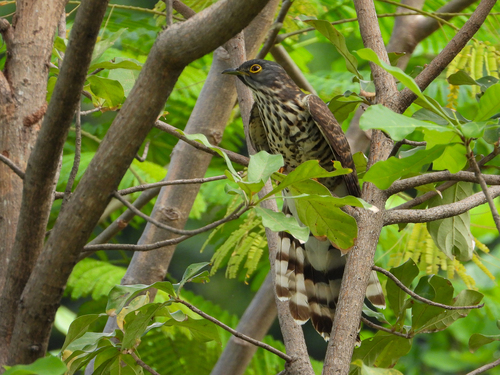 Large Hawk-Cuckoo
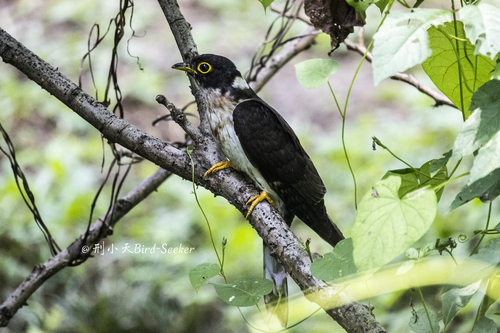 Northern Hawk-Cuckoo
In short
The most reliable field mark between Large Hawk-Cuckoo and Northern Hawk-Cuckoo is the presence of a distinctive white wing patch on the folded wing of Northern Hawk-Cuckoo, visible when perched and in flight, especially in juveniles and subadults. Large Hawk-Cuckoo lacks this white wing patch entirely. Juvenile Northern Hawk-Cuckoo also shows a brown crown with white nape spots and streaked underparts, while Large Hawk-Cuckoo juveniles are less well described but do not show this combination. Structurally, Northern Hawk-Cuckoo is slightly smaller and slimmer, but this is subtle in the field. Both species can be confused due to similar overall hawk-like shape and coloration, but careful attention to wing pattern and underpart color will separate them.
Identification tips
- White wing patch (Northern only): Look for a bold white patch on the folded wing when perched, or as a flash in flight. This is present in all ages of Northern Hawk-Cuckoo and absent in Large Hawk-Cuckoo.
- Juvenile pattern (Northern): Juvenile Northern Hawk-Cuckoo shows a brown crown with white nape spots, brown/rufous streaks on the back, and white underparts with black streaks and spots. Large Hawk-Cuckoo juveniles are not described with these features.
- Rufous underparts (Northern): Adults and subadults of Northern Hawk-Cuckoo have extensive rusty red underparts, blending from the lower cheeks down. Large Hawk-Cuckoo lacks this overall rufous wash.
- Black chin patch (Large only): Adult Large Hawk-Cuckoo has a distinct black patch on the chin, which is not present in Northern Hawk-Cuckoo of any age.
- Tail pattern: Both have banded tails, but Northern Hawk-Cuckoo's tail ends with a large black subterminal band and a rufous tip, while Large Hawk-Cuckoo's tail pattern is less distinctly described here.
- Eyering and iris color: Northern Hawk-Cuckoo has a yellow eyering with variable iris color (orange, brown, or white), but this is not described for Large Hawk-Cuckoo and may not be reliable at distance.
- Bill color: Northern Hawk-Cuckoo has a yellow base to the bill with a black tip; bill details for Large Hawk-Cuckoo are not provided.
- Under tail coverts: Northern Hawk-Cuckoo shows white under tail coverts; this is not specified for Large Hawk-Cuckoo.
- Size: Large Hawk-Cuckoo is somewhat larger and heavier, but this is subtle and not always useful unless both are seen together.
- Perching height: Northern Hawk-Cuckoo is more likely to be seen perched high in the canopy, often making observation challenging.
- Range: In far eastern Asia (Japan, Korea, eastern China), Northern Hawk-Cuckoo is more likely, but Large Hawk-Cuckoo can overlap in East Asia. Use range only as supporting context.
- Voice: Large Hawk-Cuckoo’s call is loud and repetitive but does not rise in crescendo. Northern Hawk-Cuckoo’s song is different but not described here; use with caution.
- Season: Both are migratory, but Northern Hawk-Cuckoo winters further south (Borneo). Timing may help but is not diagnostic on its own.
- Confusion with Common Hawk-Cuckoo: Large Hawk-Cuckoo is larger and has a black chin patch, while Northern Hawk-Cuckoo is more rufous and has the white wing patch.
- When in doubt: The combination of white wing patch (Northern), black chin patch (Large), and underpart color are the most reliable field marks. Juveniles are best separated by the white wing patch and streaked underparts in Northern.
Size
Northern Hawk-Cuckoo is somewhat smaller and lighter than Large Hawk-Cuckoo, with a recorded body mass of 120g. While exact measurements for Large Hawk-Cuckoo are not provided here, it is described as 'somewhat larger' than its congeners. In the field, this difference is subtle and not always reliable unless both species are seen together. Both have a long-tailed, slim profile typical of hawk-cuckoos.
Plumage
- Juvenile and Subadult Northern Hawk-Cuckoo: Shows a prominent white patch on the inner flight feathers, visible as a panel on the folded wing when perched and in flight. Juveniles have a brown crown with white nape spots, brown and rufous streaks on the back, and white underparts with black streaks and spots. The tail is banded and tipped rufous. Subadults retain the white wing patch and have irregular black streaks and spots on the flanks and breast, with some rufous on the lower back.
- Adult Northern Hawk-Cuckoo: Slate grey head, back, and wings, rusty red underparts, white throat and grey chin, yellow eyering, and a white under tail covert. The white wing patch remains visible. Tail is banded with narrow black and broad pale bands, ending with a large black subterminal band and rufous tip.
- Large Hawk-Cuckoo (all ages): Lacks the white wing patch entirely. Adults have a black patch on the chin, which is absent in Northern Hawk-Cuckoo. Underparts are not described as rusty red, and the overall coloration is less rufous than Northern Hawk-Cuckoo. Juvenile plumage is not detailed, but no mention is made of a white wing patch or the distinctive juvenile pattern of Northern Hawk-Cuckoo.
- Key contrast: The white wing patch (Northern only), rusty red underparts (Northern), and black chin patch (Large only, adult) are the most diagnostic plumage features.
Behaviour
Northern Hawk-Cuckoo is described as elusive and tends to perch high in the crowns of tall trees, making it difficult to observe directly. Both species are brood parasites and share hawk-like flight and perching behavior. There is no mention of behavioral differences in flight style or foraging that would reliably separate them in the field.
Habitat
Large Hawk-Cuckoo breeds along the Himalayas and temperate Asia, extending to East Asia, and winters further south. Northern Hawk-Cuckoo is found in eastern China, Korea, far eastern Russia, and Japan, wintering in Borneo. While ranges overlap in East Asia, Northern Hawk-Cuckoo is considered rare and more elusive, often in higher canopy. Habitat alone is not diagnostic where ranges overlap, but Northern is more likely in far eastern regions and at higher perches.
Voice
Large Hawk-Cuckoo gives loud, repetitive calls similar to Common Hawk-Cuckoo but without a rising crescendo. No specific vocal description is provided for Northern Hawk-Cuckoo here, but it is noted that differences in song were part of the taxonomic split. In the field, vocalizations may help, but without a clear description for Northern, this is not a primary separation point.