

Karoo Long-billed Lark vs Black-bellied Starling
Certhilauda subcoronata versus Notopholia corusca
Play a quiz with Karoo Long-billed Lark and Black-bellied Starling
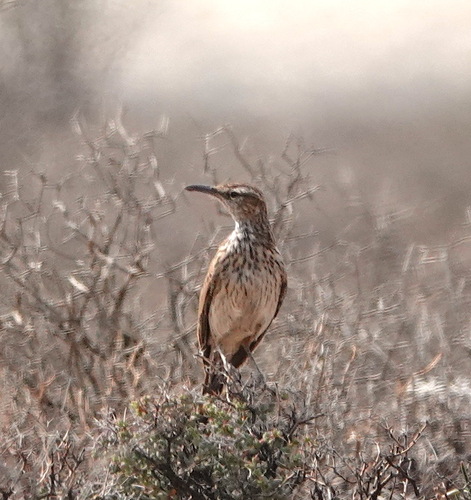 Karoo Long-billed Lark
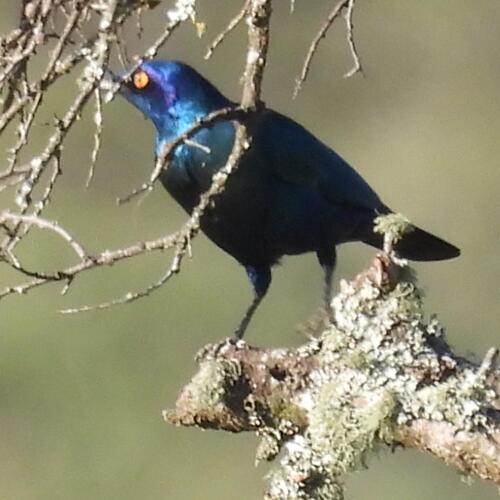 Black-bellied Starling
In short
The most reliable field mark to separate Karoo Long-billed Lark from Black-bellied Starling is overall structure and plumage: the lark is a streaky, earth-toned, long-billed ground bird of dry shrubland, while the starling is a glossy, dark, short-billed, arboreal species. In any age or season, the lark shows a long, decurved bill and cryptic coloration, while the starling is strikingly dark and iridescent with a compact, upright stance. If you see a streaky, sandy bird on the ground in arid country, it's the lark; a glossy, dark bird in a tree is the starling. These two are unlikely to be confused except in fleeting views, but structure and context are decisive.
Identification tips
- Bill shape and length: The lark has a long, decurved bill, always obvious in profile; the starling's bill is short, straight, and pointed. This is visible at any age or angle.
- Plumage gloss: Black-bellied Starling is glossy and iridescent, especially in good light; the lark is always matte and earth-toned. Even in shade, the starling looks dark and uniform, while the lark is streaky and sandy.
- Underparts: The starling has a uniformly dark (blackish) belly and breast, while the lark has pale, streaked or spotted underparts. This is clear in perched birds and often in flight.
- Streaking: Only the lark is streaked above and below; the starling is never streaked.
- Eye color: The starling's iris can change color with mood, but this is subtle and not a reliable field mark. The lark's eye is dark and unremarkable.
- Leg color: Not diagnostic from the notes, but the lark often shows pale or pinkish legs, while the starling's legs are dark.
- Posture and jizz: The lark is horizontal, often crouched low to the ground; the starling is upright and perches high.
- Habitat: Lark in open, dry shrubland; starling in woodland, forest edge, or gardens. If you see a 'lark' in a tree, reconsider.
- Flight style: Lark flies low and undulating; starling flies directly between perches.
- Group size: Larks are usually solitary or in pairs; starlings are often in small, noisy flocks.
- Tail shape: Not detailed in the notes, but larks often have longer, more graduated tails; starlings have shorter, squarer tails.
- Vocalizations: Not described in the notes, so not a reliable separator here.
- Juvenile confusion: Even young starlings are dark and glossy, never streaked or sandy; juvenile larks are streaked and cryptic.
- Geographic context: If in the Karoo or similar arid zone, expect lark; if in eastern or coastal woodland, expect starling.
- Perched vs. foraging: Lark forages on ground, starling often in trees or bushes.
Size
Direct size comparison is not possible from the available notes, but both species are medium-sized passerines. The starling may appear slightly bulkier and more compact, while the lark is more elongated, particularly due to its long bill and tail. In the field, the lark's proportions are more slender and horizontal, while the starling is more upright and robust.
Plumage
Plumage is the most obvious separator at all ages. The Karoo Long-billed Lark is earth-toned, with streaked upperparts and a pale, streaked or spotted breast, blending well with dry shrubland. It never shows iridescence. Juvenile and adult larks are similarly cryptic, with no strong contrast or glossy areas. The Black-bellied Starling, in contrast, is glossy blackish or dark with a metallic sheen, especially in adults. Its underparts are uniformly dark (hence the name), and it lacks any streaking or sandy tones. Even immature starlings are much darker and glossier than any lark, and never show the lark's streaked, camouflaged pattern. There are no distinctive age-specific upperwing patterns noted for either species, but the overall color and gloss are diagnostic.
Behaviour
Behavior is a strong clue: Karoo Long-billed Lark is almost always seen on the ground, walking or running in open, dry shrubland, often alone or in pairs. It rarely perches high. Black-bellied Starling is typically arboreal, foraging in trees or shrubs, and often seen in small groups. It perches upright and may be active and noisy. Flight style also differs: the lark has a bounding, undulating flight low over the ground, while the starling flies more directly between trees.
Habitat
Habitat is a key separator. Karoo Long-billed Lark is restricted to subtropical or tropical dry shrubland in southern Africa, especially the Karoo and similar arid zones. Black-bellied Starling is found in a much wider range, including woodland, forest edge, and gardens across eastern and southern Africa, but is not a bird of open, dry shrubland. If you are in true Karoo habitat, the starling is very unlikely; in woodland or urban areas, the lark is out of place.
Karoo Long-billed Lark · Black-bellied Starling · My Tricky Birds