

Iberian Chiffchaff vs Greenish Warbler
Phylloscopus ibericus versus Phylloscopus trochiloides
Play a quiz with Iberian Chiffchaff and Greenish Warbler
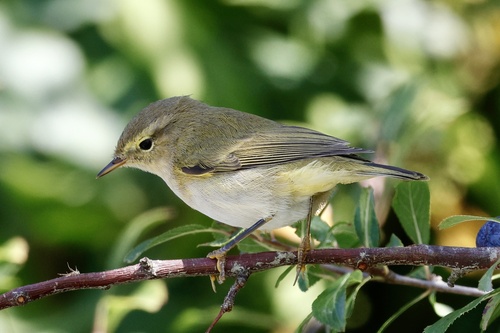 Iberian Chiffchaff
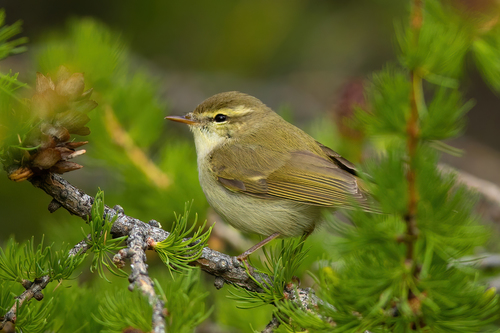 Greenish Warbler
In short
The most reliable field mark between Iberian Chiffchaff and Greenish Warbler is the presence of a clear single wing bar on most Greenish Warblers, which is absent in Iberian Chiffchaff of all ages. Iberian Chiffchaff shows a brighter, cleaner green upperpart and yellow breast, while Greenish Warbler is duller grayish-green above and off-white below. Structure is similar, but Greenish Warbler tends to be slightly smaller and slimmer-billed. Voice and habitat can help, but in Western Europe, Greenish Warbler is a rare migrant or vagrant, while Iberian Chiffchaff is a local breeder. Focus on wing pattern, upperpart tone, and underpart color for the most practical separation.
Identification tips
- Check for a wing bar: Greenish Warbler (all ages, especially western populations) shows a clear single pale wing bar on the greater coverts, sometimes with a faint second bar. Iberian Chiffchaff always lacks wing bars. This is the quickest and most reliable separation, especially in autumn or with immature birds.
- Upperpart color: Iberian Chiffchaff has brighter, cleaner green upperparts with no brown hue, while Greenish Warbler is duller, grayish-green above.
- Underpart color: Iberian Chiffchaff shows a yellow breast and white belly, often reminiscent of Willow Warbler, while Greenish Warbler is off-white below, sometimes with a yellowish wash on the throat and breast but generally less bright.
- Eyestripe and supercilium: Iberian Chiffchaff has a distinct dark eyestripe, enhancing the Willow Warbler-like look. Greenish Warbler's supercilium is more yellowish and less sharply defined, with a less contrasting eyestripe.
- Bill structure: Greenish Warbler's bill is slightly thinner and lacks a dark tip to the lower mandible, but this is subtle and not always visible in the field.
- Song: Iberian Chiffchaff's song is a fast, monotonous series with rattles and drawn-out whistles, not the classic 'chiff-chaff'. Greenish Warbler's song is a high, jerky trill, sometimes with slurred notes, and is more uniform and warbling. If you hear a classic 'chiff-chaff', it's neither of these.
- Size and shape: Greenish Warbler is marginally smaller and slimmer-billed, but this is a minor difference and not reliable without direct comparison.
- Habitat and range: In Western Europe, Iberian Chiffchaff is a local breeder; Greenish Warbler is a rare migrant or vagrant, so context can help but is not a field mark.
- Flight views: In flight, the wing bar(s) of Greenish Warbler can be conspicuous, while Iberian Chiffchaff's wings are plain.
- Season: In autumn, Greenish Warbler is more likely as a vagrant, but Iberian Chiffchaff is resident/breeding in its range. Use this as supporting evidence, not a primary mark.
- Juvenile birds: The presence or absence of a wing bar is especially useful in juveniles and first-winters, as other plumage features can be less distinct.
- Pitfalls: Do not confuse Iberian Chiffchaff's yellow breast and white belly for Greenish Warbler's off-white underparts; the overall brightness and green tone are key.
- Supercilium confusion: Both can show a pale supercilium, but Greenish Warbler's is more yellowish and less sharply defined.
- Mixed flocks: If seen with other Phylloscopus warblers, compare directly for wing bar and upperpart color.
- When in doubt: If the bird shows any wing bar, rule out Iberian Chiffchaff; if the bird is bright green above and yellow-breasted with no wing bar, Iberian Chiffchaff is favored.
Size
Both species are small leaf warblers and broadly similar in size, but Greenish Warbler is slightly smaller and slimmer-billed compared to Iberian Chiffchaff. This difference is subtle and not always reliable in the field, especially without direct comparison. [wikipedia]
Plumage
- Juvenile/First-winter/Immature birds: Greenish Warbler (especially western populations) typically shows a distinct single pale wing bar on the greater coverts, sometimes with a faint second bar, visible both perched and in flight. Iberian Chiffchaff lacks any wing bar at all ages, showing uniform wing coverts. This is the most immediate separation in the field for non-adult birds.
- Adults: Iberian Chiffchaff has clean green upperparts with no brown hue, a yellow breast, and white belly, often with a distinct dark eyestripe. Greenish Warbler is duller, grayish-green above and off-white below, sometimes with a yellowish supercilium and throat, but generally less bright than Iberian Chiffchaff. The wing bar(s) remain a key mark in adults as well.
- Supercilium and eyestripe: Both have a supercilium, but Greenish Warbler's is often more yellowish and less sharply defined than the dark eyestripe of Iberian Chiffchaff.
- Bill: Greenish Warbler's bill is thinner and lacks a dark tip to the lower mandible, but this is subtle and not always visible.
Behaviour
Both species are active, restless foragers in foliage, typical of Phylloscopus warblers. No strong behavioral differences are noted in the sources. Both flick wings and tails but do not show distinctive jizz differences that are diagnostic between the two.
Habitat
Iberian Chiffchaff breeds in southwestern Europe and northwestern Africa, favoring woodland and scrub. Greenish Warbler breeds in northeastern Europe and across continental Asia, typically in lowland deciduous or mixed forest, and is a rare vagrant in Western Europe. In Western Europe, finding a Greenish Warbler in breeding season is highly unlikely; context can be a clue, but not a field mark.
Voice
Iberian Chiffchaff's song is not the classic 'chiff-chaff' but a faster, more monotonous series with rattles and drawn-out whistles ("chiff-chiff-chiff-chiff-dr-dr-dr-dr-swit-swit-swit"). Greenish Warbler's song is a high, jerky trill, sometimes with down- or upslurred notes, and is more uniform and warbling than the Iberian Chiffchaff. Calls are not described as diagnostic between these two, but song structure can help if heard well.