

House Sparrow vs Rock Sparrow
Passer domesticus versus Petronia petronia
Play a quiz with House Sparrow and Rock Sparrow
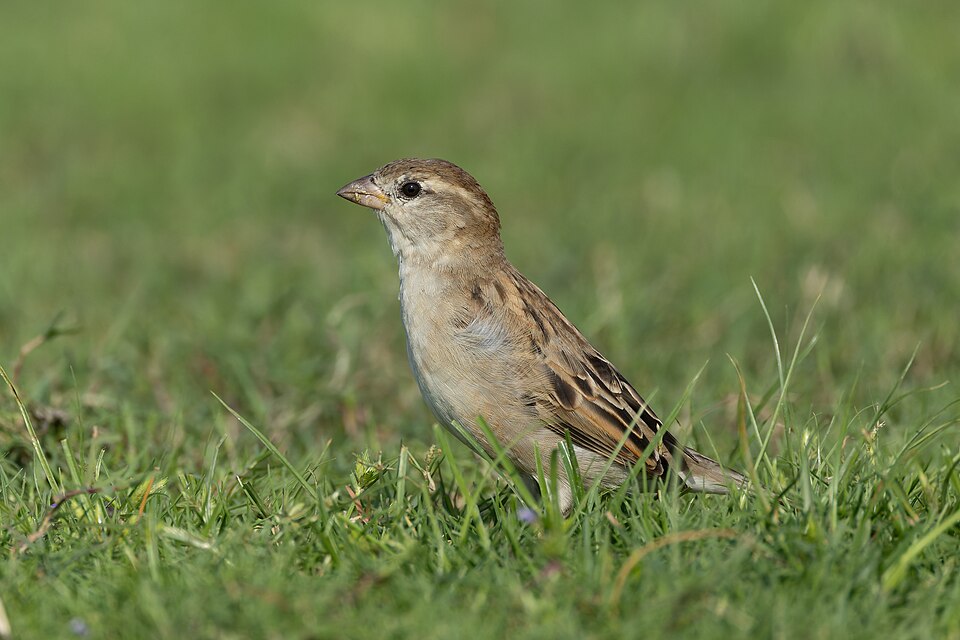 House Sparrow
 Rock Sparrow
In short
The most reliable field mark to separate House Sparrow from Rock Sparrow is the presence of a yellow throat or upper breast patch on Rock Sparrow—this is diagnostic but can be subtle at a distance. Rock Sparrow also shows a strong whitish supercilium (eyebrow) and a distinctly larger, more conical bill, while House Sparrow males have a bold black bib and chestnut head markings. Juvenile and female House Sparrows are plain-faced and lack the yellow throat, making confusion with Rock Sparrow most likely in drab birds. In flight or perched, look for Rock Sparrow's streaked underparts and overall more monochrome brown tones, versus the warmer, more patterned look of House Sparrow. Structure, especially bill size and shape, is a reliable backup in all ages and seasons.
Identification tips
- Yellow throat/upper breast patch: Only Rock Sparrow shows a yellow patch on the upper breast or throat, present in both sexes and all ages. This is diagnostic but can be hard to see at a distance or in dull light.
- Whitish supercilium: Rock Sparrow has a strong, pale eyebrow stripe, much more prominent than the weak or absent supercilium of House Sparrow (especially in females and juveniles).
- Bill size and shape: Rock Sparrow's bill is noticeably larger and more conical than House Sparrow's, even in juveniles. This is a reliable structural difference at all ages and seasons.
- Head pattern (male House Sparrow): Adult male House Sparrows have a grey crown, chestnut sides to the head, bold black bib, and white cheeks (grey in some subspecies). Rock Sparrow lacks these contrasting head markings.
- Underpart streaking: Rock Sparrow shows streaked underparts, while House Sparrow is plain below (males grey, females buffy).
- Overall coloration: Rock Sparrow is more monochrome brown with earth tones, while House Sparrow (especially males) shows warmer browns and more contrast.
- Juvenile confusion: Juvenile House Sparrows are plain, with poorly defined supercilia and no yellow throat. Juvenile Rock Sparrows should still show the yellow patch and strong supercilium.
- Face pattern (female/immature): Female and immature House Sparrows have plain faces and lack any yellow or strong eyebrow, while Rock Sparrow of all ages and sexes shows a strong supercilium and yellow throat.
- Flight views: No distinctive upperwing or flight marks are described for either species; rely on structure and face/throat pattern.
- Habitat context: In urban areas, House Sparrow is vastly more likely. In rocky, open country, especially in southern Europe or Asia, check carefully for Rock Sparrow.
- Vocalizations: Listen for a loud, wheezy song (Rock Sparrow) versus chirps and chatters (House Sparrow).
- Group behavior: Both species can be gregarious, so flocking is not diagnostic.
- Bill color (juveniles): Young House Sparrows have paler, straw-colored bills, but this is subtle and not always reliable for separation.
- Sexual dimorphism: House Sparrow shows strong male/female differences; Rock Sparrow is similar in both sexes, with both showing the yellow patch.
- Geographic range: House Sparrow is cosmopolitan; Rock Sparrow is local to rocky hills in southern Europe, North Africa, and Asia, and is a rare vagrant elsewhere.
Size
Both species are similar in length (House Sparrow: ~16 cm; Rock Sparrow: 15–17 cm), but Rock Sparrow averages slightly larger and is notably heavier-billed. House Sparrow has a compact, full-chested look with a short tail, while Rock Sparrow appears a bit longer and bulkier due to its bill and head shape. Adult House Sparrow mass averages 30.5 g [wikidata]; no direct mass data for Rock Sparrow, but it is not markedly heavier.
Plumage
-
Juveniles and immatures: House Sparrow juveniles resemble adult females—plain brown above, pale below, with poorly defined supercilia and no yellow or strong face pattern. Their plumage is scruffy, with broad buff feather edges and a generally uniform look. Juvenile Rock Sparrows are not described in detail here, but all ages show a strong whitish supercilium and a yellow throat/upper breast patch (though this can be hard to see at distance or in poor light).
-
Adult males: House Sparrow males have a grey crown, chestnut head sides, bold black bib, and white cheeks (grey in some subspecies). Rock Sparrow adults (both sexes) are more monochrome brown, with streaked underparts, a strong whitish supercilium, and a diagnostic yellow throat/upper breast patch. The face is less contrasting than male House Sparrow, but the supercilium is much bolder.
-
Adult females: Female House Sparrows are plain, buffy-brown, lacking the yellow throat and strong supercilium of Rock Sparrow. Both sexes of Rock Sparrow have the yellow patch, making this a key mark in all plumages.
-
In flight: No distinctive upperwing or flight pattern differences are described for either species in the provided notes.
Behaviour
Both species are gregarious and often found in groups, sometimes in human settlements. Rock Sparrow forages mainly on the ground and is adapted to rocky, open habitats, while House Sparrow is more urban and suburban, often seen hopping or running on the ground or perching on wires and buildings. No major behavioral differences are described that are diagnostic in the field.
Habitat
House Sparrow is ubiquitous in urban, suburban, and rural human-modified environments worldwide. Rock Sparrow is much more restricted, breeding on barren rocky hills, cliffs, and sometimes in human settlements in suitable rocky country, but is a rare vagrant north of its main range. If seen in a typical cityscape, House Sparrow is overwhelmingly more likely; Rock Sparrow is expected in rocky, open country, especially in southern Europe and Asia.
Voice
Rock Sparrow has a loud, wheezy song, which is quite different from the House Sparrow's familiar chirping and chattering. If you hear a harsh, drawn-out wheeze, suspect Rock Sparrow; if the calls are short, sharp chirps, House Sparrow is more likely.