

House Finch vs Common Crossbill
Haemorhous mexicanus versus Loxia curvirostra
Play a quiz with House Finch and Common Crossbill
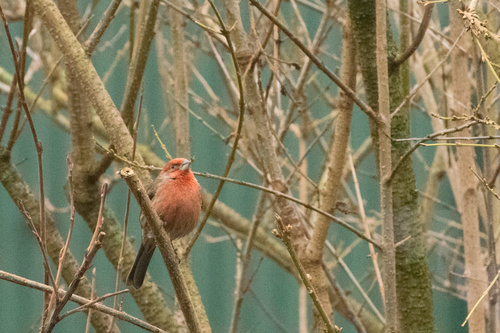 House Finch
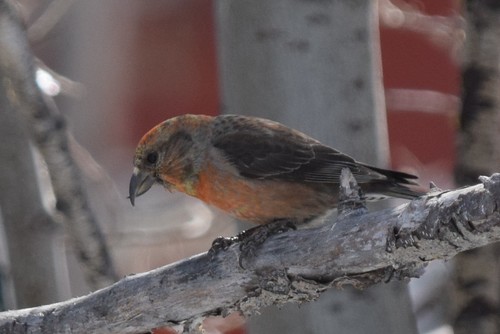 Common Crossbill
In short
The most reliable way to separate House Finch from Common Crossbill in the field is by bill shape: Common Crossbill has a unique, obviously crossed bill, while House Finch’s bill is straight and conical. Adult males of both can show red tones, but House Finch males are streaked below and never have a crossed bill. Females and immatures of both are streaked brownish or grayish, but Crossbill always shows the distinctive bill and a chunkier, more parrot-like head. In flight or perched, Crossbill lacks any wing bars (unlike some crossbill relatives), and House Finch has plain brown wings. Size and structure are similar, but Crossbill is bulkier and more robust, especially in the head and bill. Habitat can help: House Finch is common in urban and open habitats, while Crossbill is tied to coniferous forests and is highly nomadic.
Identification tips
- Bill shape (all ages): Crossbill has a thick, parrot-like bill with tips that cross over; House Finch has a slim, straight, conical bill. This is the single most reliable mark at any age or season.
- Head and face structure: Crossbill’s head is noticeably bulkier and deeper, with a more curved forehead and a heavy bill base. House Finch has a flatter forehead and a more delicate, sparrow-like head.
- Adult male color: Both can show red, but House Finch males are brown above with red restricted to the head, throat, and upper breast, and always have strong brown streaks on the flanks and belly. Crossbill males are red or orange overall, with less streaking and a more uniform look.
- Female/immature color: House Finch females are brown above, heavily streaked below, with a plain face. Crossbill females are greenish or yellowish, with less streaking and a chunkier head and bill.
- Juvenile/immature confusion: Both are streaked and brownish, but Crossbill juveniles always have the crossed bill. If the bill is straight, it is not a Crossbill.
- Wing pattern (all ages): Both species have plain, dark wings with no wing bars or pale panels. If you see wing bars, it is not either of these.
- Tail shape: House Finch has a long, square-tipped tail; Crossbill’s tail is shorter and more notched, but this is subtle and not always reliable in the field.
- Feeding behavior: Crossbill is often seen prying open conifer cones, sometimes hanging upside down. House Finch feeds on seeds, buds, and fruit, usually perched upright or on the ground.
- Habitat: House Finch is common in urban, suburban, and open areas; Crossbill is found in coniferous forests and rarely in cities or open farmland.
- Flock structure: Crossbills often move in tight, fast-moving flocks high in the trees; House Finches are more likely to be seen in loose groups at feeders or on wires.
- Vocalizations: House Finch song is a musical jumble; Crossbill calls are sharp, metallic, and not musical. Calls are often the first clue in flight.
- Seasonal movement: House Finch is resident and predictable; Crossbill is nomadic and irruptive, appearing only when cone crops are good.
- Sexual dimorphism: Both species show sex differences in color, but only Crossbill has the crossed bill in both sexes.
- Location context: If you are in a coniferous forest, especially during a cone crop, expect Crossbill; in a city or open woodland, expect House Finch.
- When marks fail: In poor light or distant views, focus on bill shape and head structure. If you cannot see the bill clearly, try for a call note or observe feeding behavior.
Size
House Finch is 12.5–15 cm long with a wingspan of 20–25 cm and an average mass of 21 g [wikipedia]. Common Crossbill is similar in length but is more robust, with a noticeably thicker head and heavier body. The Crossbill’s bill is much larger and deeper, especially at the base, giving the head a bulkier look. House Finch appears slimmer and more delicate overall. In hand, Crossbill is heavier, but in the field, the difference is mostly in the head and bill proportions.
Plumage
-
Juveniles/immatures: Both species are streaked below and brownish or grayish above, but only Crossbill juveniles have the distinctive crossed bill. House Finch juveniles have a straight, conical bill. Neither species shows wing bars or strong upperwing pattern in this age; both have plain, darkish wings.
-
Adult males: House Finch males are brown above with red on the head, throat, and upper breast, sometimes extending onto the belly and back, but always with strong brown streaking on the flanks and belly. Crossbill males are red or orange overall, with less streaking below, and always have the crossed bill. Both lack wing bars.
-
Adult females: House Finch females are brown above, heavily streaked below, with a plain face and straight bill. Crossbill females are greenish or yellowish, less streaked below, and have the crossed bill and a more robust head.
-
Wings in flight: Both species have plain, dark wings with no wing bars or pale panels. The only crossbill in the region with wing bars is the Two-barred Crossbill, not covered here.
Behaviour
House Finches are often seen in small flocks, perching on wires, feeders, or shrubs, and are comfortable around humans. Their flight is undulating and light. Common Crossbills are more likely to be seen in coniferous trees, often high in the canopy, using their bills to pry open cones. Their flight is strong and direct, with flocks moving between treetops. Crossbills may hang upside down while feeding, a behavior rarely seen in House Finch.
Habitat
House Finch is an urban and suburban generalist, found in cities, towns, farms, and open woodlands throughout most of North America. It is rarely found in deep coniferous forests. Common Crossbill is closely tied to coniferous forests, especially where cone crops are abundant. It is highly irruptive and nomadic, sometimes appearing far from typical range, but always in association with conifers. If you are in a city or open farmland, Crossbill is unlikely; if you are deep in a pine or spruce forest, House Finch is rare.
Voice
House Finch song is a long, musical jumble ending with a high 'wheer', and calls are soft 'cheet' or 'wheat' notes. Crossbill calls are sharp, metallic 'jip-jip' or 'kip-kip', often given in flight, and their song is rarely heard and not musical. In the field, the call notes are usually the best clue: House Finch is musical and sweet, Crossbill is harsh and metallic.