
Hen Harrier vs Eurasian Sparrowhawk
Circus cyaneus versus Accipiter nisus
Play a quiz with Hen Harrier and Eurasian Sparrowhawk
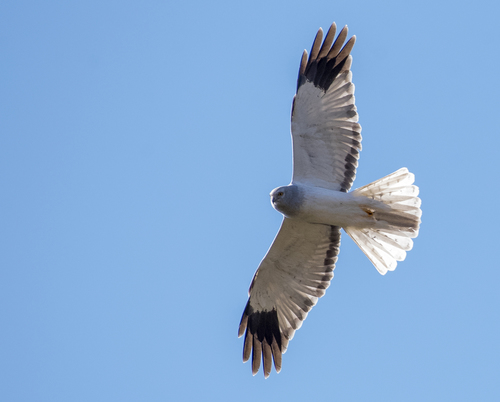 Hen Harrier
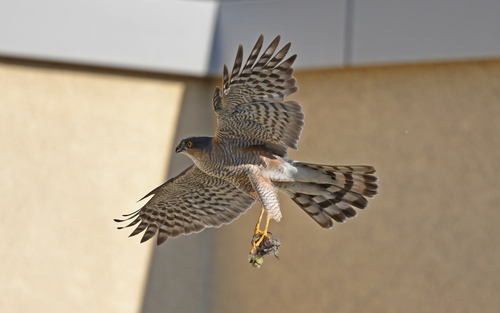 Eurasian Sparrowhawk
In short
The most reliable field mark is the combination of structure and flight style: Hen Harrier shows long, slim wings and tail with a distinctive low, buoyant flight, while Eurasian Sparrowhawk is compact, with short, broad wings and a square-tipped tail, flying with rapid flap-flap-glide sequences. Juvenile and female Hen Harriers ('ringtails') can be confused with female/juvenile Sparrowhawks, but the harrier's white rump and longer proportions are key. In perched birds, note the harrier's longer legs and more upright stance versus the sparrowhawk's stocky, horizontal posture. Both species show sexual dimorphism, but the harrier is always much larger and longer-winged.
Identification tips
- White rump patch (all ages/sexes): Only Hen Harrier shows a bright white rump, visible in flight and often when perched. Sparrowhawk never has a white rump.
- Wing shape in flight: Hen Harrier has long, slim wings held in a shallow V, giving a buoyant, gliding flight. Sparrowhawk's wings are short, broad, and rounded, with a rapid flap-flap-glide pattern and more undulating flight.
- Tail shape and length: Hen Harrier's tail is long and often appears rounded or slightly wedge-shaped in flight. Sparrowhawk's tail is long but more square-tipped and appears shorter relative to the body.
- Size: Hen Harrier is much larger and longer-winged than Sparrowhawk. Even female Sparrowhawks (the largest) are smaller and more compact than male Hen Harriers (the smallest).
- Perched posture: Hen Harrier stands upright and long-legged, often on the ground or low perches in open country. Sparrowhawk perches more horizontally, with a compact, stocky build, often in trees or on fences.
- Plumage – adult males: Male Hen Harrier is pale grey above, white below with black wingtips and white rump. Male Sparrowhawk is bluish-grey above with orange-barred underparts and no white rump.
- Plumage – females/juveniles: Both female/juvenile Hen Harrier and Sparrowhawk are brown above and barred below, but only Hen Harrier has the white rump. Juvenile Sparrowhawks have rusty fringes and a streaked throat.
- Facial disc: Hen Harrier has a subtle owl-like facial disc, most visible at close range, aiding in hunting by sound. Sparrowhawk lacks this feature.
- Flight behavior: Hen Harrier quarters low over open ground, often gliding for long stretches. Sparrowhawk dashes through trees or across open spaces with rapid, direct flight and frequent glides.
- Habitat context: Hen Harrier is found in open landscapes (moors, marshes, grasslands); Sparrowhawk prefers woodland, parks, and gardens, rarely hunting far from cover.
- Vocalizations: Hen Harrier is more likely to be heard calling over open ground, especially during food passes or displays. Sparrowhawk is generally quieter.
- Bill and legs: Sparrowhawk has a small bill for plucking birds and long toes for grasping, but these are rarely diagnostic at field distances compared to overall structure.
- Sexual dimorphism: Both species show strong sex differences, but this does not usually cause confusion between species—focus on structure and rump patch.
- Common pitfalls: Juvenile/female Hen Harrier ('ringtail') is the most frequent source of confusion with female/juvenile Sparrowhawk. Always check for the white rump and overall size/shape.
- When marks fail: In poor light or distant views, structure and flight style are often more reliable than plumage. If you see a raptor gliding low over open ground with a white rump, it's a Hen Harrier; if it's dashing through trees or gardens without a white rump, it's a Sparrowhawk.
Size
Hen Harrier is substantially larger and longer-winged: average body mass is 436.5g versus 220g for Eurasian Sparrowhawk [wikidata]. Hen Harrier's wingspan (97–122 cm) and length (41–52 cm) far exceed Sparrowhawk's (59–80 cm wingspan, 29–41 cm length) [wikipedia]. Even the largest female Sparrowhawk is smaller and more compact than the smallest male Hen Harrier. In the field, Hen Harrier appears rangy and slim, while Sparrowhawk is noticeably smaller, more compact, and broad-winged.
Plumage
- Juvenile/immature/female Hen Harrier ('ringtail'): Brown above, buff below with brown barring, and always shows a conspicuous white rump patch in all ages and sexes. Juveniles have less distinct barring and dark brown secondaries. The white rump is diagnostic in flight and often visible when perched.
- Juvenile/female Eurasian Sparrowhawk: Brown above, barred or spotted brown below, but lacks the white rump. Juveniles have rusty fringes to upperparts and coarsely barred underparts, with pale yellow eyes and a streaked throat (no central stripe). Adult females are brown or greyish-brown above with brown-barred underparts, but again, no white rump.
- Adult male Hen Harrier: Pale grey above, white below with grey upper breast, black wingtips, and white rump.
- Adult male Eurasian Sparrowhawk: Bluish-grey above, orange-barred underparts, orange-yellow to orange-red eyes. No white rump, and wings are short and broad, not long and pointed.
- Key contrast: Only Hen Harrier (all ages/sexes) shows a white rump patch. Sparrowhawk never does. Wing shape in flight is also distinctive: harrier's long, narrow wings versus sparrowhawk's short, rounded wings.
Behaviour
Hen Harrier hunts by quartering low over open ground, wings held in a shallow V, gliding buoyantly and often circling while listening and looking for prey. It is vocal while hunting and uses its owl-like facial disc for enhanced hearing. Eurasian Sparrowhawk is adapted for woodland hunting, using rapid, agile flight with quick bursts and glides to pursue small birds through trees. In flight, Sparrowhawk shows a characteristic flap-flap-glide pattern, often undulating, and is less likely to be seen gliding low over open ground for long periods. When perched, Hen Harrier stands more upright and long-legged; Sparrowhawk is more horizontal and compact.
Habitat
Hen Harrier breeds and hunts in open habitats: marshes, grasslands, moors, bogs, and farmland. It is rarely found in dense woodland. Eurasian Sparrowhawk is a woodland specialist, often seen in or near forests, parks, and gardens, but can also hunt in open areas near cover. If you see a raptor quartering open moorland, Hen Harrier is far more likely; a raptor dashing through trees or appearing in suburban gardens is almost always a Sparrowhawk.
Voice
Hen Harrier is notably more vocal in flight, with females giving a whistled 'piih-eh' when receiving food and a rapid 'chit-it-it-it-it-et-it' alarm call; males give a 'chek-chek-chek' and a bouncing 'chuk-uk-uk-uk' in display. Sparrowhawk's calls are not described in detail in the notes, but are generally less vocal and less likely to be heard in open country.