

Helmeted Pygmy-Tyrant vs Acre Tody-Tyrant
Lophotriccus galeatus versus Hemitriccus cohnhafti
Play a quiz with Helmeted Pygmy-Tyrant and Acre Tody-Tyrant
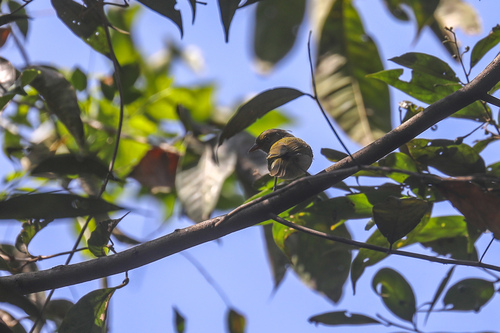 Helmeted Pygmy-Tyrant
 Acre Tody-Tyrant
In short
The most reliable field mark to separate Helmeted Pygmy-Tyrant from Acre Tody-Tyrant is the presence of a distinctive long, black, sometimes-erectile crest on the Helmeted Pygmy-Tyrant, which is never shown by Acre Tody-Tyrant. In addition, Helmeted Pygmy-Tyrant is smaller and paler below, with a whitish face and underparts, while Acre Tody-Tyrant is larger, with a greenish olive head and underparts, and a tawny wash on the face. Both species show two wing bars, but the color and prominence differ. Bill shape and color, iris color, and underpart streaking also provide useful clues. Habitat overlap is possible, but Acre Tody-Tyrant is more restricted in range.
Identification tips
- Crest presence: Helmeted Pygmy-Tyrant shows a long, black, erectile crest with grayish olive edges, often visible even when flattened; Acre Tody-Tyrant never shows a crest. This is the single most reliable field mark for all ages and seasons.
- Head pattern: Helmeted Pygmy-Tyrant has a mostly olive face with contrasting whitish lores; Acre Tody-Tyrant has a greenish olive head and nape with darker streaks and a tawny wash on the lores and face. Look for the pale lores versus tawny wash.
- Underparts color: Helmeted Pygmy-Tyrant is mostly whitish below with faint gray streaks; Acre Tody-Tyrant is olive-green on the throat and breast with creamy yellowish streaks, olive-green flanks, and a sulphur-yellow lower belly and undertail. The overall impression is much paler below in Helmeted Pygmy-Tyrant.
- Wing bars: Both species show two wing bars, but Helmeted Pygmy-Tyrant's are faint and olive-tipped, while Acre Tody-Tyrant's are more prominent, yellowish tawny, and stand out against the blackish wing coverts. This is most useful in good light.
- Wing and tail edges: Helmeted Pygmy-Tyrant has olive edges on dusky wings and tail; Acre Tody-Tyrant has yellow outer edges and whitish inner edges on the flight feathers, and the tail is blackish with dark green inner vanes. The yellow edges and green tones are more pronounced in Acre Tody-Tyrant.
- Bill shape and color: Helmeted Pygmy-Tyrant has a gray bill with a pink base to the mandible; Acre Tody-Tyrant has a flatter, broader bill with a wide base, large oval nostrils, black with a creamy base to the mandible. Bill differences are subtle but can help at close range.
- Iris color: Helmeted Pygmy-Tyrant has a yellowish to orangish white iris; Acre Tody-Tyrant's iris is cream to brownish hazel. This is subtle and not always visible in the field.
- Leg color: Helmeted Pygmy-Tyrant has grayish pink legs and feet; Acre Tody-Tyrant's are gray. Leg color is rarely diagnostic but may help in photos.
- Size and structure: Helmeted Pygmy-Tyrant is smaller and more delicate, with a shorter, finer bill and overall petite jizz. Acre Tody-Tyrant is bulkier, with a slightly longer body and heavier bill. Use this when birds are side by side or with known species for scale.
- Underpart streaking: Helmeted Pygmy-Tyrant's streaking is faint and gray on whitish underparts; Acre Tody-Tyrant's streaking is creamy yellowish on olive-green, and only on throat and breast. The lower belly is unstreaked and yellow in Acre Tody-Tyrant.
- Tail color: Both have dark tails, but Helmeted Pygmy-Tyrant's is dusky with olive edges, while Acre Tody-Tyrant's is blackish with dark green inner vanes. This is subtle and best seen in good light.
- Vocalization: If you hear a short, low-pitched trill of 'tick' notes without introductory notes, it's likely Acre Tody-Tyrant. Lack of song is not diagnostic for Helmeted Pygmy-Tyrant.
- Range and habitat: If outside Bolivia, Brazil, or Peru, Acre Tody-Tyrant can be ruled out. Within overlap zones, habitat is not diagnostic, but Helmeted Pygmy-Tyrant is more widespread.
- Sex and age: Both species have similar plumage in both sexes and all described ages; no age-specific wing or tail patterns are reported. Focus on crest and underpart color for all individuals.
- Common pitfalls: The faint wing bars and olive tones of Helmeted Pygmy-Tyrant can be overlooked, making it appear even plainer than Acre Tody-Tyrant. Always check for the crest, even if not fully raised, and do not rely solely on size unless you have a direct comparison.
Size
Helmeted Pygmy-Tyrant is distinctly smaller, averaging about 6.6 g in mass and 10 cm in length. Acre Tody-Tyrant is larger, at about 11 cm and at least 9 g (based on a single male). In the field, Helmeted Pygmy-Tyrant will appear noticeably more petite and delicate, with a finer structure overall.
Plumage
No age-specific juvenile or immature wing patterns are described for either species, so focus is on adult plumage. Helmeted Pygmy-Tyrant has a unique long black crest with grayish olive edges, which can be raised or flattened, extending beyond the rear of the head. Its face is olive with contrasting whitish lores, and the underparts are mostly whitish with faint gray streaks. The wings are dusky with olive edges and two faint wing bars. The tail is dusky with olive edges. In contrast, Acre Tody-Tyrant lacks a crest, has a greenish olive head with darker streaks on the crown, and a tawny wash on the lores and face. Its underparts are olive-green with creamy yellowish streaks on the throat and breast, unstreaked olive-green flanks, and a sulphur-yellow lower belly and undertail. The wings are blackish with yellow outer edges and two yellowish tawny wing bars, more prominent than in Helmeted Pygmy-Tyrant. The tail is blackish with dark green inner vanes.
Behaviour
Both species are small, active flycatchers, likely to be seen flitting in the lower to mid-levels of forest or woodland. There are no detailed behavioral differences described in the sources; both may be seen sallying for insects or making short flights between perches. Helmeted Pygmy-Tyrant may appear even more restless and delicate due to its smaller size.
Habitat
Helmeted Pygmy-Tyrant has a broader range, found in Brazil, Colombia, French Guiana, Guyana, Peru, Suriname, and Venezuela, and is likely to be encountered in a wider variety of forested habitats. Acre Tody-Tyrant is more restricted, found only in Bolivia, Brazil, and Peru. Both species occur in Amazonian regions, so overlap is possible in western Amazonia. Habitat alone is not diagnostic unless outside the range of Acre Tody-Tyrant.
Voice
Only Acre Tody-Tyrant's vocalizations are described: a short, low-pitched trill of 'tick' notes, usually without introductory notes, and single-note 'skep' or 'keek' calls, sometimes combined with lower frequency 'kup' calls. No vocal description is given for Helmeted Pygmy-Tyrant, so voice is not a reliable separator unless Acre Tody-Tyrant's distinctive trill is heard.