

Hawaiian Coot vs American Coot
Fulica alai versus Fulica americana
Play a quiz with Hawaiian Coot and American Coot
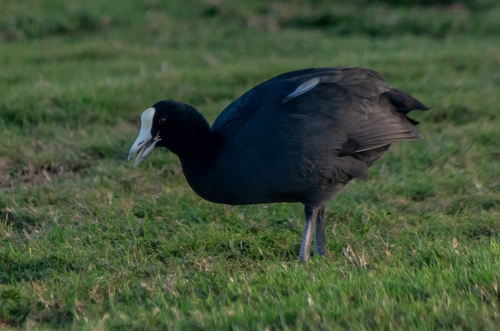 Hawaiian Coot
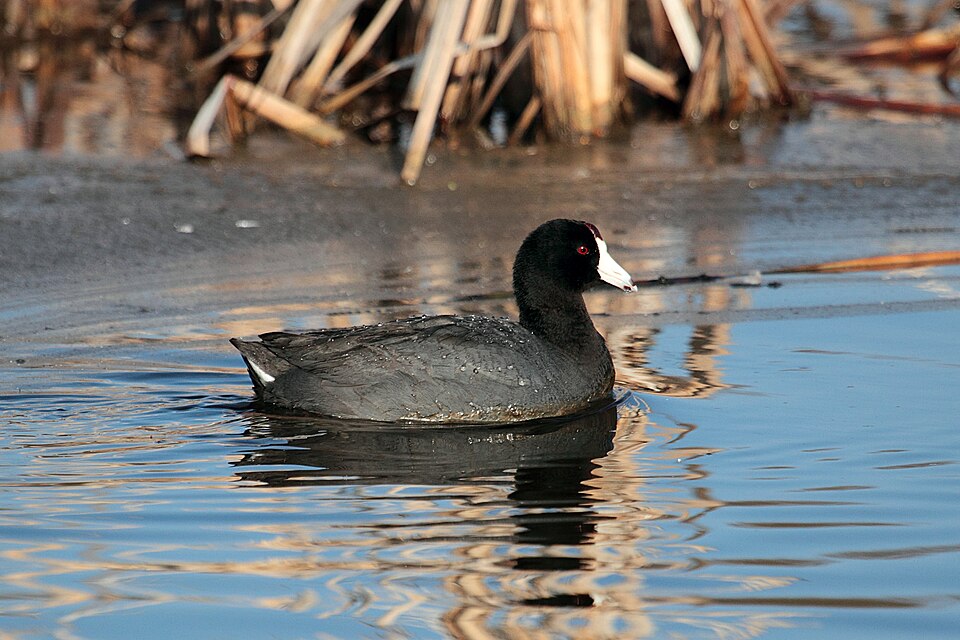 American Coot
In short
The most reliable field mark between Hawaiian Coot and American Coot is the pattern and color of the bill and frontal shield: Hawaiian Coots show a clean, all-white shield and bill, while American Coots typically have a white shield with a reddish-brown spot near the top of the bill. Both species are similar in size and shape, with overall blackish plumage, but their ranges do not overlap: Hawaiian Coot is strictly endemic to Hawaii, while American Coot is widespread across North America. Juvenile plumages are not described in detail for Hawaiian Coot, but American Coot juveniles are paler with olive-brown crowns and grayish bodies. In the field, context and shield color are your best clues.
Identification tips
- Frontal shield and bill color (all ages): Hawaiian Coot has a clean, all-white frontal shield and bill, while American Coot usually shows a reddish-brown spot near the top of the shield. This is the most reliable field mark at close range or with good optics.
- Geographic range: Hawaiian Coot is endemic to Hawaii; American Coot is not found there. If you are birding in Hawaii, you are almost certainly seeing Hawaiian Coot. If you are on the mainland or elsewhere in North America, it is American Coot.
- Juvenile plumage: American Coot juveniles are paler, with olive-brown crowns and grayish bodies, before molting into adult-like blackish plumage by about 4 months. Hawaiian Coot juveniles are not described in detail but are likely similar to adults, so a pale, grayish juvenile is more likely American Coot.
- Size and structure: Both species are very similar in size and shape, with only subtle differences. American Coot females are slightly smaller, but this is not reliable in the field.
- Sex differences: Both species are sexually monomorphic; do not use sex to separate them.
- Feet and legs: Both have broad, lobed toes (not webbed), which is a coot trait and not useful for separating these two.
- Behavior: Both swim and walk in a similar manner. American Coots may be seen in larger flocks, especially outside the breeding season, while Hawaiian Coots are more localized and less numerous.
- Habitat: Hawaiian Coots are restricted to freshwater and brackish wetlands in Hawaii. American Coots are found in a wide range of wetland habitats across North America.
- Voice: No diagnostic vocal differences are described in the available sources.
- Flight views: No distinctive upperwing or flight pattern differences are described for either species at any age; both show plain dark wings in flight.
- Pitfalls: The main pitfall is assuming all coots are the same species, especially in Hawaii. Always check the shield color and consider your location.
- Seasonal context: American Coots may be present year-round in some areas, but their numbers and flocking behavior change with season. Hawaiian Coots do not migrate and are present year-round in suitable habitat.
- Shield spot visibility: The reddish-brown spot on American Coot's shield can be subtle or obscured in poor light or at distance. Use multiple marks if possible.
- Conservation status: Hawaiian Coot is endangered and rare; American Coot is common and widespread. This can help set expectations in the field.
- Checklist approach: In Hawaii, default to Hawaiian Coot unless there is strong evidence otherwise. Elsewhere, assume American Coot.
Size
Both species are very similar in size: Hawaiian Coot measures 33–40.6 cm (13–16 in) in length and weighs around 700 g, while American Coot is 34–43 cm (13–17 in) long, with males weighing 576–848 g and females 427–628 g. There is significant overlap, and size alone is not reliable for separation in the field. Both have a compact, rail-like build with short tails and rounded wings. Females of American Coot are slightly smaller on average, but this is subtle and not diagnostic at a distance.
Plumage
- Juvenile/immature plumage: American Coot juveniles are distinctly paler than adults, with olive-brown crowns and grayish bodies, becoming adult-like by about 4 months. There is no detailed description of Hawaiian Coot juvenile plumage, but it is implied to be similar to adults (blackish overall).
- Adult plumage: Both species are blackish overall with a prominent white bill and frontal shield. The key difference is in the shield: Hawaiian Coot has a clean, all-white shield and bill, while American Coot usually shows a reddish-brown spot near the top of the shield (between the eyes). This spot is often visible at close range or in good light. No differences in wing pattern or upperwing markings are described for either species at any age.
- Sexes: Both species are sexually monomorphic in plumage; males and females look alike.
Behaviour
Both species behave similarly, swimming on open water and walking on land with a distinctive, somewhat awkward gait. American Coots are noted for their aggressive territorial defense, especially during breeding, and are often seen in larger flocks outside the breeding season. Hawaiian Coots, being endangered and restricted to Hawaii, are less likely to be seen in large groups and may be more wary. Both species have broad, lobed toes rather than webbed feet, which is visible when they walk or stand out of water.
Habitat
Hawaiian Coot is strictly endemic to Hawaii and found only in freshwater lakes, marshes, coastal lagoons, and water storage areas on the islands. American Coot is widespread across North America, breeding in marshes, lakes, and ponds, and wintering in a variety of freshwater and sometimes saltwater habitats. If you are outside Hawaii, any coot is almost certainly American. Within Hawaii, American Coot is not expected, so any coot seen is almost certainly Hawaiian Coot. Habitat overlap is not an issue in the field, but context is crucial for identification.