

Guianan Gnatcatcher vs Buff-breasted Wren
Polioptila guianensis versus Cantorchilus leucotis
Play a quiz with Guianan Gnatcatcher and Buff-breasted Wren
 Guianan Gnatcatcher
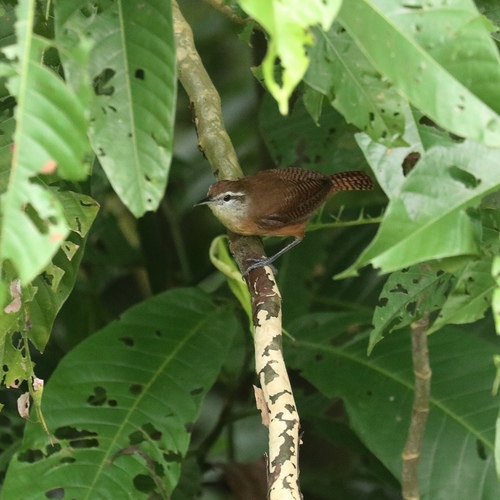 Buff-breasted Wren
In short
The most reliable way to separate Guianan Gnatcatcher from Buff-breasted Wren is by size and structure: the gnatcatcher is a tiny, slim bird with a long, thin tail and delicate bill, while the wren is much larger, bulkier, and has a short, heavily barred tail. In plumage, the gnatcatcher is bluish gray above with a broken white eye ring and a striking black-and-white tail pattern, whereas the wren is rufescent to gray-brown above with a buffy or cinnamon underbelly and a barred tail. Females and immatures of both species can be confusing, but the gnatcatcher's paler gray tones and white supercilium (in females) contrast with the wren's richer browns and buff. Both species occur together in the Guianas, so careful attention to structure and tail pattern is essential.
Identification tips
- Size and structure: Guianan Gnatcatcher is tiny and slim, with a long, thin tail and small, delicate bill. Buff-breasted Wren is much larger, rounder, and has a proportionally shorter, stouter tail and a heavier bill. This is the quickest field clue if seen well.
- Tail pattern: Gnatcatcher shows a striking black-and-white tail (black central feathers, white outer feathers), often fanned or flicked. Buff-breasted Wren has a tail that is heavily barred throughout, never with the gnatcatcher's crisp black-and-white contrast.
- Tail behavior: Gnatcatchers often flick and fan their tails above the body, while wrens cock their tails upward but do not fan them in the same way.
- Plumage above: Gnatcatcher males are bluish gray above; females are paler gray with a white supercilium. Buff-breasted Wrens are rufous to gray-brown above, lacking any bluish tones.
- Underparts: Gnatcatcher is white below (throat and belly), while Buff-breasted Wren has a buffy or cinnamon chest and belly, much warmer in tone.
- Facial markings: Gnatcatcher males have a broken white eye ring; females add a white supercilium. Buff-breasted Wren has a variable pale supercilium but never a full eye ring; the face is more patterned and can appear grayish or brownish.
- Bill: Gnatcatcher's bill is thin and needle-like, suited for picking tiny insects. Wren's bill is heavier and slightly downcurved.
- Juvenile confusion: Young Buff-breasted Wrens are duller but still show a barred tail and buff underparts; gnatcatcher immatures are not well described but should lack barring and show paler gray tones.
- Habitat use: Gnatcatcher is often in the canopy or outer branches; wren is in dense, low tangles or thickets.
- Behavior: Gnatcatcher is restless, acrobatic, and often in mixed flocks; wren is more methodical, often in pairs or family groups, and may be seen near their globular nests.
- Voice: Not described in the notes, so do not rely on song or call for separation based on this data.
- Season and sex: Both species occur year-round in the Guianas; female gnatcatchers are paler with a white supercilium, while male and female wrens are similar except for slight weight differences.
- Pitfalls: In poor light, the gnatcatcher's gray may appear brownish, and the wren's buff may seem paler. Always check tail pattern and size before relying on color alone.
- Flight views: Gnatcatcher in flight is slim and flicks its tail; wren is bulkier and flies with a more bounding, direct motion.
- When in doubt: If the bird is tiny, grayish, with a black-and-white tail, it's a gnatcatcher. If it's larger, brownish, with a barred tail and buffy underparts, it's a wren.
Size
Guianan Gnatcatcher is much smaller and lighter (about 6 g, 10–11 cm long) than Buff-breasted Wren (males 18.5–22.8 g, females 16.0–19.5 g). The gnatcatcher is a dainty, almost warbler-like bird, while the wren is noticeably bulkier and more robust, with a rounder body and proportionally shorter tail. In the field, the size gap is striking if both are seen in quick succession.
Plumage
- Juveniles and immatures: Fledgling Buff-breasted Wrens are duller than adults, with a paler buff chest, but still show the characteristic barred tail and overall brownish tones. No specific juvenile plumage is described for Guianan Gnatcatcher, but young birds are likely similar to adults, only paler in females.
- Adults: Guianan Gnatcatcher males are bluish gray above with a broken white eye ring, white underparts, and a tail with black central feathers and white outer feathers. Females are paler gray and have a white supercilium. Buff-breasted Wrens are rufescent to gray-brown above, with a buffy or cinnamon chest and belly, and a heavily barred tail. Their face is variable but ranges from whitish to gray-brown, with a pale supercilium. The wren's tail barring and warm underparts are never matched by the gnatcatcher, while the gnatcatcher's crisp black-and-white tail and bluish tones are absent in the wren.
Behaviour
Guianan Gnatcatcher is typically active and acrobatic, foraging for insects in the outer foliage, often high in trees and moving quickly with a fidgety, restless jizz. Buff-breasted Wren is more often seen lower in dense tangles or thickets, moving methodically and often cocking its tail. Wrens may be seen in pairs or family groups, sometimes near their distinctive globular nests. Gnatcatchers are more solitary or in mixed-species flocks, rarely pausing for long.
Habitat
Both species overlap in the Guianas and northern Amazonia, but their microhabitat preferences differ. Guianan Gnatcatcher favors the canopy and edges of humid forests, often in the outer foliage of tall trees. Buff-breasted Wren is more likely in dense undergrowth, vine tangles, or shrubby edges, often near water or forest gaps. If the bird is low in thick brush, wren is more likely; if high and exposed, gnatcatcher is favored.