

Grey Trembler vs Black-faced Grassquit
Cinclocerthia gutturalis versus Melanospiza bicolor
Play a quiz with Grey Trembler and Black-faced Grassquit
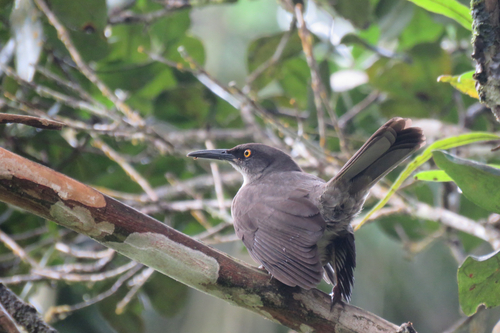 Grey Trembler
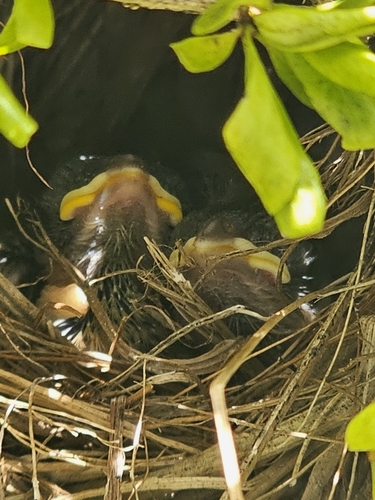 Black-faced Grassquit
In short
The most reliable way to separate Grey Trembler from Black-faced Grassquit is by size and structure: the trembler is a large, long-tailed, thrush-like bird with a slightly downcurved bill, while the grassquit is a tiny, compact seedeater with a short, conical bill. Adult male Black-faced Grassquits are strikingly dark-faced and greenish, but females and juveniles are drab olive and can be confused with the browner, mottled young Grey Trembler. In flight or perched, focus on overall bulk, bill shape, and tail length. Juvenile plumage is a potential pitfall, but even then, the trembler's size and structure should stand out.
Identification tips
- Size is the single most reliable mark: Grey Trembler is massive compared to Black-faced Grassquit—over five times heavier and twice as long. Even at a distance or in poor light, the trembler's bulk and long tail are obvious.
- Bill shape: Trembler has a long, slightly downcurved bill (female's longer than male's), suited for probing and tearing. Grassquit has a short, thick, conical bill, classic for seed-eating finches. Bill shape is diagnostic at any age or sex.
- Tail length and shape: Trembler's tail is long and often appears slightly rounded or fanned, while grassquit's tail is short and square. In flight or perched, the difference is striking.
- Plumage—adult males: Male Black-faced Grassquit is black-faced and black below, with greenish upperparts—no confusion with trembler. Trembler is never black-faced or black-bellied.
- Plumage—adult females and juveniles: Female and juvenile grassquits are plain olive-green, sometimes browner or grayer below. Juvenile tremblers are browner with a mottled chest, but always larger and longer-tailed. In poor light, drab grassquits may look browner, but structure and size still separate them.
- Face pattern: Trembler has a somewhat darker face than the rest of the head, but never a sharply defined black mask like male grassquit. Female/juvenile grassquits have plain faces with no strong markings.
- Underparts: Trembler has a buffy white throat and belly, with browner, olive-tinged flanks. Grassquit males are black below; females/juveniles are plain olive or grayish. No grassquit shows the trembler's buffy white center.
- Behavior: Watch for the trembler's unique 'trembling'—wings drooped and vibrated rapidly, especially when agitated or foraging. Grassquits never show this; their wing vibrations are only in brief display flights.
- Habitat: Trembler is a forest specialist, often in dense cover or canopy. Grassquit is found in open grassy or shrubby areas, rarely deep in forest. Context can help if the view is poor.
- Foraging height: Trembler ranges from ground to canopy, often seen probing in tangles or epiphytes. Grassquit is almost always low or on the ground, feeding on seeds.
- Vocalizations: If you hear a buzzy, emphatic song or a soft 'tsip', it's a grassquit. Trembler's song is not described, so silence is not helpful for trembler ID.
- Leg color: Both have dusky pinkish legs, not useful for separation.
- Iris color: Both have dark irises; not a separating mark.
- Subspecies variation: Some grassquit subspecies are paler or brighter olive, but none approach the trembler's size or structure. Trembler subspecies differ slightly in breast and flank color but remain much larger and structurally distinct.
- Pitfalls: The main confusion is between juvenile/female grassquits and juvenile tremblers. Always check size, bill, and tail length first—these are never similar.
Size
Grey Trembler is dramatically larger, weighing about 69 g and measuring 23–26 cm in length. In contrast, Black-faced Grassquit is tiny, weighing just 7–13 g and measuring 10.2–11.5 cm. The trembler is nearly twice as long and over five times heavier. This size difference is obvious in the field, even at a distance or in mixed flocks.
Plumage
-
Juveniles: Young Grey Tremblers are browner overall with a mottled chest, while juvenile Black-faced Grassquits resemble adult females—plain olive-green above and below, sometimes browner or grayer underneath. Both can appear dull and non-descript, but the trembler is always much larger and longer-tailed.
-
Adults: Adult Grey Tremblers are warm gray-brown above with a darker face and wings, buffy white throat and belly, and browner flanks with an olive tinge. Adult male Black-faced Grassquits are unmistakable: black head, throat, and underparts with greenish upperparts, wings, and tail. Adult females are drab olive-green above and below, lacking any black on the face or underparts. Subspecies variation in grassquits can affect brightness and underpart color, but never approaches the trembler's size or structure.
-
Flight/wing pattern: No distinctive upperwing or flight pattern marks are described for either species in any age; separation relies on structure and overall coloration.
Behaviour
Grey Trembler often forages by tearing open tangles and probing epiphytes from ground to canopy, and is famous for its 'trembling' behavior: wings drooped and rapidly vibrated. This unique motion is not seen in grassquits. Black-faced Grassquits feed mostly on the ground or low vegetation, often in loose colonies, and males may perform short aerial courtship flights with wing vibrations, but these are brief and associated with display, not foraging.
Habitat
Grey Trembler is restricted to forested habitats on Martinique and Saint Lucia, ranging from ground level to canopy. Black-faced Grassquit is much more widespread in the West Indies and prefers open areas, grassy fields, and shrubby edges, often near human habitation. Overlap is possible in edge habitats, but the trembler is a forest bird, while the grassquit favors open country.
Voice
Black-faced Grassquit has a distinctive buzzy, emphatic song and a soft 'tsip' call. Grey Trembler's vocalizations are not described in the provided notes, so voice is only useful for confirming grassquit presence, not for identifying the trembler.