

Grey Plover vs American Golden Plover
Pluvialis squatarola versus Pluvialis dominica
Play a quiz with Grey Plover and American Golden Plover
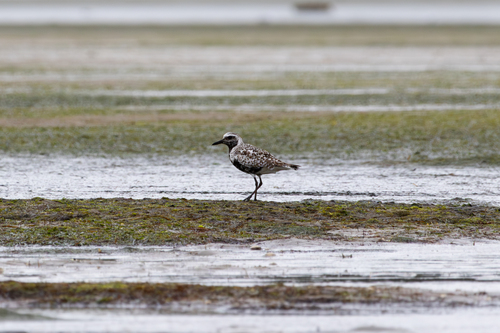 Grey Plover
 American Golden Plover
In short
The single most reliable field mark between Grey Plover and American Golden Plover is the color of the underwing in flight: Grey Plover of all ages shows striking black axillaries (armpit feathers), while American Golden Plover has pale gray axillaries. This mark is visible in flight and is diagnostic for all ages and seasons. Structurally, Grey Plover is noticeably bulkier with a larger, heavier bill, while American Golden Plover is slimmer and more delicate. In breeding plumage, both have black faces and bellies, but Grey Plover has a white rump and tail with black barring, while American Golden Plover shows gold-spotted upperparts and a white crown and nape. Non-breeding and immature birds are more similar, but the underwing pattern and bill size remain reliable.
Identification tips
- Underwing color in flight (all ages): Grey Plover always shows black axillaries (armpit feathers) and inner underwing; American Golden Plover has pale gray axillaries. This is the most reliable field mark, especially for immatures and non-breeding birds.
- Bill size and shape: Grey Plover has a noticeably larger, heavier bill (24–34 mm) that looks thick and blunt-tipped; American Golden Plover's bill is smaller and finer. This is visible both at rest and in flight.
- Overall structure: Grey Plover is bulkier and more robust, with a thicker neck and heavier body. American Golden Plover is slimmer, more delicate, and relatively longer-legged for its size.
- Breeding plumage (spring/summer): Both have black faces, necks, breasts, and bellies, but Grey Plover's black is bordered by white and the rump and tail are white with black barring. American Golden Plover has a white crown and nape, gold-spotted upperparts, and the black on the underparts is more solid and extensive in males.
- Non-breeding/juvenile plumage: Both become plainer above and paler below, but Grey Plover remains larger and shows black axillaries in flight. American Golden Plover shows a whitish eyebrow and is more uniformly brownish above.
- Tail and rump: Grey Plover's white rump and tail with black barring are visible in flight and when preening; American Golden Plover lacks this strong rump/tail contrast.
- Primary projection: Not detailed in the sources for these two, but American Golden Plover is described as having a relatively long primary projection compared to European Golden Plover.
- Leg color: Both have dark legs; not useful for separation.
- Habitat context: On Eurasian coasts, a large plover on mudflats is more likely Grey Plover; American Golden Plover is more often inland or on drier ground, especially on migration.
- Migration timing: American Golden Plover molts later (September–October) than Pacific Golden Plover, but this is not a separation from Grey Plover.
- Sexual dimorphism: Breeding female American Golden Plover is less extensively black below than the male; Grey Plover sexes are similar in breeding plumage.
- Pitfalls with immatures: First-winter and juvenile plumages are very similar in both species, especially on the ground. Always try to see the underwing in flight for confirmation.
- Size in mixed flocks: If both species are present, Grey Plover will stand out as the larger, more robust bird.
- Plumage edges in juveniles: Juvenile Grey Plover has blacker upperparts with creamy feather edges; American Golden Plover juveniles are more brownish and gold-spotted above.
- Voice: Not covered in the sources, so not reliable for separation here.
Size
Grey Plover is the larger, heavier bird: it measures 27–30 cm in length with a wingspan of 71–83 cm and can weigh up to 280 g (sometimes more before migration). American Golden Plover is smaller and lighter, at 24–28 cm long, wingspan 65–67 cm, and typical mass around 145 g. Grey Plover appears more robust and thickset, with a noticeably stouter bill. American Golden Plover is slimmer, with a smaller, finer bill and relatively longer legs for its size.
Plumage
- Juvenile and First-winter (all ages in flight): Grey Plover always shows black axillaries and inner underwing, a unique feature among Pluvialis plovers. American Golden Plover has pale gray axillaries. This is the most reliable mark in flight for all non-adult-plumaged birds.
- Breeding plumage (spring/summer): Both species have black faces, necks, breasts, and bellies. Grey Plover has a white border to the black face and a white rump and tail with black barring. American Golden Plover has a white crown and nape extending down the side of the neck, and its back is marked with gold spots. The female American Golden Plover is less extensively black below.
- Non-breeding (winter) plumage: Both species become plainer above and paler below. Grey Plover is plain grey above with a grey-speckled breast and white belly; American Golden Plover is grey-brown above and pale below, with a distinct whitish eyebrow. Juvenile Grey Plover is darker above with creamy feather edges, but still shows black axillaries in flight.
- Tail and rump: Grey Plover has a white rump and tail with black barring; American Golden Plover does not show such a marked rump/tail contrast.
Behaviour
No strong behavioral differences are noted in the sources for field separation. Both species are long-distance migrants and may be seen singly or in loose groups on open ground or mudflats. Grey Plover may appear more deliberate and less active than the more agile, slimmer American Golden Plover, but this is subtle.
Habitat
Grey Plover is nearly worldwide on coastal mudflats and estuaries outside the breeding season, while American Golden Plover is more likely to be found on drier, open tundra during breeding and migrates through grasslands or agricultural fields. On migration and wintering grounds, both can occur on open flats, but Grey Plover is more strictly coastal, especially in Eurasia.