

Grey Nightjar vs Large-tailed Nightjar
Caprimulgus jotaka versus Caprimulgus macrurus
Play a quiz with Grey Nightjar and Large-tailed Nightjar
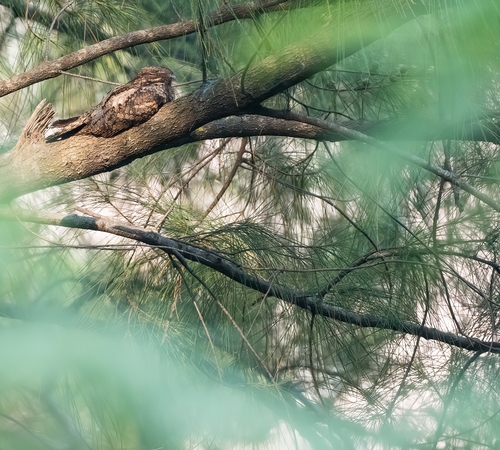 Grey Nightjar
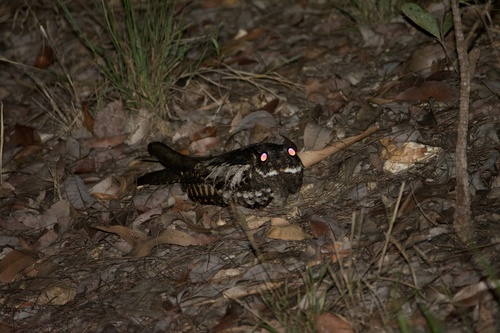 Large-tailed Nightjar
In short
The most reliable field mark between Grey Nightjar and Large-tailed Nightjar is the pattern and extent of white in the wings and tail, especially in flight and on adult males. Large-tailed Nightjar males show large, obvious white patches on the primaries and outer tail feathers, while Grey Nightjar males have more limited white: a single white patch on the first primary and smaller subterminal tail patches. Females of both species lack or greatly reduce these white areas, but the Large-tailed Nightjar still appears longer-tailed and bulkier. Structure and tail shape are also helpful: Large-tailed Nightjar is notably longer-tailed and broader-winged, while Grey Nightjar is more compact. Both species are cryptic when perched, but subtle differences in crown, scapular, and throat patterns can help with close views.
Identification tips
- White wing and tail patches in flight (adult males): Large-tailed Nightjar males have large, obvious white patches on the primaries and outer tail feathers, easily seen in flight or when the bird fans its tail. Grey Nightjar males have a single white patch on the first primary and smaller, more restricted white on the tail. Females of both species lack or greatly reduce these marks, but the contrast is still useful for males and some immatures.
- Tail length and shape: Large-tailed Nightjar is notably longer-tailed and broader-tailed than Grey Nightjar. In flight or perched, look for a tail that projects well beyond the wingtips and appears broad and rounded in Large-tailed; Grey Nightjar's tail is shorter and more squared-off.
- Crown and scapular pattern: Large-tailed Nightjar males have a pale crown with a dark median stripe and a prominent row of black scapulars with broad buff or whitish fringes. Grey Nightjar's crown is more intricately vermiculated with a central black stripe, and scapulars are black with brownish-yellow spots, less boldly edged.
- Throat patch: Both males have a white throat patch, but it's larger and brighter in Large-tailed Nightjar. In Grey Nightjar, the patch is smaller, especially in females, and may be tinged brown.
- Underparts: Grey Nightjar is more densely barred and vermiculated below, with dark brown and pale brownish-yellow horizontal stripes. Large-tailed Nightjar is less heavily marked, appearing cleaner below, especially in males.
- Female plumage: Female Large-tailed Nightjars are paler and greyer, with smaller buff wing patches and less vibrant tail patches. Female Grey Nightjars are only slightly paler than males, and lack white in wing and tail; their throat patch is smaller and browner.
- Resting posture: Grey Nightjar often perches lengthwise along branches, blending in closely with bark. Large-tailed Nightjar is more likely to be found on the ground or in leaf litter, but both can use either substrate.
- Flight style: Grey Nightjar has slow wingbeats, often glides or hovers, and can make sharp turns. Large-tailed Nightjar's longer tail may give a more languid, gliding flight, but direct comparison is needed for certainty.
- Habitat context: In dense, humid lowland or mangrove forest, especially in Southeast Asia or Australia, Large-tailed Nightjar is more likely. In open woodland, grassy slopes, or temperate forest edge in East Asia, Grey Nightjar is favored.
- Geographic range: If in Japan, Korea, or the Russian Far East, it's Grey Nightjar. In Australia or Wallacea, it's Large-tailed. In the Himalayas and Southeast Asia, both are possible; use structure and plumage.
- Voice: Large-tailed Nightjar's deep, repetitive 'wroww' or 'wrrrog' song is distinctive. Grey Nightjar's calls differ (not described here), but absence of song is not diagnostic.
- Camouflage and detection: Both are extremely cryptic when roosting; careful scanning for shape, tail length, and scapular pattern is essential.
- Jizz: Large-tailed Nightjar gives a heavier, longer impression overall, especially when perched or in flight. Grey Nightjar is more compact and less bulky.
- Sex and age: Most white in wing and tail is on adult males; females and immatures are trickier and require close attention to structure and subtle plumage differences.
- Overlap and pitfalls: In areas of range overlap, especially in the Himalayas and Southeast Asia, expect confusion. Use a combination of tail length, white patch extent, scapular pattern, and habitat to separate them.
Size
Large-tailed Nightjar is the larger species, measuring about 31.5–33 cm in length [wikipedia], with a proportionally longer and broader tail. Grey Nightjar is medium-sized for a nightjar, but distinctly smaller and more compact than Large-tailed. In the field, Large-tailed Nightjar often looks heavier-bodied and longer from bill to tail tip, especially when perched or in flight. Both have large heads and eyes typical of nightjars, but the overall impression is more robust for Large-tailed.
Plumage
- Immature and adult males in flight: Large-tailed Nightjar males show large white patches on the primaries (outer wing) and broad white patches on the outer tail feathers, easily visible in flight. Grey Nightjar males have a single white circular patch on the first primary and smaller, more restricted white subterminal patches on the outer tail feathers. Females of both species reduce or lack these white areas, but in Grey Nightjar females, the white is nearly absent from both wing and tail, and the throat patch is smaller and browner.
- Crown and scapulars: Both species have a dark median crown stripe, but Large-tailed Nightjar males have a paler crown and a very prominent row of black scapulars with broad buff or whitish fringes. Grey Nightjar's scapulars are black with brownish-yellow spots and less contrasty.
- Throat and underparts: Both males have a white throat patch, but it's larger and brighter in Large-tailed Nightjar. Grey Nightjar's throat patch is smaller, especially in females, and can be tinged brown. Underparts of Grey Nightjar are densely barred and vermiculated, while Large-tailed Nightjar is less heavily marked below.
- Tail pattern: Large-tailed Nightjar's tail is longer, with uneven dark bars and broad white patches (male). Grey Nightjar's tail is shorter, with dense vermiculations and 6–7 black wavy bands; white is smaller and more restricted.
- Females: Both species' females are duller, but Large-tailed Nightjar females are paler and greyer overall, with smaller buff wing patches and less vibrant tail patches, while Grey Nightjar females are only slightly paler than males and lack white in wing and tail.
Behaviour
Both species are nocturnal and cryptic by day, often roosting on the ground or low branches. Grey Nightjar is especially noted for resting parallel to branches, blending with bark. In flight, Grey Nightjar is silent, with slow wingbeats and occasional glides or hovers, often flying in circles but capable of sharp turns when chasing insects. Large-tailed Nightjar also flies at night but is less described in detail; its longer tail may give a more languid, gliding flight. Both are hard to detect when roosting due to their camouflage.
Habitat
Grey Nightjar breeds in East Asia (southeastern Russia, China, Korea, Japan, northern Indochina, Himalayas) and is migratory in the north, wintering south to Java. It favors open woodlands, grassy slopes, and forest edges. Large-tailed Nightjar has a much broader range, from the southern Himalayas through Southeast Asia to northern Australia, and is resident throughout. It uses a wider variety of habitats, including lowland and montane forests, mangroves, plantations, wooded parks, and even agricultural land. Overlap is possible in Southeast Asia and the Himalayan foothills, but Large-tailed is more likely in dense forest and humid lowlands, while Grey Nightjar prefers more open or temperate habitats.
Voice
Large-tailed Nightjar has a distinctive, monotonous territorial song, described as a series of deep 'wroww' or fast 'wrrrog' notes, and also gives grunting calls. Grey Nightjar's vocalizations are not described in the provided notes, but the two species were split in part by differences in call. In the field, hearing a classic Large-tailed Nightjar song is a strong clue, but silence or absence of song is not diagnostic.