

Grey-headed Albatross vs White-capped Albatross
Thalassarche chrysostoma versus Thalassarche cauta
Play a quiz with Grey-headed Albatross and White-capped Albatross
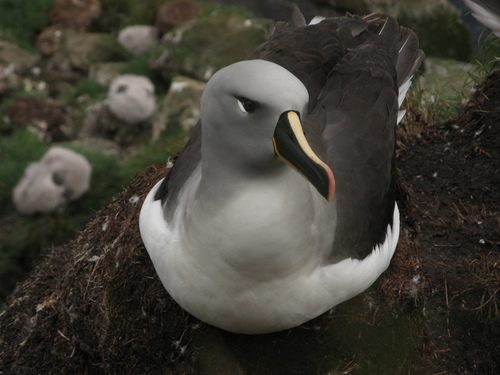 Grey-headed Albatross
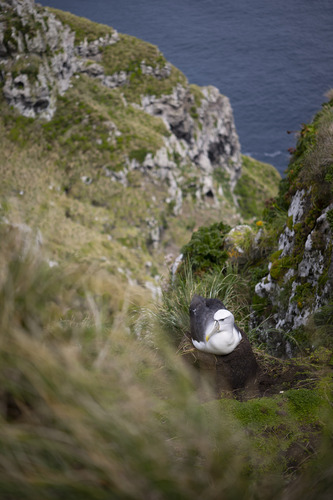 White-capped Albatross
In short
The most reliable field mark to separate Grey-headed Albatross from White-capped Albatross is the head and bill: adult Grey-headed shows a uniform ashy-grey head and neck with a sharply contrasting black bill edged in bright yellow, while adult White-capped has a white crown and forehead, pale grey face, and a grey-yellow bill with a yellow culmen and tip. In flight, the underwing of Grey-headed is white with extensive black on the leading edge (almost entirely dark in juveniles), whereas White-capped shows a distinctive black 'thumb mark' at the base of the underwing’s leading edge. Juvenile Grey-headed Albatrosses are darker overall, with a nearly all-dark underwing and indistinct eye crescent, while juvenile White-capped are paler-faced. Both are large mollymawks, but White-capped is slightly larger and bulkier. Habitat and range overlap at sea, but breeding sites are distinct, and context may help if known.
Identification tips
-
Head Color (All Ages): Adult Grey-headed Albatross has a uniform ashy-grey head, throat, and neck, sharply contrasting with its white body. White-capped Albatross adults have a white crown and forehead, pale grey face, and a dark eyebrow—never a uniform grey head.
-
Bill Pattern (All Ages): Grey-headed has a black bill with bright yellow ridges and a pink-orange tip; White-capped's bill is grey-yellow with a prominent yellow culmen and yellow tip. Bill color is especially useful at close range or in good light.
-
Underwing Pattern (Juveniles): Juvenile Grey-headed Albatrosses have an almost entirely dark underwing, with little to no white, and a dark head. Juvenile White-capped are paler-faced and show the beginnings of the adult's white underwing with a black thumb mark at the base of the leading edge. If you see a very dark underwing and head, think Grey-headed.
-
Underwing Pattern (Adults): Grey-headed adults show a white underwing with extensive black along the leading edge and less on the trailing edge. White-capped adults have a white underwing with a distinct black 'thumb mark' at the base of the leading edge, but less black overall than Grey-headed. The thumb mark is a key field mark for White-capped.
-
Eye Crescent: Grey-headed adults have a white crescent behind the eye, which is indistinct or absent in juveniles. White-capped lacks this feature, instead showing a dark eyebrow below the white crown.
-
Face Pattern: White-capped always shows a white crown and forehead, with a pale grey face and dark eyebrow. Grey-headed never shows a white crown or eyebrow; its head is uniformly grey.
-
Upperparts: Both species have dark upperwings, mantle, and tail, but Grey-headed's are almost black, while White-capped's are grey-black. This is subtle and not always reliable at sea.
-
Rump and Underparts: Both have white rumps and underparts, not useful for separation.
-
Size and Structure: White-capped is slightly larger (90–99 cm vs. 81 cm), with a broader, heavier look, but this is only apparent with direct comparison or experience.
-
Jizz in Flight: Both soar low over the ocean with similar flight style; structure is not a reliable separator.
-
Habitat/Range: If seen breeding, location is diagnostic: Grey-headed breeds on subantarctic islands throughout the Southern Ocean; White-capped only on three Tasmanian islands. At sea, both range widely and overlap.
-
Juvenile Pitfalls: Juvenile Grey-headed can be mistaken for other dark-headed mollymawks, but the combination of a dark head, dark bill, and nearly all-dark underwing is distinctive. Juvenile White-capped are paler-faced and begin to show the adult's white crown.
-
Bill Color in Juveniles: Juvenile Grey-headed has a black bill; White-capped juveniles have a paler, greyish bill, but this can be subtle.
-
Season/Sex: No strong sexual dimorphism or seasonal variation in either species; age is more important for identification.
-
When in Doubt: Prioritize head color and underwing pattern, especially in flight. If you see a uniform grey head and extensive black on the underwing, it is Grey-headed. If the crown is white and the underwing shows a black thumb mark, it is White-capped.
Size
White-capped Albatross is the larger of the two, averaging 90–99 cm in length and 220–256 cm wingspan, with a mean weight of about 4.1 kg [wikipedia]. Grey-headed Albatross is slightly smaller, averaging 81 cm in length, 2.2 m wingspan, and a mean mass of 3.65 kg [wikipedia]. In the field, this size difference is subtle and may not be obvious unless birds are side by side, but White-capped often appears bulkier and longer-winged.
Plumage
-
Juveniles/immatures: Juvenile Grey-headed Albatrosses are very dark overall, with a black bill and head, darker nape, and an underwing that is almost completely dark. The white eye crescent is indistinct or absent. Juvenile White-capped Albatrosses, while not described in detail here, are typically paler-faced and show the beginnings of the adult's white crown and pale face, lacking the uniform dark head of juvenile Grey-headed.
-
Adults: Adult Grey-headed Albatrosses have a uniform ashy-grey head, throat, and upper neck, with a white crescent behind the eye and a striking black bill with yellow ridges and a pink-orange tip. The upperwings, mantle, and tail are almost black, contrasting with the white rump and underparts. The underwing is white with extensive black on the leading edge and less on the trailing edge. Adult White-capped Albatrosses have a white forehead and crown, a pale grey face bordered below by a dark eyebrow, and a grey-yellow bill with a prominent yellow culmen and tip. The upperwing, mantle, and tail are grey-black, and the underwing is white with a distinctive black 'thumb mark' at the base of the leading edge. The rest of the underwing is less extensively marked than in Grey-headed.
-
Bill: Grey-headed: black with bright yellow ridges and pink-orange tip. White-capped: grey-yellow with yellow culmen and tip.
Behaviour
Both species are typical mollymawks in flight, using dynamic soaring and gliding low over the ocean. White-capped Albatross may appear slightly heavier and broader-winged, but flight style is very similar and not a reliable separation. Both are highly pelagic outside breeding, rarely seen near land except at colonies.
Habitat
Grey-headed Albatross breeds on isolated islands throughout the Southern Ocean, especially South Georgia and subantarctic islands, and forages further south than any other mollymawk, often within or south of the Antarctic Polar Frontal Zone [wikipedia]. White-capped Albatross is endemic as a breeder to three islands off Tasmania, Australia, but ranges widely at sea, including the southern Indian Ocean and occasionally the Pacific and South Atlantic. At sea, both can overlap, but breeding context is diagnostic if known.
Grey-headed Albatross · White-capped Albatross · My Tricky Birds