
Grey Hawk vs Broad-winged Hawk
Buteo plagiatus versus Buteo platypterus
Play a quiz with Grey Hawk and Broad-winged Hawk
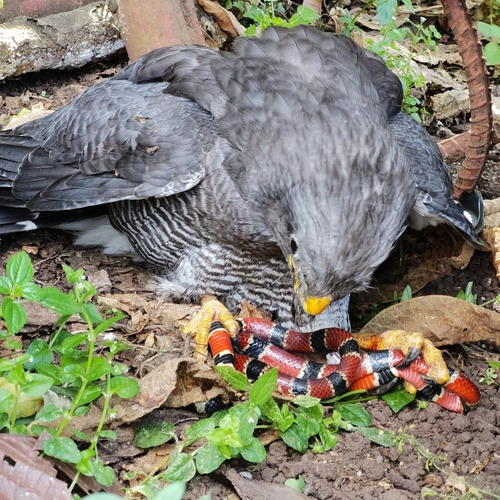 Grey Hawk
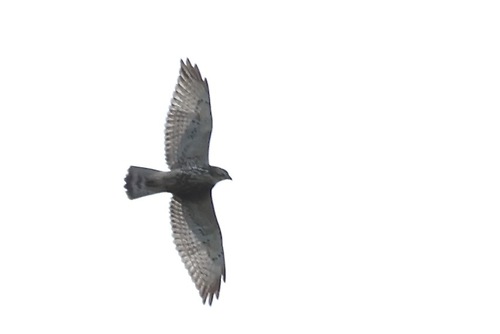 Broad-winged Hawk
In short
Juvenile Grey Hawks show bold facial stripes and white upper tail coverts, while juvenile Broad-winged Hawks lack these features and instead have more longitudinal barring below. In adults, Grey Hawks are smooth, pale gray above with a distinctly banded black-and-white tail, while Broad-winged Hawks are brown above with a white belly and horizontal barring. Grey Hawks have a longer tail and shorter wings, giving them a different flight profile from the more compact, broad-winged Broad-winged Hawk. Both species are small Buteos, but their structure, tail pattern, and juvenile plumage are the most reliable field marks for separation.
Identification tips
- Juvenile facial pattern: Juvenile Grey Hawks have bold, obvious facial stripes and white upper tail coverts—look for these in perched or flying birds. Juvenile Broad-winged Hawks lack these facial stripes and do not show white upper tail coverts.
- Juvenile underparts: Grey Hawk juveniles have streaked or spotted underparts, while Broad-winged Hawk juveniles show more longitudinal (vertical) barring below.
- Adult upperparts: Adult Grey Hawks are smooth, pale gray above, with little to no pattern. Broad-winged Hawks are dark brown above.
- Tail pattern (adult): Grey Hawk adults have a black tail with three white bands (one wider), always with a white tip. Broad-winged Hawk adults have a dark gray-black tail with white lines at the middle, base, and tip, but these are less sharply defined than in Grey Hawk.
- Tail length and shape: Grey Hawk has a longer tail relative to its body and shorter wings, giving a more accipiter-like profile in flight. Broad-winged Hawk has a shorter tail and broader, more pointed wings, resulting in a compact, broad-winged look.
- Wing shape in flight: Grey Hawk’s wings are broad but relatively short, and the long tail is noticeable. Broad-winged Hawk’s wings are broad and pointed, with a tapered appearance unique among Buteos.
- Adult underparts: Grey Hawk adults are pale gray and white below, with minimal barring. Broad-winged Hawk adults have a white belly and chest with horizontal barring.
- Morphs: Only Broad-winged Hawk shows light and rare dark morphs; Grey Hawk does not have such variation.
- Leg color: Grey Hawk adults have orange or yellow legs; leg color is not diagnostic for Broad-winged Hawk in the notes.
- Perched jizz: Grey Hawk often appears slimmer and longer-tailed when perched, while Broad-winged Hawk is more compact.
- Flight style: Grey Hawk is agile and fast, often hunting from a perch or with quick, accipiter-like flights. Broad-winged Hawk is more likely to soar on thermals with steady, broad-winged glides.
- Habitat context: In open country or forest edge in the southwest US or Central America, suspect Grey Hawk. In eastern forests or during migration, especially in large soaring flocks, suspect Broad-winged Hawk.
- Voice: If heard, a shrill 'kleee-ooo' supports Grey Hawk, but lack of vocalization is not diagnostic.
- Size: Grey Hawk is slightly larger and longer-tailed, but size alone is unreliable due to overlap and variation.
- Sex differences: Both species show little sexual dimorphism in plumage; females are slightly larger in Broad-winged Hawk, but this is not useful in the field.
Size
Grey Hawk is slightly larger overall, averaging 46–61 cm (18–24 in) in length and about 475 g (16.8 oz) in weight [wikipedia]. Broad-winged Hawk is smaller, at 32–44 cm (13–17 in) in length and 265–560 g (9.3–19.8 oz) [wikipedia]. Grey Hawk has a longer tail and relatively shorter wings, while Broad-winged Hawk has a shorter tail and broader, more pointed wings. The wingspan of Broad-winged Hawk (74–100 cm) can overlap with Grey Hawk, but Grey Hawk’s longer tail is distinctive.
Plumage
-
Juvenile/immature: Juvenile Grey Hawks have a dark brown upper side, bold white upper tail coverts, and very obvious facial stripes. Their underparts are streaked or spotted, and the tail shows numerous dark bands. Juvenile Broad-winged Hawks are brown above but lack bold facial stripes and white upper tail coverts; their underparts show more longitudinal (vertical) barring rather than the streaks/spots of Grey Hawk juveniles.
-
Adult: Adult Grey Hawks are smooth, pale gray above with a lighter gray and white underside. Their tail is black with three white bands (one wider), always ending with a white tip. Adult Broad-winged Hawks are dark brown above, with a white belly and chest featuring horizontal barring. Their tail is dark gray-black with white lines at the middle, base, and tip, but the pattern is less crisp than the Grey Hawk's bold black-and-white bands.
-
Morphs: Broad-winged Hawk has both light and rare dark morphs. Grey Hawk does not show such variation.
Behaviour
Grey Hawk typically hunts from an open high perch, swooping down on prey, but can also hunt from a low glide. Its flight is agile and fast for a Buteo, aided by its short wings and long tail. Broad-winged Hawk is more likely to soar on thermals with broad, pointed wings and a compact silhouette, especially during migration. Both species may perch in trees, but Grey Hawk’s hunting style is more reminiscent of an accipiter, while Broad-winged Hawk is more typical of Buteos in its soaring and gliding.
Habitat
Grey Hawk is found in open country and forest edges, especially in the southwestern US through Central America. Broad-winged Hawk breeds in eastern North America, favoring deciduous or mixed forests, and migrates to Central and South America for winter. Overlap is possible in migration or wintering grounds, but Grey Hawk is more tied to open and edge habitats, while Broad-winged Hawk is more forest-associated.
Voice
Grey Hawk gives a shrill, whistled 'kleee-ooo.' Broad-winged Hawk’s call is not described in the provided notes, so vocalization is not reliably diagnostic here.